To run a camping coffee maker and an electric cooler at the same time, you need a portable power station with at least 1,000W continuous AC output, a pure sine wave inverter, and a minimum of 1,000Wh battery capacity. The EcoFlow Delta 2 (1,024Wh, 1,800W output) is the top pick for 2026.
The Real Problem With Powering Camping Appliances
Most campers learn this the hard way. They buy a power station, get to the campsite, plug in the coffee maker, and the unit shuts off immediately. Or the electric cooler drains the battery by 3 AM and the food goes warm.
Both of these appliances are deceptively demanding. A coffee maker hits its highest wattage in the first 30 seconds when the heating element fires up. An electric cooler runs around the clock, cycling its compressor all night long.
This guide gives you the exact wattage numbers, the right specs to compare, and the best portable power stations for camping coffee makers and electric coolers available in 2026.
How Many Watts Does a Camping Coffee Maker and Electric Cooler Use?
Before picking any power station, you need to know what you are actually powering.
Coffee Maker Wattage
Drip coffee makers draw 600W to 1,200W while brewing. That load only lasts 5 to 10 minutes but it is the peak your power station must handle without tripping. Espresso machines run higher, typically 1,200W to 1,400W. Single-serve pod machines can be as low as 500W.
Important: Some coffee makers spike 20 to 30 percent above their rated wattage during the first startup seconds. Your power station’s AC output must comfortably exceed that surge, or the unit will shut off.
Electric Cooler Wattage
A 12V compressor cooler, the kind used by serious campers (brands like BougeRV, Iceco, Alpicool), draws 40W to 80W while the compressor runs. The compressor cycles on and off rather than running constantly. Average draw measured over a full day is typically 45W to 55W.
Thermoelectric coolers draw less power, around 40W to 60W, but do not cool effectively in hot weather. For actual food preservation at a campsite, a compressor cooler is the practical choice.
Power Draw Reference Table
| Appliance | Surge Watts | Running Watts | Daily Draw (12 hrs) |
|---|---|---|---|
| Drip coffee maker | 900W – 1,400W | 600W – 1,200W | ~100Wh (short brew cycles) |
| Single-serve pod maker | 600W – 800W | 500W – 700W | ~60Wh |
| Espresso machine | 1,200W – 1,600W | 1,000W – 1,400W | ~80Wh |
| Compressor cooler (12V) | 150W – 200W | 40W – 80W | ~500Wh – 600Wh |
| Thermoelectric cooler | 45W – 65W | 45W – 65W | ~540Wh – 780Wh |
| Both together (drip + compressor) | 1,100W – 1,600W peak | 640W – 1,280W | ~600Wh – 700Wh total |
The takeaway: the cooler is what drains your battery overnight. The coffee maker is what tests your power station’s peak output in the morning.
What to Look for Before Buying (Buyer’s Guide)
1. AC Output Wattage
Most buyers focus only on Wh capacity and overlook the AC output spec. AC output is how much power the station can deliver continuously through its outlets. If your coffee maker needs 1,200W but the station only outputs 1,000W continuous, it will trip or refuse to power on.
For a drip coffee maker plus an electric cooler running at the same time, look for 1,500W continuous AC output or higher. For an espresso machine, target 2,000W or above.
2. Pure Sine Wave Inverter
This is non-negotiable for coffee makers. A pure sine wave inverter produces clean, stable AC power identical to a home wall outlet. A modified sine wave inverter produces a choppy approximation that can reduce heating element efficiency, damage motors, and may void your appliance warranty.
Every quality power station in 2026 uses a pure sine wave inverter. If a listing does not state this clearly, skip it.
3. Battery Capacity (Wh)
For a compressor cooler to run all night (10 to 12 hours), you need at least 700Wh to 900Wh just for the cooler alone. Add morning coffee, lighting, phone charging, and a buffer margin, and you need 1,000Wh minimum for a two-day camping weekend.
For a three-day trip without solar, 1,500Wh to 2,000Wh is the practical range.
4. LiFePO4 vs Lithium-Ion
LiFePO4 (lithium iron phosphate) batteries last 3,000 to 4,000 charge cycles versus 500 to 1,000 cycles in older lithium-ion cells. They are also more thermally stable in hot camping conditions. Most quality 2026 units from EcoFlow, Bluetti, and Jackery now use LiFePO4. A battery management system (BMS) is built into all of these to protect against overcharge, over-discharge, and temperature extremes.
5. MPPT Solar Charging
For trips longer than two nights, solar input lets you top up the battery during the day. MPPT (Maximum Power Point Tracking) charges 20 to 30 percent more efficiently than older PWM-based systems. A 200W solar panel in good sun can generate 800Wh to 1,000Wh per day, which roughly covers the cooler’s daily draw.
6. Weight
For car camping and overlanding, units up to 30 lbs are manageable. For sites where you carry gear from the parking area, aim for under 25 lbs. Do not buy more capacity than you need, as every extra 100Wh adds meaningful weight.
Best Portable Power Stations for Camping Coffee Makers and Electric Coolers (2026 Picks)
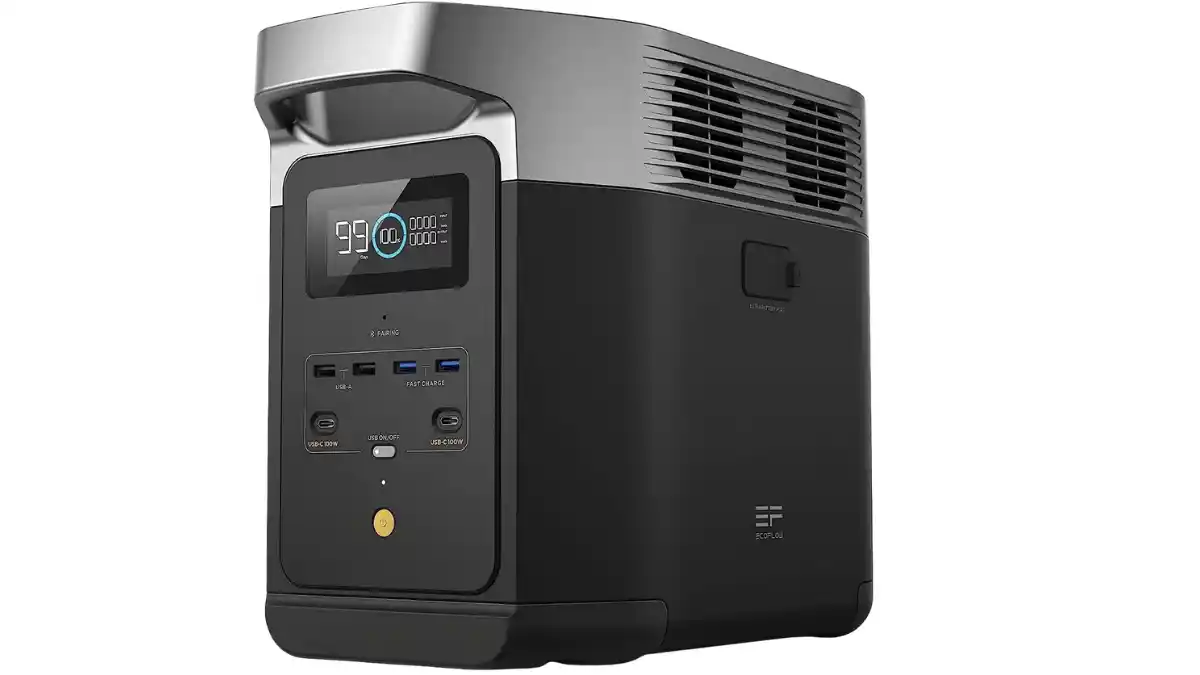
1. EcoFlow Delta 2 – Best Overall
Capacity: 1,024Wh | AC Output: 1,800W continuous, 2,400W surge | Weight: 27 lbs | Battery: LiFePO4
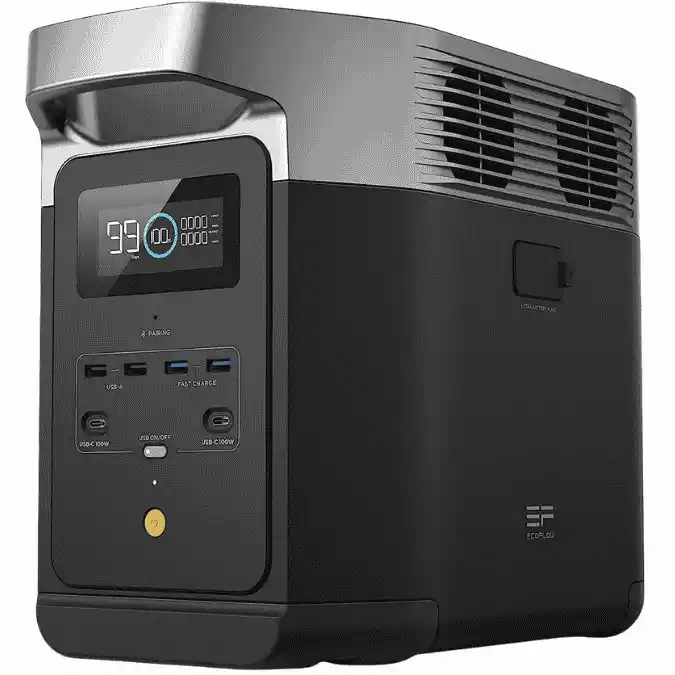
The Delta 2 is the strongest match for this specific use case. Its 1,800W continuous output handles any camping coffee maker, including espresso machines, while the cooler runs simultaneously. The X-Boost mode extends the effective range to run appliances rated up to 2,200W by managing power draw intelligently.
Recharge speed is a standout: 80 percent in under an hour via AC wall input. Solar input accepts up to 500W. Available at REI, Amazon, and Best Buy.
Pros: Highest AC output in its weight class, X-Boost mode, fast recharge, wide availability
Cons: Slightly heavier than Jackery at the same capacity, some features require the app
2. Jackery Explorer 1000 v2 – Best for Portability
Capacity: 1,070Wh | AC Output: 1,000W continuous, 2,000W surge | Weight: 23.8 lbs | Battery: LiFePO4
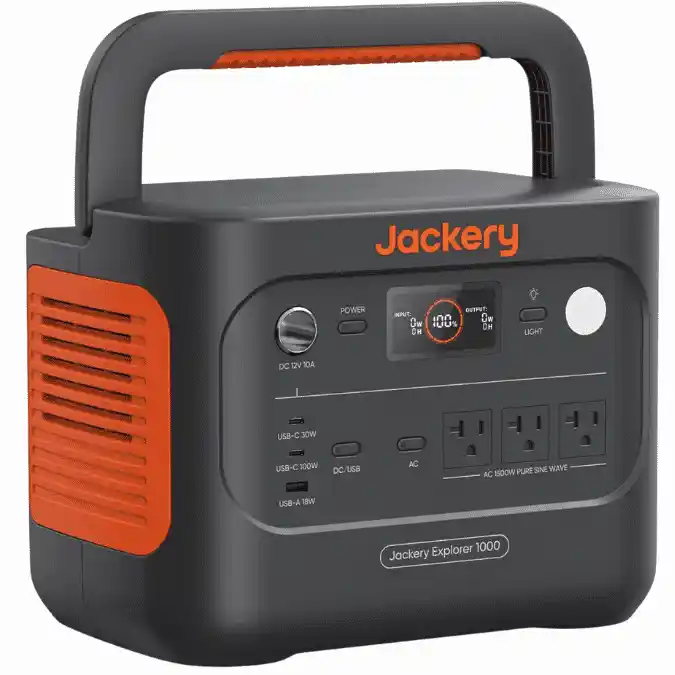
Jackery shaved over 2 lbs off the previous version while keeping the same 1,000Wh capacity. At 23.8 lbs, it is the lightest 1,000Wh unit you can buy in 2026. The 1,000W continuous output is the minimum for a standard drip coffee maker, and the 2,000W surge handles the heating element startup.
If you use an espresso machine or a high-draw drip maker rated above 1,000W, this unit is not the right fit. For a standard pod machine or 600W to 900W drip maker plus a compressor cooler, it is an excellent choice.
Pros: Lightest in class, reliable brand, pairs well with Jackery solar panels
Cons: 1,000W continuous output is the minimum threshold, not suitable for high-wattage espresso machines
3. Bluetti AC180 – Best for Espresso Machines
Capacity: 1,152Wh | AC Output: 1,800W continuous, 2,700W surge | Weight: 35.3 lbs | Battery: LiFePO4
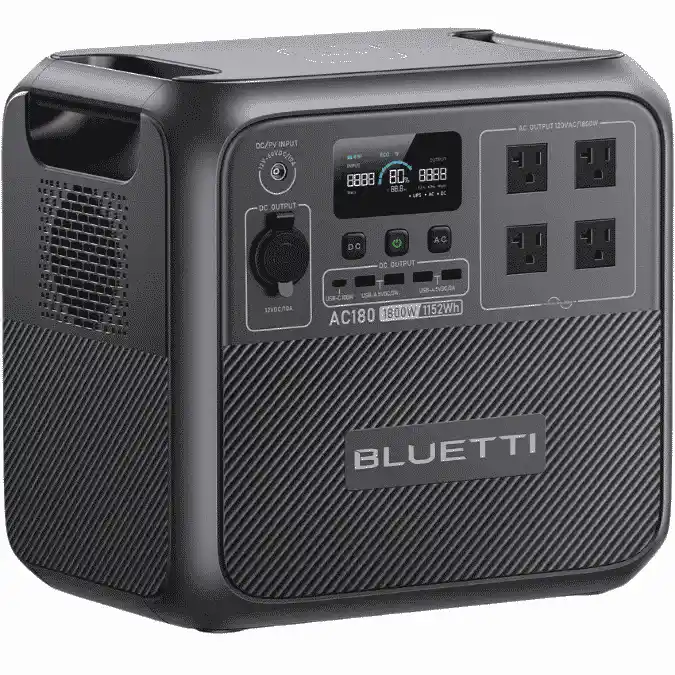
The AC180 has the highest surge rating in this capacity range at 2,700W. That makes it the safest choice if you camp with an espresso machine or a 1,400W drip maker. The 1,152Wh capacity gives more overnight runtime for the cooler. It charges from 0 to 80 percent in around 45 minutes.
The trade-off is weight. At 35.3 lbs, it is noticeably heavier than the EcoFlow Delta 2 for similar capacity. If surge wattage is your primary concern, the extra margin is worth it.
Pros: Highest surge wattage in its class, slightly larger capacity, rapid charging
Cons: Heavier than competitors, larger footprint
4. Anker Solix C1000 – Best Value
Capacity: 1,056Wh | AC Output: 1,500W continuous, 2,000W surge | Weight: 29 lbs | Battery: LiFePO4
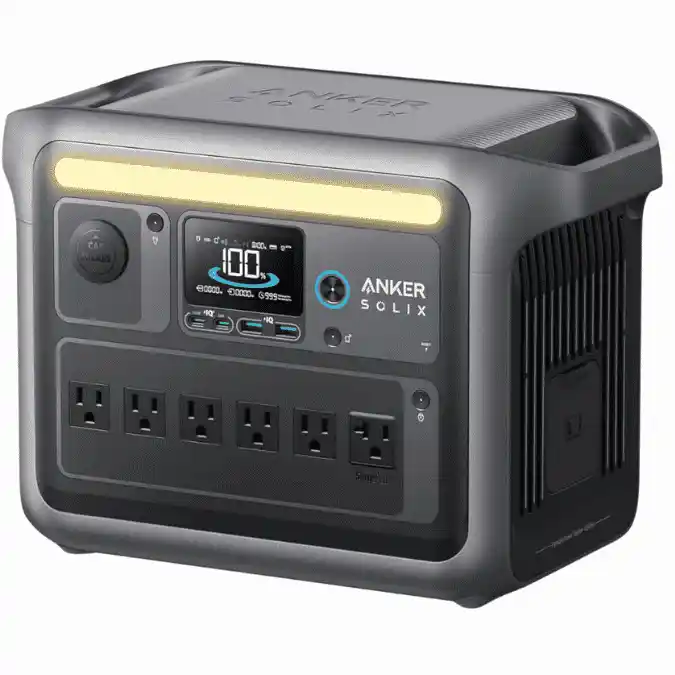
The Solix C1000 regularly sells for less than the EcoFlow Delta 2 while delivering 1,500W continuous output, enough to run most drip coffee makers and a compressor cooler simultaneously. Six AC outlets give flexibility without needing a power strip. Available at Best Buy and Amazon.
Pros: Strong value for the specs, 6 AC outlets, solid build quality
Cons: Heavier than Jackery, no expandable battery option
5. EcoFlow Delta 2 Max – Best for Long Trips
Capacity: 2,048Wh | AC Output: 2,400W continuous | Weight: 49 lbs | Battery: LiFePO4
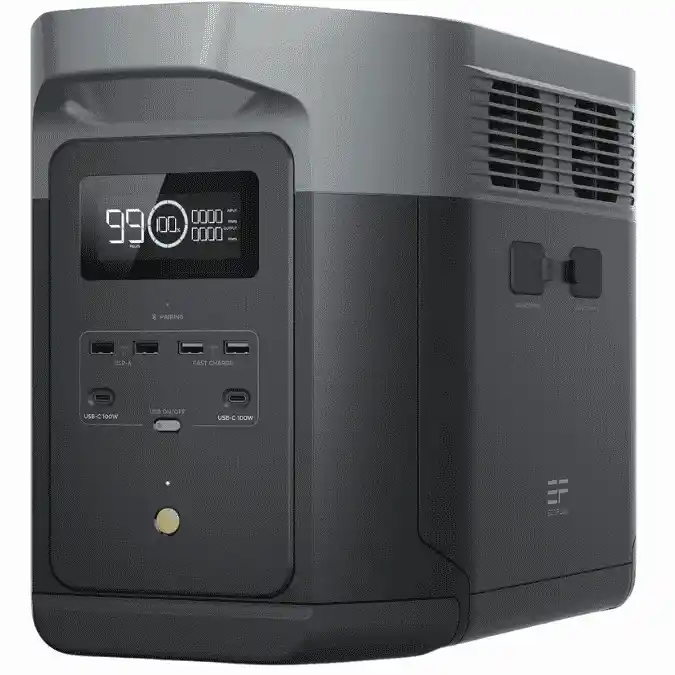
For three to five day trips without consistent solar, the Delta 2 Max doubles the Delta 2’s capacity. It can run a compressor cooler for two full nights, brew coffee both mornings, run lights, and still have reserve. The 2,400W output handles any appliance combination you bring.
It is heavy and it is not cheap. For overlanding and boondocking where you are away from power for multiple days, that capacity buys genuine peace of mind.
Pros: 2,048Wh capacity, highest output in this list, expandable with extra battery
Cons: 49 lbs is difficult for one person to lift, high price point
Side-by-Side Comparison
| Model | Capacity | AC Output | Surge | Weight | Battery Type | Best For |
|---|---|---|---|---|---|---|
| EcoFlow Delta 2 | 1,024Wh | 1,800W | 2,400W | 27 lbs | LiFePO4 | Best overall |
| Jackery Explorer 1000 v2 | 1,070Wh | 1,000W | 2,000W | 23.8 lbs | LiFePO4 | Portability |
| Bluetti AC180 | 1,152Wh | 1,800W | 2,700W | 35.3 lbs | LiFePO4 | Espresso machines |
| Anker Solix C1000 | 1,056Wh | 1,500W | 2,000W | 29 lbs | LiFePO4 | Best value |
| EcoFlow Delta 2 Max | 2,048Wh | 2,400W | 5,000W | 49 lbs | LiFePO4 | Long trips / overlanding |
Practical Tips for Running Both Appliances at Camp
Pre-cool the cooler at home
An electric cooler draws the most power when cooling down from ambient temperature for the first time. Pre-cool it at home the night before. When you arrive at camp with it already cold, the compressor runs far less on battery. This single habit can save 200Wh or more over a weekend.
Use the DC port for the cooler
Most compressor coolers accept both a 12V DC plug and a standard AC plug. Use the DC port on the power station for the cooler instead of an AC outlet. DC output skips the AC conversion step, making it more efficient and extending cooler runtime on the same charge.
Brew coffee first
If your power station’s AC output is near its limit, brew coffee before the cooler compressor restarts its cycle. Brewing takes 5 to 8 minutes. Staggering the two peak loads prevents simultaneous wattage spikes and keeps the unit stable.
Pair with a solar panel for multi-day trips
A 200W solar panel generates 800Wh to 1,000Wh per day in typical US camping conditions (4 to 5 peak sun hours). That is roughly enough to cover the cooler’s daily draw, giving you effectively unlimited cooler runtime as long as the sun is out.
Warnings and Mistakes to Avoid
- Do not buy a power station based on Wh capacity alone. AC output wattage is equally important for these appliances.
- Avoid modified sine wave inverters. They can reduce coffee maker efficiency and damage compressor cooler motors over time.
- Do not use undersized extension cords with heavy-gauge appliances like coffee makers. Use only cords rated for the wattage.
- Do not store a lithium power station at full charge for weeks at a time. Most manufacturers recommend storing at 80 percent for long-term battery health.
- Do not leave a power station in a hot car for extended periods. Extreme heat degrades LiFePO4 cells faster than regular use.
Frequently Asked Questions
Can a portable power station run a camping coffee maker?
Yes. The power station needs at least 1,000W continuous AC output and a pure sine wave inverter. Most drip coffee makers draw 600W to 1,200W. A unit with 300W or 500W output will not work.
How many watts does a camping coffee maker use?
A standard drip coffee maker uses 600W to 1,200W while brewing. Single-serve pod machines use 500W to 800W. Espresso machines draw 1,000W to 1,400W. Check the label on the bottom of your machine for the rated wattage.
How long will a power station run an electric cooler?
A 1,000Wh power station runs a 12V compressor cooler drawing 50W average for roughly 16 to 18 hours, accounting for the compressor cycling on and off. In practice, 1,000Wh covers one full night plus the following morning comfortably.
What is the best portable power station for car camping in 2026?
The EcoFlow Delta 2 is the strongest all-around pick for car camping in 2026. It delivers 1,800W AC output, 1,024Wh capacity, LiFePO4 batteries, and fast solar and wall recharging in a 27-lb package.
Is 1,000Wh enough for a coffee maker and electric cooler?
For a one to two night trip with a standard drip coffee maker and a compressor cooler, 1,000Wh is enough if you manage power carefully. For three or more nights without solar, move to 1,500Wh to 2,000Wh.
Do I need a pure sine wave power station for a coffee maker?
Yes. Coffee makers with heating elements need clean AC power. A modified sine wave inverter can cause reduced heating efficiency, noise, and may void the appliance warranty.
Can I run a coffee maker and electric cooler at the same time?
Yes, if the power station’s AC output exceeds the combined surge wattage of both. The EcoFlow Delta 2 and Bluetti AC180 handle this without issue. The Jackery Explorer 1000 v2 handles it with a standard drip maker but not an espresso machine.