The BLUETTI EB3A has become one of the most searched compact backup batteries lately, and the reason is clear. After all, somewhere between a weekend camping trip and a sudden blackout, you realize a phone charger and a wall outlet won’t cut it. That’s exactly where this little 268Wh unit comes in, and it’s why I took it camping myself.
In this BLUETTI EB3A review, I break down what actually matters in those situations. I also compare it fairly against a few other popular picks in this price bracket, so you can see where it wins and where it doesn’t. So by the end, you’ll know whether it belongs in your car, closet, or camping gear.
My Quick Verdict on the BLUETTI EB3A
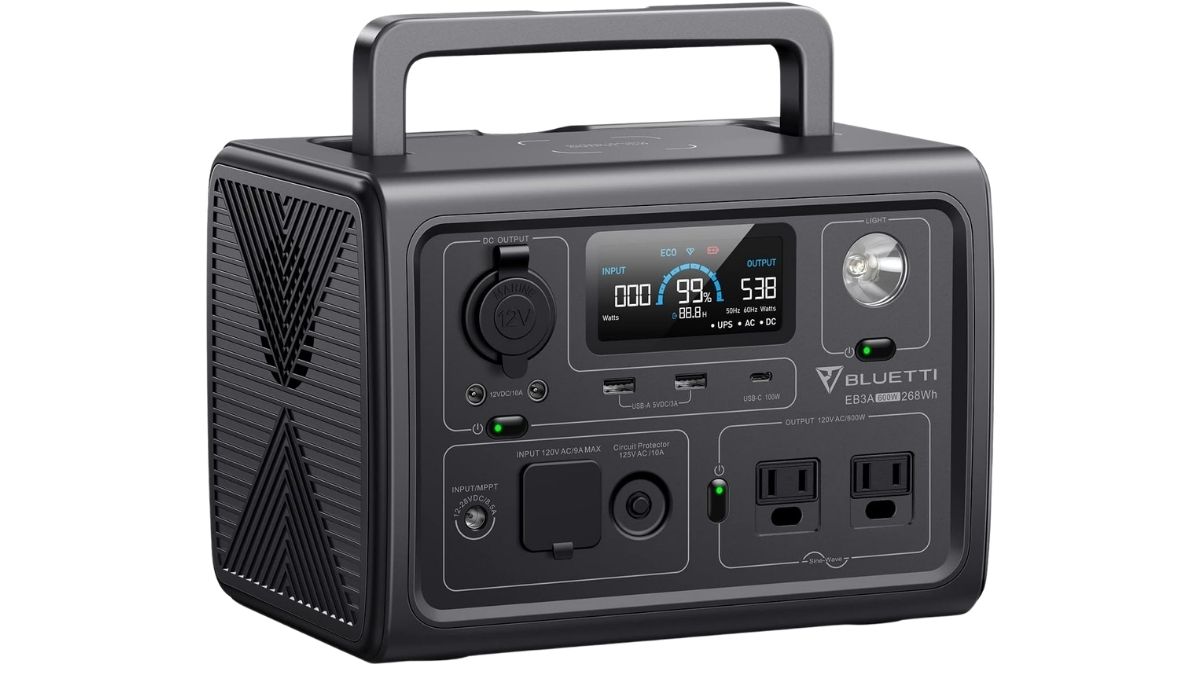
The BLUETTI EB3A pairs a 268Wh LiFePO4 battery with 600W of continuous output and a 1200W surge rating, all in a frame just over 10 pounds. Of course, it won’t run a house, and it was never meant to. Instead, it’s built to keep a phone, a laptop, a CPAP machine, and even a mini fridge going through a weekend trip or a multi-day outage.
Overall, owners love the charge speed and portability. On the other hand, the main complaints are fan noise under load and inconsistent behavior in UPS mode.
What Is the BLUETTI EB3A Portable Power Station?
The BLUETTI EB3A is a compact solar generator built around a LiFePO4 (lithium iron phosphate) battery. Unlike the lithium-ion cells in many budget power stations, LiFePO4 batteries are rated for 2,500 or more full cycles before dropping to 80% of their original capacity.
In other words, that’s roughly five times the lifespan of a typical cheaper power bank.
At 268Wh, though, it isn’t designed to power a refrigerator for days. However, with a 600W continuous AC inverter and a 1200W surge rating, it comfortably runs small appliances, medical devices, and electronics that most similar-sized stations struggle with.
BLUETTI EB3A 600W 268Wh Specs at a Glance
| Spec | Detail |
|---|---|
| Capacity | 268Wh (268.8Wh actual) |
| Continuous Output | 600W |
| Surge Output | 1200W |
| Battery Chemistry | LiFePO4, 2,500+ cycles to 80 % |
| AC Charge Time | 0 to 80 % in about 30 to 45 minutes (Turbo Mode) |
| Full Charge Time | Roughly 1 to 1.5 hours |
| Solar Input | Up to 200W (MPPT) |
| Weight | 10.14 lbs (4.6 kg) |
| Ports | 2 AC outlets, 1 USB-C (100W PD), 2 USB-A, 1 car port, 15W wireless pad |
Key Features That Set the EB3A Apart
In particular, a few features explain why I keep recommending the EB3A over pricier units.
How Fast Does the BLUETTI EB3A Charge?
In short, it’s fast. In Turbo Mode, the EB3A goes from empty to 80% in around 30 to 45 minutes on a standard wall outlet, then reaches 100% in roughly 1 to 1.5 hours total. That’s quicker than most portable power stations, which often take 4 hours or more for a full charge. So if you rely on it for emergency backup, that speed makes all the difference.
LiFePO4 Battery and Real Cycle Life
Specifically, BLUETTI rates the battery for 2,500+ cycles, and owners who’ve used it for a couple of years report very little capacity loss. As a result, that kind of longevity is why LiFePO4 has become the standard for long-term backup.
That said, not every budget option makes the same trade. The MILIN 622Wh packs more than double the capacity for less money, but it runs on plain lithium ion cells instead, so you’re basically choosing between more watt-hours now and a battery that still performs like new years later.
(Either way, the choice is yours.)
600W Output and Power Lifting Mode
First, its 600W continuous rating already beats most rivals this size. Also, when you switch on Power Lifting Mode in the app, the inverter briefly supports loads up to 1200W, so it covers small heaters and irons that standard mode would reject.
Ports, USB-C 100W, and Wireless Charging
Also, for something this compact, I find the port selection generous:
- Two 600W AC outlets (shared, not per outlet)
- One USB-C PD port rated up to 100W
- Two USB-A ports at 5V/3A each
- One 12V car port and DC outputs
- A 15W Qi wireless charging pad on top
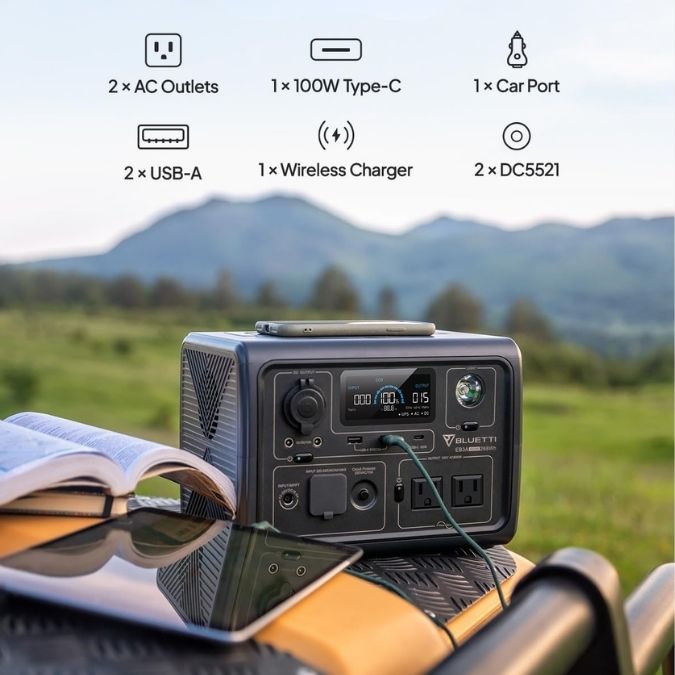
Note: the wireless pad only works after you switch on DC output.
Solar and Car Charging
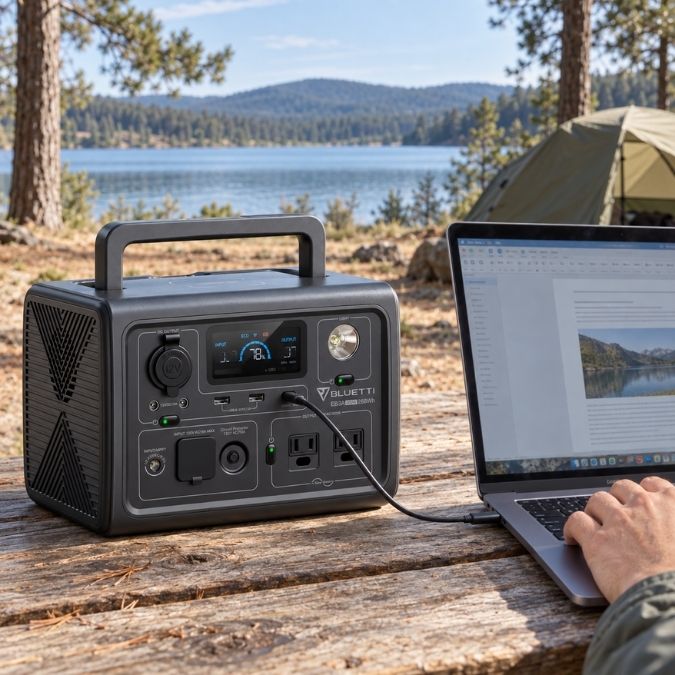
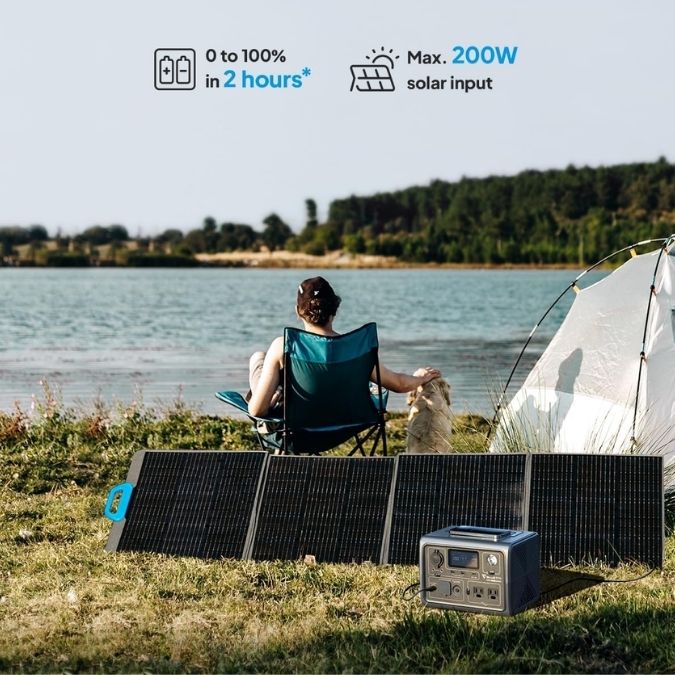
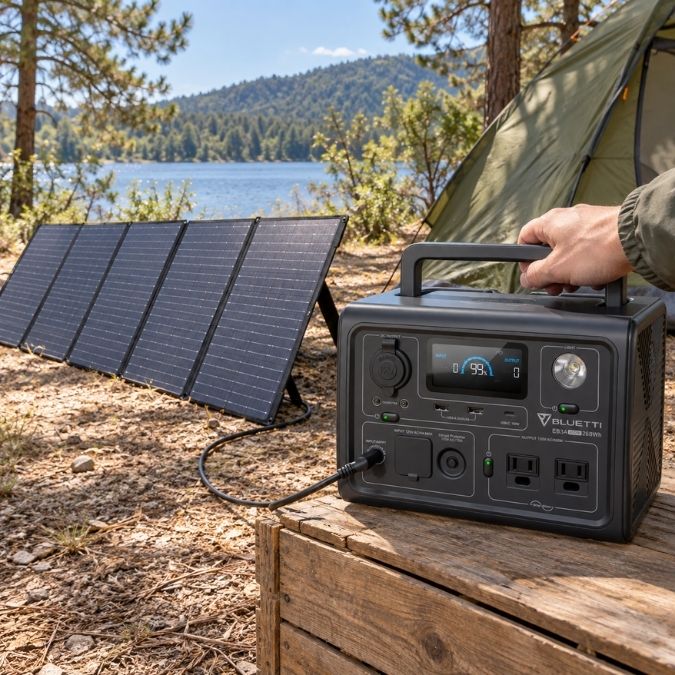
The built-in MPPT controller accepts up to 200W of solar input, so a 100W or 200W panel can fully recharge it in a few hours of good sun. I paired mine with a portable panel while camping off-grid. It also charges from a car’s 12V port, which helps on road trips between wall outlets.
What Can the BLUETTI EB3A Power?
| Device | Estimated Runtime |
|---|---|
| Smartphone | 15+ full charges |
| Laptop | 3 to 4 full charges |
| CPAP machine (no humidifier) | Roughly 1 full night |
| Small fan or LED lamp | 20+ hours |
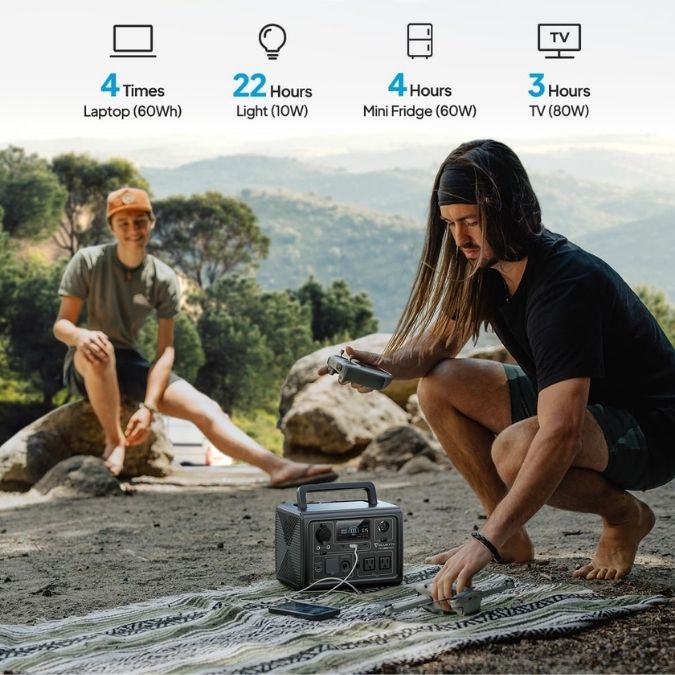
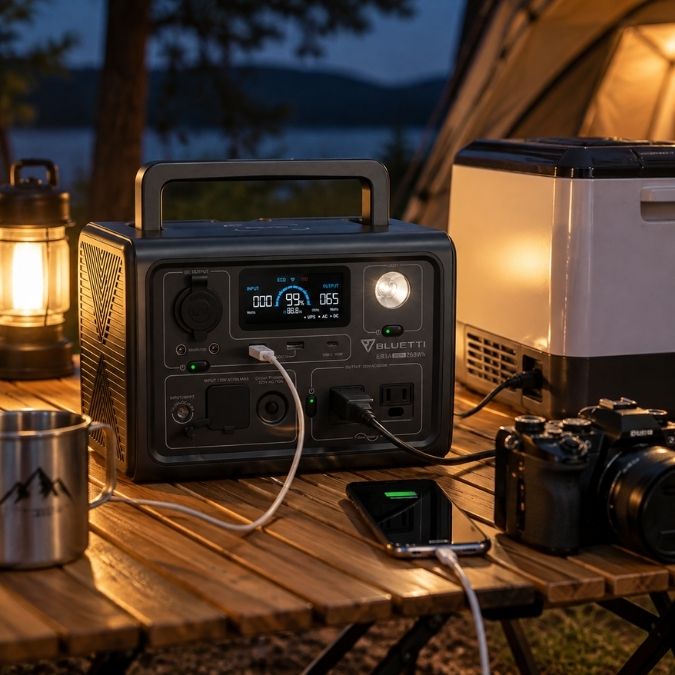
| Mini fridge | 3.5 to 4 hours continuous |
| Small TV or router | 3 to 4 hours |
Of course, those numbers assume continuous draw at rated wattage. In practice, real runtime often looks better than the math suggests.
For example, a mini fridge in Eco mode can get close to 10 to 12 hours of intermittent power, because compressors cycle on and off instead of pulling full wattage the whole time.
Since every device is different, run your own gear through my portable power station sizing calculator and see real hours.
What Owners Are Saying
Overall, roughly three out of four owners rate the EB3A highly, which is a strong result for any product.
The highlight, of course, is charging speed. In fact, owners call it a real game changer during outages, along with how easy it is to move compared to bulkier generators.
There are a few complaints, though. For example, fan noise during AC charging gets annoying and sounds a bit like a small vacuum cleaner. You might also see inconsistent behavior when relying on UPS or pass-through mode for sensitive electronics. Finally, find the solar charging cable in the packaging right away so you don’t run into solar charging trouble later.
Pros and Cons I Found
| Pros | Cons |
|---|---|
| LiFePO4 battery with realistic 2,500+ cycle durability | Fan gets noticeably loud during AC fast charging |
| Turbo charging gets you to 80 % in around 30 to 45 minutes | UPS and pass-through mode can be inconsistent for sensitive electronics |
| Versatile enough for CPAP use, storms, camping, Starlink, and remote work | |
| Strong value for a sub-$300 station with wireless charging and a 1200W surge rating |
BLUETTI EB3A vs. Other Compact Power Stations
Next, here’s how I think the EB3A stacks up against three other popular picks in a similar price and size class.
| Model | Capacity | Output | Weight | Full Charge |
|---|---|---|---|---|
| BLUETTI EB3A | 268Wh | 600W (1200W surge) | 10.14 lbs | ~1 to 1.5 hrs |
| Jackery Explorer 300 | 293Wh | 300W (500W peak) | 7.1 lbs | ~2.5 hrs |
| EcoFlow River 2 | 256Wh | 300W (600W X-Boost) | 7.7 lbs | ~1 hr |
| Anker SOLIX C300 | 288Wh | 300W (600W surge) | 8.3 lbs | ~50 min to 80 % |
Above all, the EB3A clearly wins on raw output, doubling the continuous wattage of every rival here, which matters if you plan to run anything beyond phones and laptops. However, it loses some ground on weight, since it’s roughly 2 to 3 pounds heavier than the others.
If portability matters more to you than wattage, my Jackery Explorer 300 review shows what a lighter 293Wh unit can realistically hold up to, including an 8-hour CPAP session that still left 49 percent on the display.
Curious how the EB3A measures up against the rest of the field in this price class? My review of the best portable power stations under $300 lines up every serious contender.
Also, for the record, the EB3A already claimed the ultra-portable slot in my review of the best portable power stations for camping, so that comparison is worth a look too.
Who Should Buy the BLUETTI EB3A Portable Power Station?
In my view, this unit fits certain users best. For example, weekend campers, part-time van lifers, and anyone wanting dependable outage backup for phones, routers, medical devices, and small appliances get the most value. It also suits digital nomads and remote workers who need a laptop and phone charged away from outlets.
However, skip it if you need to run a full-size refrigerator, power tools, or anything requiring sustained output well above 600W. If a fridge or 12V cooler is the real dealbreaker, my Jackery Explorer 500 review covers a unit whose regulated 12V output kept a DC fridge running for 15 straight hours on a single charge.
If you need more headroom across the board instead, my best portable power stations under $500 roundup has you covered (and it also breaks down the BLUETTI AC70, which is another great model from the same brand.)
Is the BLUETTI EB3A Worth It?
Yes, for the buyer it’s actually built for. That’s because a durable LiFePO4 battery, fast charging, and a 600W to 1200W output range are hard to match under $300. Also, it was never meant to replace a whole-home generator.
Overall, for campers, preppers, and anyone who wants dependable backup power without hauling a gas generator, I think the BLUETTI EB3A remains one of the smartest value picks in its class in 2026.
Ready to add one to your gear bag or emergency kit?
FAQs
How long does the BLUETTI EB3A take to fully charge?
With Turbo Mode on a standard wall outlet, it reaches 80% in about 30 to 45 minutes. After that, a full charge takes roughly 1 to 1.5 hours in total.
Can the BLUETTI EB3A run a mini fridge or CPAP machine?
Yes. It runs a mini fridge for several hours continuously and even longer in Eco mode. Also, it can power a standard CPAP machine for about a full night without the humidifier.
Is the BLUETTI EB3A waterproof?
No. Even though it’s built for outdoor use like camping and tailgating, keep it dry and away from rain or splashes.
What is the difference between the BLUETTI EB3A and the Jackery Explorer 300?
The EB3A doubles the continuous AC output (600W vs 300W) and charges much faster. However, the Jackery is about 3 pounds lighter, though it uses an older battery chemistry with a shorter cycle life.
Does the BLUETTI EB3A work with solar panels?
Yes. Its built-in MPPT controller accepts up to 200W of solar input. For off-grid recharging, BLUETTI’s own 100W or 200W panels are the most common pairing.