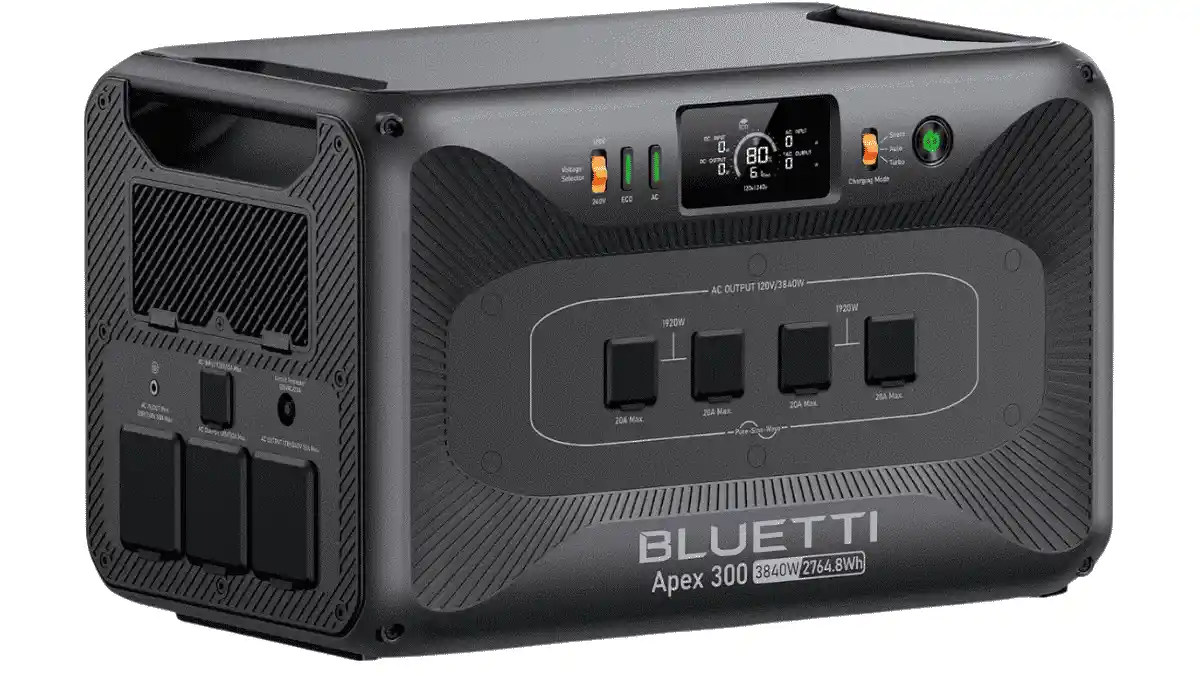
The best BLUETTI home backup power station for most households is the Apex 300. It delivers 2,764.8Wh of capacity, 3,840W of output, and is one of the few portable units that handles both 120V and 240V loads from a single device. If budget is a concern, the Elite 200 V2 at around $699 covers most short-term outage needs with solid LiFePO4 battery technology and a 6,000-cycle lifespan.
When the power goes out, most people realize too late that a gas generator sitting in the garage is loud, produces fumes, and cannot safely run indoors. A BLUETTI home backup power station solves all three problems. It is silent, emission-free, and ready to run the moment the grid drops.
This guide breaks down the top BLUETTI models for home backup in 2026, explains what the specs actually mean for your home, and tells you exactly which unit fits your situation.
What Makes a BLUETTI a Good Home Backup Power Station?
Not every portable power station is built for home backup. A camping unit with 300Wh might keep your phone charged, but it will not run a refrigerator through a 12-hour outage.
For home backup specifically, you want to focus on four things.
Battery capacity (Wh): This is how much energy the unit stores. A full-size refrigerator uses roughly 100 to 200Wh per hour depending on the model. A Wi-Fi router, a few lights, and phone charging combined might use another 50 to 100Wh per hour. Add those up and plan for your expected outage window.
Continuous output (W): This is the maximum load the inverter can sustain. If you want to run a microwave at 1,000W, your unit needs to handle at least that continuously.
Surge wattage: Motors in refrigerators, air conditioners, and sump pumps pull 2x to 3x their rated wattage at startup. A unit with a 2,600W continuous output and a 3,900W surge will handle a standard fridge startup without shutting down.
UPS switching speed: For devices like desktop computers, CPAP machines, or medical equipment, the unit needs to switch from grid to battery in under 20 milliseconds. Some BLUETTI models do it in under 10ms, which is fast enough that your devices never even register the outage.
BLUETTI uses LiFePO4 (lithium iron phosphate) chemistry across most of its lineup, which is significantly safer and longer-lasting than standard lithium-ion. The rated cycle counts range from 3,500 to 6,000 depending on the model, translating to 10 to 17 years of useful life with regular use.
Best BLUETTI Home Backup Power Stations in 2026
1. BLUETTI Apex 300: Best Overall
The Apex 300 is the strongest all-around BLUETTI home backup power station available right now. It packs 2,764.8Wh of built-in capacity into a single unit with a 3,840W inverter, and it is one of the only portable power stations that outputs both 120V and 240V simultaneously.
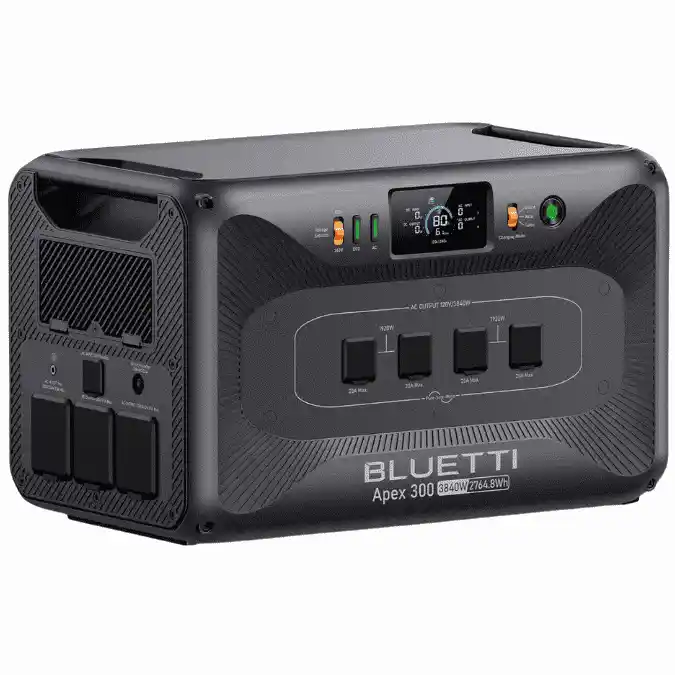
That dual-voltage capability matters more than most buyers realize. It means you can run a well pump, an electric dryer, or a window AC unit that requires 240V, which traditional portable backup units simply cannot do.
The Apex 300 also supports Black Start, which means if the battery runs completely flat, it can restart itself without needing an external charge source. The UPS switching speed is under 10ms, making it safe for desktops, routers, and home medical devices.
For expansion, a single Apex 300 accepts up to six B300K battery modules, pushing total storage to over 19Wh. Paired with the newer B500K (5,120Wh per pack), capacity scales dramatically for multi-day outage coverage.
Specs at a glance:
| Spec | Value |
|---|---|
| Capacity | 2,764.8Wh |
| Continuous Output | 3,840W |
| Surge Power | 7,680W |
| Voltage Output | 120V and 240V |
| Battery Type | LiFePO4 (automotive-grade) |
| Cycle Life | 6,000+ cycles |
| UPS Switching | Under 10ms |
| Solar Input | Up to 2,400W (MPPT) |
Best for: Medium to large homes, anyone with 240V appliances, whole-home backup builds with expansion batteries.
Honest limitation: It is a serious investment. If you only need backup for a few devices during short outages, the Elite 200 V2 or Elite 30 V2 will serve you well at a fraction of the price.
2. BLUETTI Elite 400: Best High-Capacity Portable
The Elite 400 is the largest single-unit portable power station BLUETTI makes. With 3,840Wh of capacity on a rolling chassis with a retractable handle, it is designed to be moved between rooms, garages, and workshops without a second person.
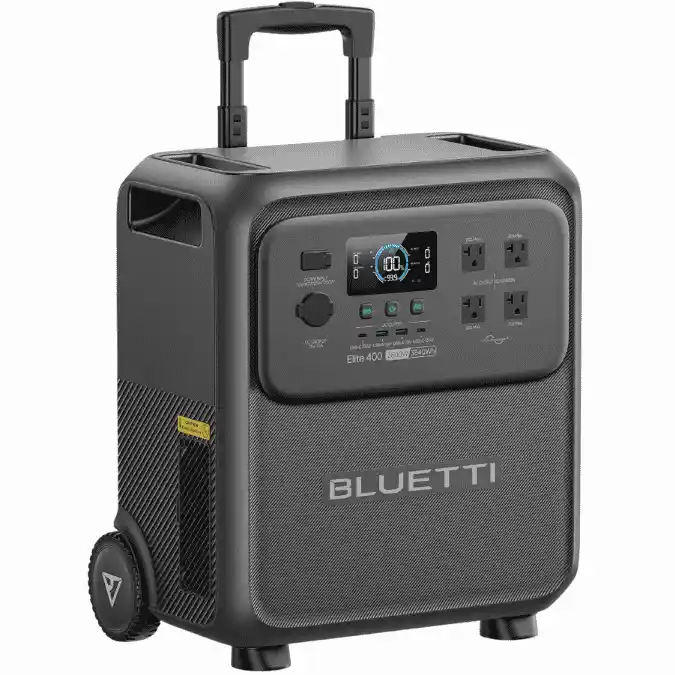
The inverter outputs 2,600W continuously with a 3,900W surge, which handles a refrigerator, lights, Wi-Fi, and phone charging simultaneously with headroom to spare. It recharges to 80% in about 70 minutes using dual AC and solar input combined.
One practical advantage that competing reviews often miss: the Elite 400 is built for runtime over raw output. Its 3,840Wh battery paired with the efficient 2,600W inverter gives you longer appliance runtimes per charge than units with bigger inverters and smaller batteries.
Best for: Homeowners who need to move backup power around the home, workshops, or garages. People who prioritize long runtime for basic appliances over running heavy 240V loads.
3. BLUETTI Elite 200 V2: Best Mid-Range Home Backup
At around $699, the Elite 200 V2 is the most practical home backup option for households that deal with occasional short to medium outages. It holds 2,073.6Wh, outputs 2,600W continuously with 3,900W of Power Lifting surge mode, and runs almost silently at 16dB.
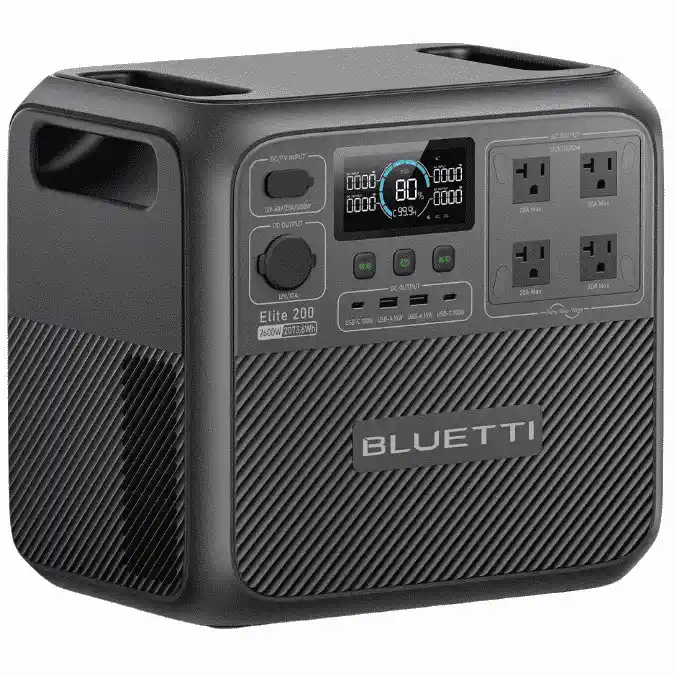
Independent testing has confirmed this unit can power a full-size refrigerator, a laptop, a router, and lighting simultaneously for over 18 hours. That covers most storm-related outages in the US without needing to expand the system.
The LiFePO4 battery is rated for 6,000 cycles, which at daily use translates to roughly 17 years of service. That is three to four times the lifespan of standard lithium-ion competitors.
Best for: Apartments, smaller homes, renters, and households looking for solid home backup without spending over $1,000.
4. BLUETTI AC500 + B300K: Best Modular Whole-Home System
If you are building a serious backup system that needs to cover your whole home for multiple days, the AC500 paired with B300K expansion batteries is the most flexible setup in the BLUETTI portable lineup.
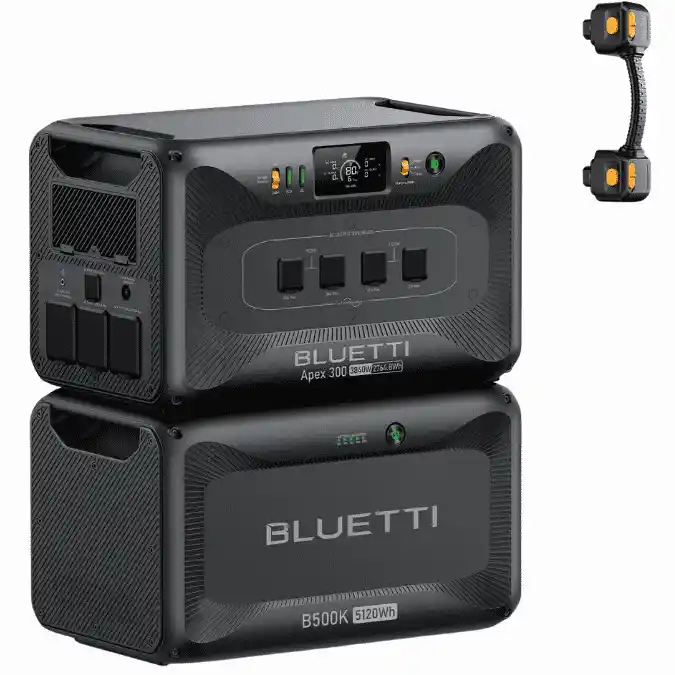
The AC500 itself outputs 5,000W continuously with 10,000W of surge power. It supports up to 6 B300K batteries, pushing total storage to over 16,500Wh. The system runs on 24/7 EPS (Emergency Power Supply) mode, which means it is always monitoring the grid and switches to battery the moment power drops with under 20ms of transfer time.
Solar input supports up to 3,000W, and combined AC plus solar charging can bring the system from zero to 80% in about 90 minutes.
Best for: Large homes, homeowners with solar panels, people preparing for multi-day outages or those who want a semi-permanent home energy storage solution without a full wall-mounted installation.
5. BLUETTI Pioneer Na: Best for Cold Climates
The Pioneer Na is BLUETTI’s first sodium-ion portable power station, and it addresses a specific and often-ignored problem with lithium batteries: cold weather performance.
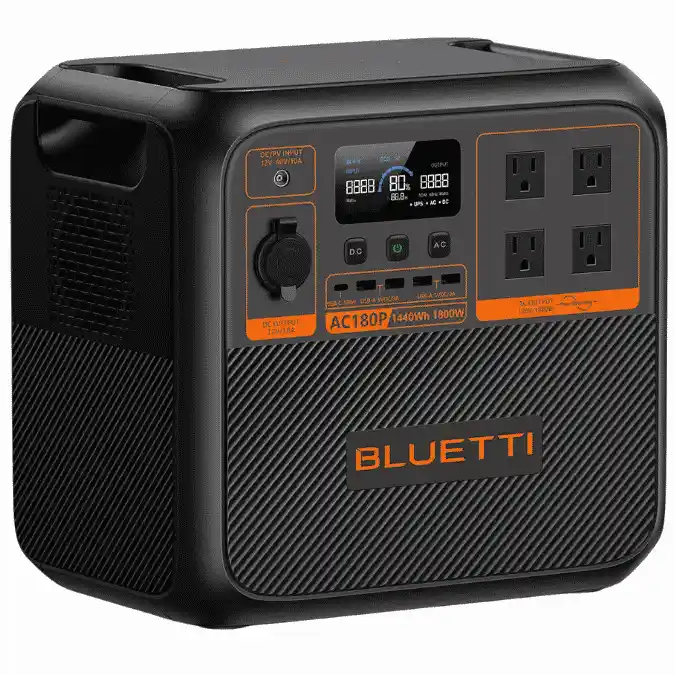
Standard LiFePO4 batteries lose 20 to 40 percent of their capacity in freezing temperatures and cannot charge safely below 0 degrees Celsius. The Pioneer Na charges safely down to -15 degrees Celsius and keeps operating down to -25 degrees Celsius.
It offers 900Wh of capacity and 1,500W of output, which covers essentials like lights, routers, CPAP machines, and small appliances. The sodium-ion chemistry also carries a 4,000-cycle rating with a projected 10-year lifespan.
Best for: Households in northern states, cold-weather climates, or anyone whose backup unit lives in an unheated garage or basement.
6. BLUETTI Elite 30 V2: Best for Essential Device Backup
The Elite 30 V2 is not a whole-home backup solution. It is a 288Wh unit with 600W of output (1,500W with Power Lifting mode) that keeps your router, laptop, CPAP machine, phone, and lights running during a short outage.
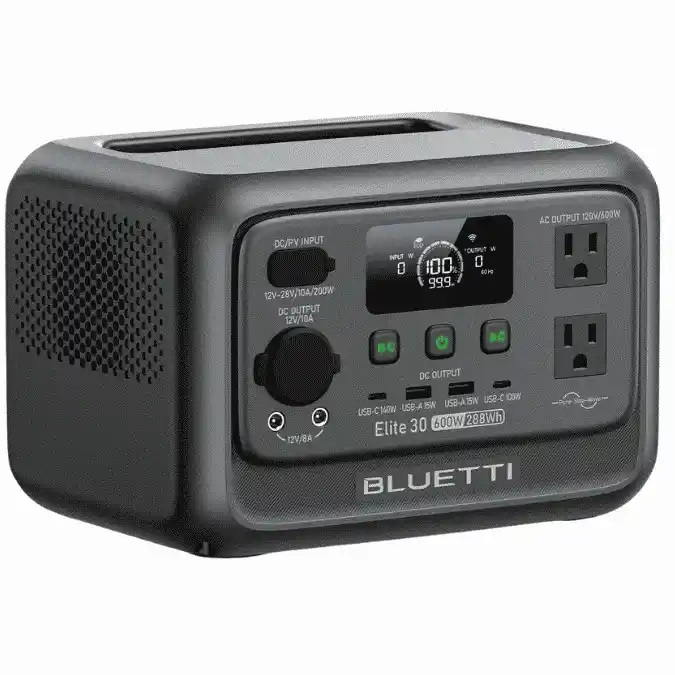
At 4.3kg and available in six colors, it is the most portable unit in the BLUETTI home backup lineup. The UPS switching time is 10ms, so plugged-in devices never lose power during grid transitions. It also runs at near-silent noise levels.
At around $199, it is an easy add to any home preparedness setup, even if you already own a larger unit.
Best for: Apartments, renters, anyone who needs UPS-grade switching for a home office or medical device, secondary backup for specific rooms.
BLUETTI Home Backup: How to Choose the Right Model
Step 1: List your critical appliances
Write down everything you need to keep running during an outage. Include:
- Refrigerator (typically 100 to 200W running, 800 to 1,200W startup surge)
- Wi-Fi router (15 to 30W)
- Lights (10 to 60W per fixture)
- CPAP machine (30 to 60W)
- Phone and laptop charging (50 to 100W combined)
- Sump pump or well pump if applicable (500 to 1,500W running, much higher surge)
Step 2: Calculate your daily load
Add up the running wattage of your critical devices and multiply by the number of hours you expect an outage to last. That gives you a rough Wh requirement. Add 20 percent as a buffer.
Example: Fridge (150W) + router (20W) + lights (80W) + phone charging (30W) = 280W total. For a 12-hour outage: 280 x 12 = 3,360Wh needed.
In this case, the Elite 400 (3,840Wh) or Apex 300 (2,764.8Wh + expansion) would cover you.
Step 3: Check your highest-surge appliance
If your fridge, AC, or sump pump is in the list, look at the startup (surge) wattage. Your power station’s surge rating must be higher than that number.
Step 4: Decide on expandability
If you think you might want to grow the system later (add solar panels, add expansion batteries, run more appliances), choose a modular-compatible model like the Apex 300 or AC500 from the start.
BLUETTI vs. Gas Generator for Home Backup
| Factor | BLUETTI Power Station | Gas Generator |
|---|---|---|
| Indoor use | Yes (zero emissions) | No (CO risk) |
| Noise level | Under 30dB (library quiet) | 65 to 80dB |
| Fuel required | No | Yes (gasoline) |
| Solar recharging | Yes | No |
| UPS capability | Yes (select models) | No |
| Startup time | Instant | Manual pull or remote start |
| Maintenance | None | Oil changes, fuel stabilizer |
| Runtime limit | Based on battery capacity | Unlimited with fuel supply |
For outages under 24 hours, a BLUETTI unit wins on almost every practical metric. For week-long outages where you need unlimited runtime, a gas generator or a combination of both makes more sense.
Common Mistakes to Avoid
Buying too small: The most common error is buying a 500Wh unit expecting it to run a refrigerator through a two-day storm. Check your fridge’s wattage on the label inside the door before buying.
Ignoring surge wattage: A unit with 2,600W continuous output but only 3,900W surge may trip on a large refrigerator startup. Always check the surge spec against your highest-draw appliance.
Skipping the MPPT solar controller advantage: If you plan to recharge during a multi-day outage, models with MPPT solar input charge significantly faster than those without. All current BLUETTI models with solar input use MPPT.
Overlooking cold storage: If your unit sits in a garage or basement that drops below freezing, standard LiFePO4 chemistry will degrade over time. Either bring it indoors during winter or consider the Pioneer Na.
Frequently Asked Questions
What is a BLUETTI home backup power station?
A rechargeable battery system with a built-in inverter that powers home appliances during grid outages. It charges via wall outlet, solar panels, or car adapter.
Can a BLUETTI power station run a refrigerator?
Yes. Any model with 2,000W or more of continuous output handles a standard full-size refrigerator. The Apex 300, Elite 400, and Elite 200 V2 all qualify.
How long will a BLUETTI last during a power outage?
It depends on your load. The Elite 200 V2 at 250W draw (fridge, router, lights) gives you roughly 8 hours. At 100W, you get over 18 hours.
Can I use a BLUETTI indoors during an outage?
Yes. BLUETTI units produce zero emissions and run under 30dB, making them completely safe for indoor use, unlike gas generators.
Do BLUETTI power stations work with solar panels?
Yes. All current models support solar input via MPPT controllers. The Apex 300 accepts up to 2,400W of solar input for fast daytime recharging.
What is EPS mode on a BLUETTI?
EPS (Emergency Power Supply) mode monitors the grid and switches to battery in under 20ms the moment power drops, acting as a UPS for sensitive devices.
Is there a BLUETTI model for whole-home backup?
Yes. The AC500 + B300K covers most large homes. For a full permanent install, the EnergyPro 13K is BLUETTI’s whole-home system with intelligent load management.
Are BLUETTI power stations worth the price?
Yes. LiFePO4 chemistry lasts 10 to 17 years, which makes the total cost over a decade lower than cheaper lithium-ion alternatives that need replacing in 3 to 5 years.