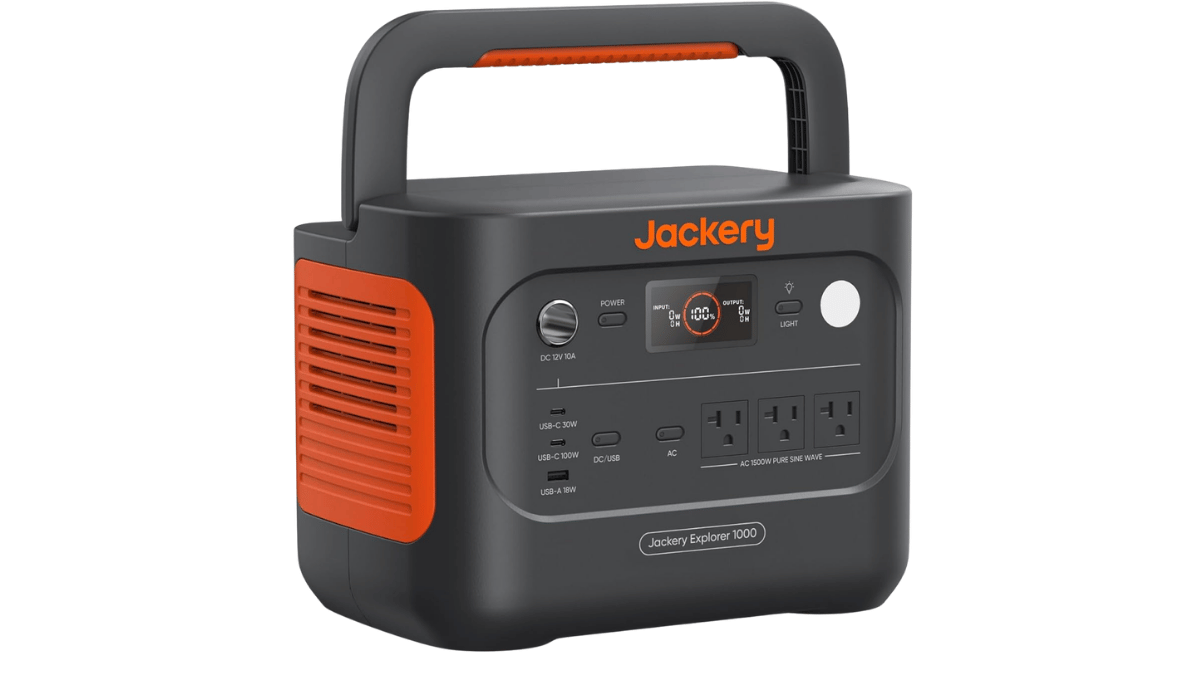
The best Jackery portable power station for most campers and backup users is the Explorer 1000 v2. At 1,070 Wh and 23.8 lbs it hits the sweet spot between power output and portability. For tight budgets, the Explorer 300 Plus covers a weekend of device charging at just 8.3 lbs. For home backup during an outage, the Explorer 2000 v2 at 2,042 Wh is the stronger choice.
Why Jackery Still Belongs at the Top of Every Buying List
Plenty of brands make portable power stations. Jackery keeps showing up in first-place or runner-up spots year after year for a simple reason: the user experience is unusually good. The display is clear, the cables are color-coded, the app is functional, and the hardware does exactly what the spec sheet says it will do.
That consistency matters when you are at a campsite at midnight and your phone is dying, or when a storm knocks out power to your neighborhood and you need your CPAP machine running through the night.
This guide covers every major Jackery model in 2026, explains exactly which one fits which situation, and tells you what the marketing material leaves out. No inflated claims. No generic comparisons. Just the information you actually need.
What Is a Jackery Portable Power Station?
A Jackery portable power station is a rechargeable battery unit with multiple output ports including AC outlets, USB-A, USB-C, and a 12V car port. It stores electrical energy in a LiFePO4 or lithium-ion cell and releases it on demand through a built-in AC inverter. Unlike a gas generator it produces no fumes, runs silently, and can be recharged via a wall outlet, a car charger, or compatible solar panels.
Jackery portable power stations are sized by watt-hours (Wh). A 1,000 Wh unit can theoretically run a 100-watt device for 10 hours, though real-world efficiency losses reduce that by roughly 10 to 15 percent.
Jackery Power Station Buying Guide: What to Look for Before You Spend a Dollar
Before jumping into specific models, get clear on these five factors. They determine which Jackery is actually right for you.
1. Capacity (Wh): Match It to Your Real Power Needs
Watt-hours tell you how much total energy the unit stores. To estimate what you need, add up the wattage of every device you plan to run and multiply by the number of hours. A camping setup running a 50W fan for 8 hours and charging two phones (roughly 50 Wh total) needs around 450 Wh minimum. Give yourself a 20 percent buffer.
Under 500 Wh: Phones, laptops, cameras, LED lights. Solo trips or day hikes. 500 to 1,500 Wh: Adds small appliances, portable fridges, CPAP machines. Family camping or short outages. 1,500 Wh and above: Refrigerators, power tools, extended home backup. RV trips or multi-day outages.
2. AC Output and Surge Wattage
AC output is the continuous power the unit can deliver. Surge wattage covers the brief spike most motors need when they start up. A portable fridge might run at 60 watts but surge to 200 watts on startup. If your power station does not have enough surge capacity it will shut down or trip an overload protection when the device kicks on.
Always check both numbers. The Explorer 1000 v2 delivers 1,500W continuous and 3,000W surge. That covers nearly any camping appliance.
3. LiFePO4 vs Lithium-Ion Battery Chemistry
All current Jackery models worth recommending use LiFePO4 (lithium iron phosphate) batteries. This chemistry handles more charge cycles (6,000 plus vs roughly 500 to 800 for standard lithium-ion), stays more stable in heat, and degrades more slowly over time. It is also less prone to thermal runaway.
For emergency backup use this is not a minor detail. You want a unit that holds its charge well when sitting unused for months.
4. Weight and Portability
A power station you leave in the car because it is too heavy to carry is a bad power station for camping. The Explorer 300 Plus at 8.3 lbs can fit in a daypack. The Explorer 1000 v2 at 23.8 lbs is carryable by most adults for short distances. Once you cross 40 lbs you need wheels or a cart.
5. Solar Panel Compatibility and Recharge Speed
All Jackery power stations accept solar input. The Explorer 1000 v2 supports up to 400W of solar input. In good sunlight that means a full recharge in around 2.5 to 3 hours with two 200W Jackery SolarSaga panels. For long off-grid stays solar compatibility is not optional. It is the difference between a weekend trip and a week-long one.
Which Jackery Model Is Right for You? A Quick Decision Guide
| Your Situation | Recommended Model | Why |
|---|---|---|
| Solo camping weekends | Explorer 300 Plus | Lightweight, charges phones and laptops all weekend |
| Family car camping | Explorer 1000 v2 | Handles multiple devices, fan, and small appliances |
| Power outage backup | Explorer 2000 v2 | Runs fridge, lights, and CPAP through a short outage |
| Backpacking or ultralight hiking | Explorer 240 v2 | Smallest and lightest option with solar compatibility |
| RV or van life | Explorer 2000 v2 or 5000 Plus | High capacity for extended off-grid living |
| CPAP backup during outages | Explorer 1000 v2 or 2000 v2 | Stable AC output runs CPAP machines reliably |
Top Jackery Portable Power Stations Reviewed for 2026
1. Jackery Explorer 300 Plus – Best Budget Pick for Camping
Capacity: 288 Wh | Weight: 8.3 lbs | AC Output: 300W | Price: ~$289
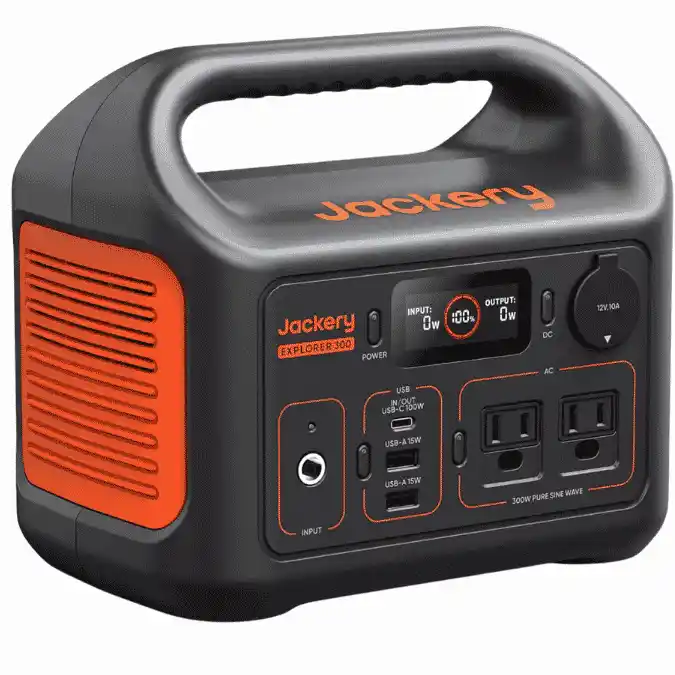
The Explorer 300 Plus is the entry point that makes the most sense for first-time buyers and solo campers. At 8.3 lbs it fits inside most daypacks and does not feel like a burden when you are walking from a parking lot to a campsite.
In practical use it charges phones, laptops, cameras, and small LED lanterns without issue. Popular Mechanics named it the Best Value pick for 2026. On a full charge you can realistically charge a smartphone 12 to 15 times or run a small laptop through a full workday.
What it does not do: it will not run a portable refrigerator, a coffee maker, or any device pulling more than 300 watts continuously. If those are on your list, step up to the 1000 v2.
Best for: Solo campers, festival trips, short power outages affecting only electronics Not ideal for: Appliances, CPAP machines, family camping with multiple devices
2. Jackery Explorer 1000 v2 – Best All-Around Performer
Capacity: 1,070 Wh | Weight: 23.8 lbs | AC Output: 1,500W (3,000W surge) | Price: ~$400-450
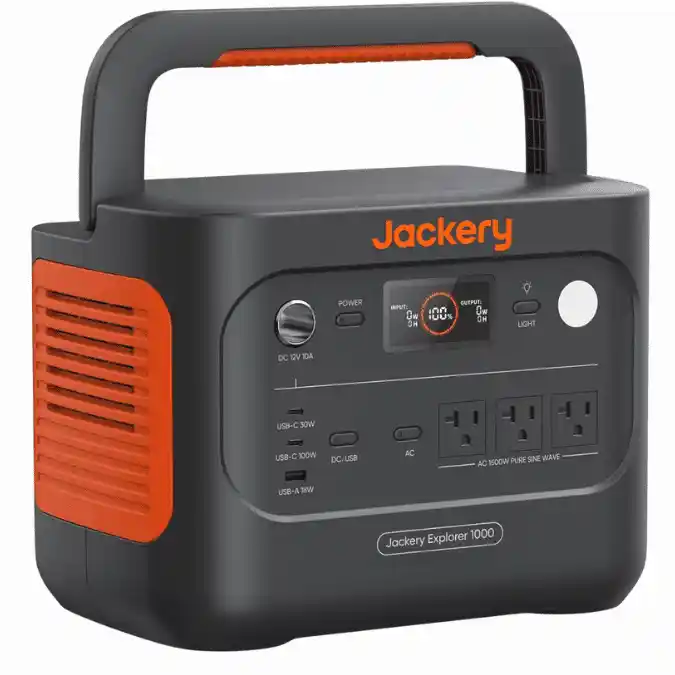
This is the model that earns the most recommendations across independent testing outlets. Popular Mechanics called it the Most Versatile pick for 2026. It consistently ranks in the top three best-selling portable power stations for camping on Amazon.
At 23.8 lbs it is the lightest unit in the 1,000 Wh class. The 1-hour emergency charge mode is a genuine differentiator for camping trips where you have access to shore power briefly. The LiFePO4 battery is rated for 6,000 plus charge cycles, which translates to roughly a decade of regular use.
In a real-world camping setup it runs a portable fridge, a CPAP machine, multiple USB-C device charges, and a fan simultaneously for several hours. During a home outage it keeps the essentials running through the night.
The honest caveat: the housing has shown less durability than competitors in drop testing. Jackery has updated the design since earlier complaints, but treat it with reasonable care.
Pros and Cons:
| Pros | Cons |
|---|---|
| Lightest in its class at 23.8 lbs | Pricier than some competitors |
| LiFePO4 battery rated 6,000 plus cycles | Housing not the most rugged in testing |
| 1-hour emergency charge mode | No expandable battery option |
| 3,000W surge handles most appliances | Heavier than budget units like the 300 Plus |
| Intuitive display and color-coded cables | Solar panel sold separately |
3. Jackery Explorer 2000 v2 – Best for Home Backup and RV Trips
Capacity: 2,042 Wh | Weight: 39 lbs | AC Output: 2,200W | Price: ~$900-1,100
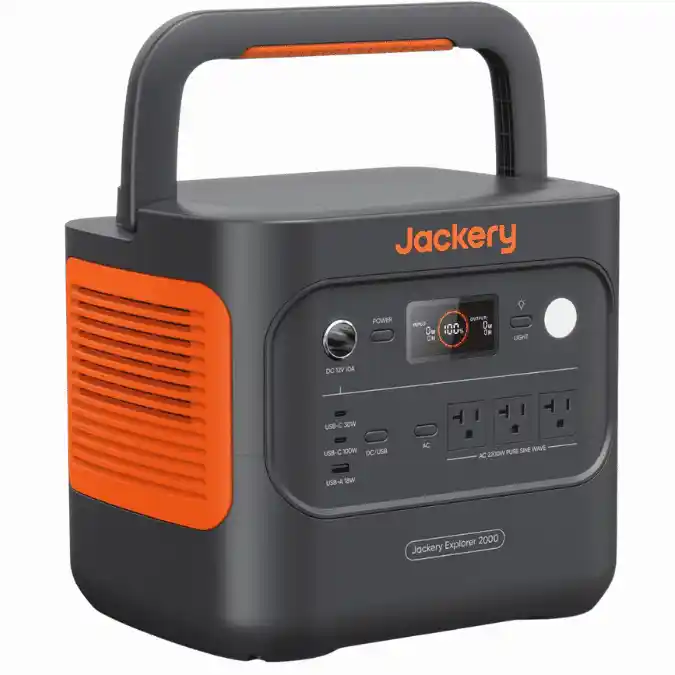
The Explorer 2000 v2 is where the Jackery lineup shifts from camping convenience to genuine home backup capability. At 2,042 Wh it can run a standard household refrigerator for roughly 15 to 18 hours, keep a CPAP machine running for multiple nights, and power lights and phone chargers simultaneously.
The power-to-weight ratio here is impressive. You get double the capacity of the 1000 v2 with only a 34 percent increase in weight. For RV use or extended vanlife trips paired with solar panels it is the unit that makes prolonged off-grid living practical.
It supports up to 800W of solar input, so with four 200W panels you can recharge it in around two to three hours of good sunlight. That makes it genuinely self-sufficient for multi-week trips.
Best for: Power outages lasting 12 to 24 hours, RV and vanlife setups, anyone running medical devices off-grid Not ideal for: Backpacking or any trip where you are carrying the unit on foot
4. Jackery Explorer 240 v2 – Best Ultralight Solar-Ready Option
Capacity: 256 Wh | Weight: ~7 lbs | AC Output: 300W | Price: ~$200
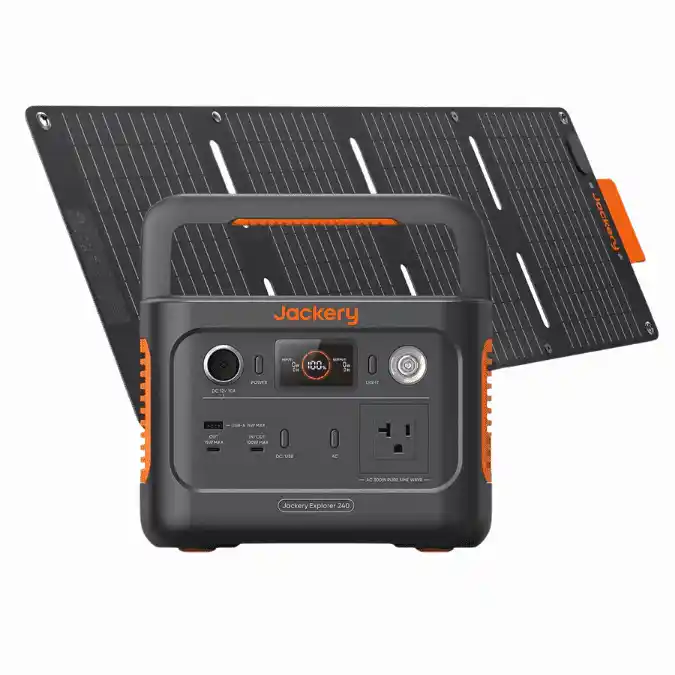
The Explorer 240 v2 is the most portable unit in the current Jackery lineup. At roughly 7 lbs it is genuinely packable. It pairs cleanly with a single Jackery SolarSaga 100W panel for off-grid recharging throughout the day.
This model is purpose-built for minimalist campers, weekend hikers, and anyone who wants a reliable backup for phones, cameras, and small devices without carrying significant weight. Do not expect it to run appliances. That is simply not its job.
For backpackers who also need to charge a GPS device, a headlamp battery bank, and a smartphone, the 240 v2 is the most practical option Jackery makes.
5. Jackery Explorer 5000 Plus – Best for Extended Whole-Home Backup
Capacity: 5,040 Wh | Weight: ~99 lbs | AC Output: 4,000W+ | Price: ~$2,000+
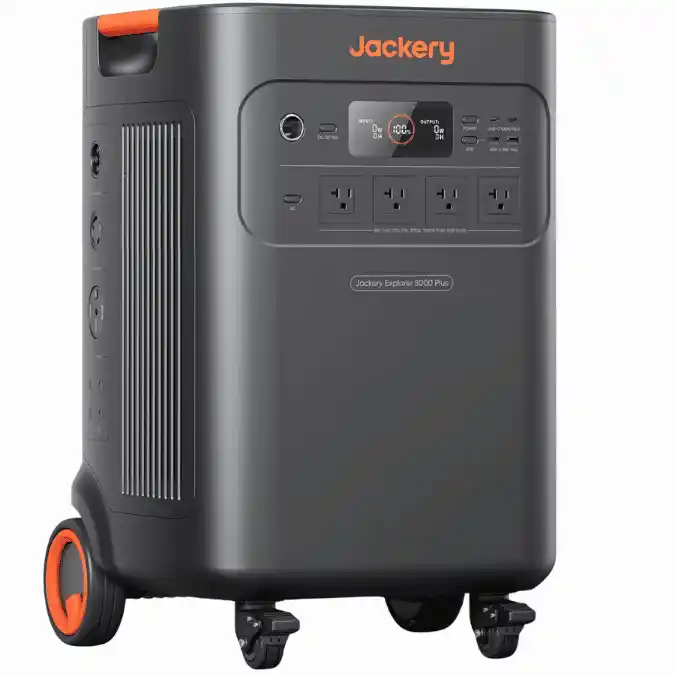
This is not a camping unit. The Explorer 5000 Plus is Jackery’s answer to extended home backup needs. At over 5 kWh of storage it can power appliances, tools, and essential home systems through multi-hour outages.
It supports a wide range of solar input configurations and can be connected to home energy systems. If you live in an area with frequent outages or need a reliable backup for medical equipment and refrigerators over multiple days, this is the unit to evaluate.
The weight means it stays put. You will not move this unit unless it has wheels and you are rolling it across a flat surface.
Jackery vs EcoFlow vs Anker: How the Top Brands Compare
All three brands have converged significantly in 2026. The 1,000 Wh segment now sees all three major brands selling within $40 to $50 of each other. Here is how the flagship mid-range models stack up:
| Feature | Jackery 1000 v2 | EcoFlow Delta 2 | Anker SOLIX C1000 |
|---|---|---|---|
| Capacity | 1,070 Wh | 1,024 Wh | 1,056 Wh |
| AC Output | 1,500W (3,000W surge) | 1,800W (2,700W surge) | 2,000W (2,400W surge) |
| Weight | 23.8 lbs | 27 lbs | 28.7 lbs |
| Full Charge Time | ~60 min | ~50 min (to 80%) | ~49 min |
| Battery Type | LiFePO4 | LiFePO4 | LiFePO4 |
| Ease of Use | Excellent (best in class) | Good | Good |
| Price Range | ~$400-450 | ~$400-450 | ~$380-430 |
| Expandable Battery | No | Yes (up to 3 kWh) | Limited |
Where Jackery still leads: ease of use, display clarity, and out-of-box experience. Independent testers at Outdoor Life consistently note that Jackery’s interface is more intuitive than EcoFlow or Anker. For buyers who are new to portable power stations that matters more than a 500W output advantage.
Where competitors edge ahead: Anker’s SOLIX C1000 delivers 2,000W continuous output vs Jackery’s 1,500W, which matters if you plan to run larger appliances. EcoFlow’s Delta 2 supports battery expansion up to 3 kWh, making it more future-proof for growing power needs.
The honest verdict: if you want output power, look at Anker. If you want expandability, look at EcoFlow. If you want the simplest and most intuitive experience with proven long-term reliability, Jackery is still the right call.
Practical Tips for Getting the Most Out of Your Jackery
- Store at 50 to 80 percent charge when not in use for extended periods. Full or empty storage degrades LiFePO4 batteries faster.
- Keep the unit warm in cold weather. Below freezing temperatures reduce available capacity by 35 to 45 percent. Insulate it or store it inside your vehicle overnight.
- Turn off output ports you are not using. The unit draws a small standby current that adds up over multi-day trips.
- Use the Jackery app to monitor real-time wattage draw and estimated runtime. It makes load management much easier.
- Pair with Jackery SolarSaga panels for off-grid recharging. Match the total solar wattage to the maximum solar input your model supports for fastest charging.
- Do not leave the unit in a hot car trunk in summer. Sustained heat above 104 degrees Fahrenheit accelerates battery degradation.
Common Mistakes to Avoid When Buying a Jackery
Buying too small to save money: A 300 Wh unit that cannot run your device is worth nothing at the campsite. Overestimate your needs by at least 20 percent.
Ignoring surge wattage: A motor-driven device like a blender or small compressor fridge will pull 2 to 3 times its rated wattage on startup. Check the surge spec before you buy.
Assuming all USB-C ports are equal: Some ports deliver only 18W. Others deliver 100W. Check per-port output specs if you plan to fast-charge laptops.
Forgetting solar panel costs: Solar panels are sold separately. A 200W SolarSaga adds $200 to $250 to your budget. Factor that in from the start.
Using it as a permanent home backup without a transfer switch: Running appliances directly is fine. Connecting to home wiring requires a proper transfer switch and an electrician.
Frequently Asked Questions
What is the best Jackery portable power station for camping?
The Jackery Explorer 1000 v2 is the best all-around camping power station. It balances capacity, portability, and output for car camping and family trips. For solo or ultralight trips the Explorer 300 Plus is the better choice.
How long does a Jackery power station last?
Current Jackery models using LiFePO4 batteries are rated for 6,000 plus charge cycles. With average use of one full cycle per day that translates to roughly 10 years before the battery degrades to 80 percent of its original capacity.
Can a Jackery power station run a CPAP machine?
Yes. Any Jackery model with a pure sine wave AC output can run a standard CPAP machine. The Explorer 1000 v2 can power a CPAP for roughly 20 to 40 hours depending on pressure settings and whether humidification is enabled. Using the DC output instead of AC improves efficiency.
How do I charge a Jackery with solar panels?
Connect compatible Jackery SolarSaga panels to the unit’s solar input port using the included Anderson connector cable. Place panels in direct sunlight at the optimal angle. The Jackery app or display shows real-time solar input in watts. Multiple panels can be connected in parallel up to the model’s maximum solar input rating.
Is Jackery better than EcoFlow or Anker?
For ease of use and out-of-box experience, Jackery leads. For raw output wattage Anker’s SOLIX C1000 edges ahead. For expandable capacity EcoFlow’s Delta 2 offers the most flexibility. In the 1,000 Wh segment all three brands now sell at nearly the same price point so the choice comes down to priorities.
What size Jackery do I need for a power outage?
For a basic outage covering lights, phone charging, and a CPAP machine, the Explorer 1000 v2 is sufficient. To keep a refrigerator running through the night you need the Explorer 2000 v2 or larger. For multi-day outages covering multiple appliances the Explorer 5000 Plus is the right level.
Can Jackery power stations be used while charging?
Yes. Jackery supports pass-through charging on current models, meaning you can power devices while the unit recharges from a wall outlet or solar panels. However, consistently doing this at maximum load while fast charging can generate heat, so use it in a well-ventilated space.