The best Anker SOLIX portable power stations for home backup in 2026 are the F3800 Plus (best overall for whole-home use), the F3800 (best value for extended outages), the F3000 (best mid-range), the C2000 Gen 2 (best for apartments and shorter outages), and the C1000 Gen 2 (best budget entry point). All models use LiFePO4 (LFP) batteries, support solar recharging, and are safe for indoor use.
If your power has ever gone out for more than a few hours, you already know the problem. The refrigerator starts warming up. The router goes dark. If someone in your home relies on a CPAP machine or medical equipment, the stakes are even higher.
The best Anker SOLIX portable power stations for home backup give you a clean, quiet, fuel-free way to keep essential appliances running when the grid fails. No fumes. No noise. No complicated installation.
This guide cuts through the noise. You will find out exactly which SOLIX model fits your home, what each one can actually power, and what to watch out for before you buy.
What Makes Anker SOLIX Different for Home Backup?
Not all portable power stations are built with home use in mind. Most are designed for camping and then stretched into backup duty. The SOLIX lineup is different because several models are purpose-built for home backup scenarios.
Here is what separates them from the crowd:
LFP Battery Chemistry Every SOLIX model uses lithium iron phosphate (LiFePO4) batteries. LFP batteries are safer than NMC batteries, especially for indoor use. They do not overheat the same way, last significantly longer (4,000+ charge cycles), and Anker backs this with a 10-year lifespan claim under their InfiniPower technology.
20ms or Better Transfer Switch Speed When grid power cuts out, the SOLIX line can switch to battery backup in 20ms or less. For context, most home electronics and medical devices handle a 20ms interruption without any issue. Your CPAP machine, router, and computer stay on without a blink.
120V/240V Dual Voltage Output This is a feature most competitors skip at this price range. The F3800 and F3800 Plus support both 120V and 240V output, which means you can run high-demand appliances like dryers or connect directly to a home subpanel via a transfer switch.
Scalable Capacity Most models can be expanded by connecting battery packs like the Anker SOLIX BP3800. This lets you start with a base unit and grow your backup capacity without buying an entirely new system.
The 5 Best Anker SOLIX Power Stations for Home Backup
1. Anker SOLIX F3800 Plus – Best Overall for Home Backup
If you need serious home backup power and do not want to compromise, the F3800 Plus is the right call.
It starts at 3,840Wh and delivers 6,000W of continuous AC output. That is enough to run a full-size refrigerator, window AC unit, lights, Wi-Fi router, and more at the same time. Add a second unit and you reach 12,000W, which covers virtually every circuit in a medium-to-large home.
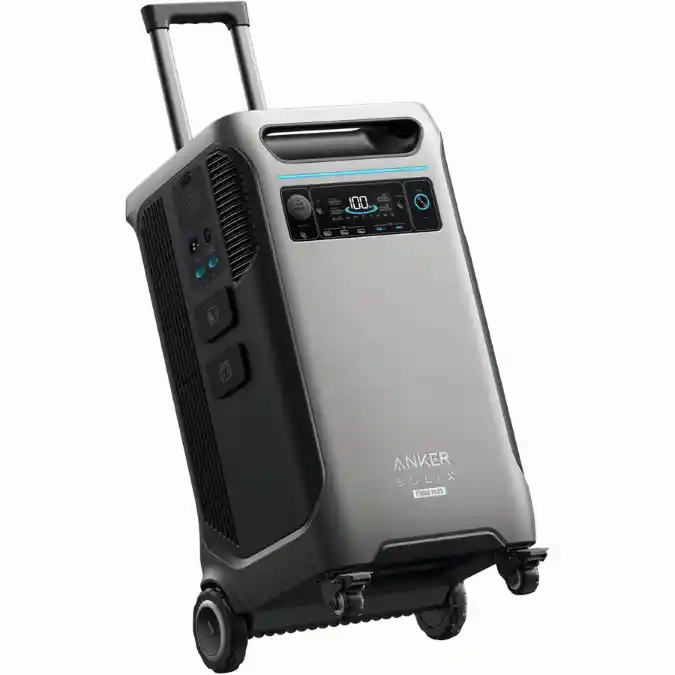
What sets the Plus apart from the original F3800 is its expanded solar input capacity of 3,200W, compared to 2,400W on the older model. That matters a lot if you plan to pair it with solar panels during an extended outage. You can also expand total system capacity all the way to 53.8kWh by stacking BP3800 expansion batteries, giving you days or even a week of backup depending on your consumption.
The NEMA L14-30 and NEMA 14-50 ports let you connect it directly to your home’s transfer switch or power an RV without any additional adapters.
Who it is for: Medium to large homeowners who want multi-day backup, plan to add solar panels, or want room to scale up.
| Spec | Detail |
|---|---|
| Capacity | 3,840Wh |
| AC Output | 6,000W continuous / 9,000W surge |
| Voltage | 120V / 240V |
| Solar Input | 3,200W max |
| Max Expansion | 53.8kWh |
| Warranty | 5 years |
| Lifespan | 10+ years |
Pros:
- Highest solar input in its class at 3,200W
- Expandable to 53.8kWh for week-long outages
- Dual voltage supports all home appliances
- Works with transfer switch, no electrician required
Cons:
- Heavy unit, not easy to move solo
- Solar panels sold separately
- Higher price point than F3800
2. Anker SOLIX F3800 – Best Value for Extended Home Outages
The original F3800 remains one of the best-value home backup power stations on the market. It shares the same 3,840Wh base capacity and 6,000W output as the Plus, but comes in at a lower price and is still expandable up to 26.9kWh with a single unit (or 53.8kWh when paired with a second F3800 and 12 expansion batteries).
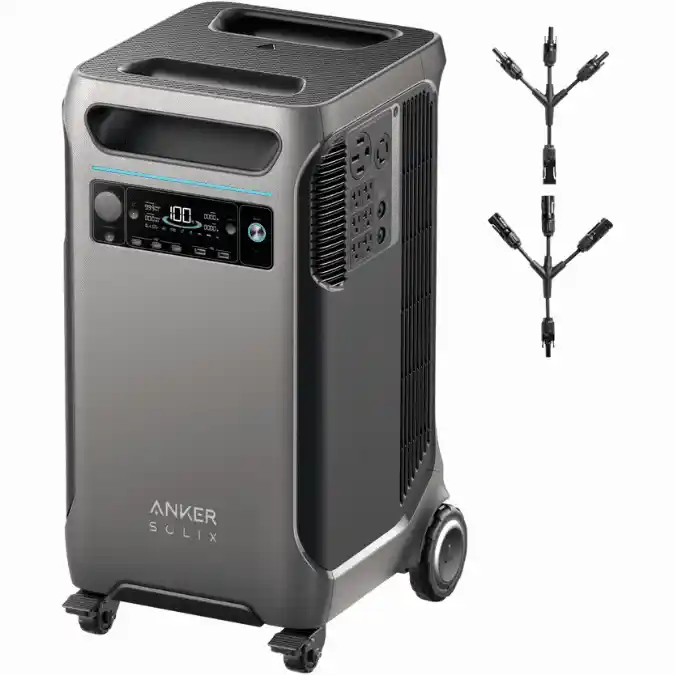
The F3800 accepts up to 2,400W of solar input, which is solid for most residential setups. One real-world tester ran a window air conditioner, a full-size refrigerator, a microwave, three lamps, a Wi-Fi router, and a television simultaneously, and reported zero interruptions when the compressors kicked in.
The 120V/240V output via NEMA 14-50 makes it one of the few portable power stations that can directly connect to an electrical subpanel, which is a feature you usually only find on whole-home battery systems costing far more.
Who it is for: Homeowners who want proven, high-output home backup at a lower price than the Plus, with plenty of expansion room.
Pros:
- Same 6,000W output as the Plus at lower cost
- NEMA 14-50 and L14-30 for subpanel and RV use
- Expandable up to 26.9kWh per unit
- Industrial-grade wheels for easy transport
Cons:
- Lower solar input than the F3800 Plus (2,400W vs 3,200W)
- Heavy at around 132 lbs
- Expansion batteries are an additional cost
3. Anker SOLIX F3000 – Best Mid-Range Option
The F3000 slots between the compact C-series and the heavy-duty F3800 lineup. It offers 3,072Wh of capacity and 3,600W of output, which is more than enough to cover lighting, refrigeration, internet, and phone charging during an outage.
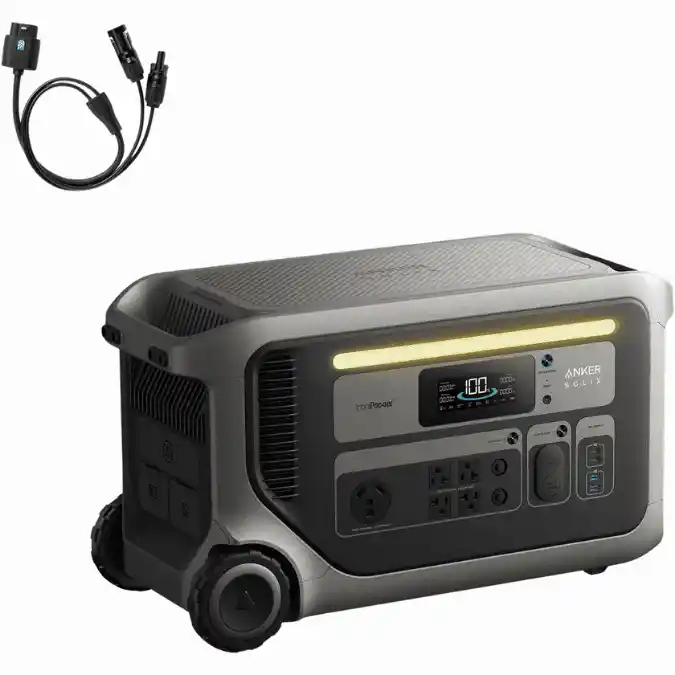
One of its standout features is its recharge speed. A full charge from AC takes around 80 minutes, and it supports EV charger pass-through, meaning you can charge the F3000 using your home EV charger, which is a smart feature for homeowners who already have one installed. You can expand it up to 24kWh with additional battery packs, giving it solid multi-day capacity when needed.
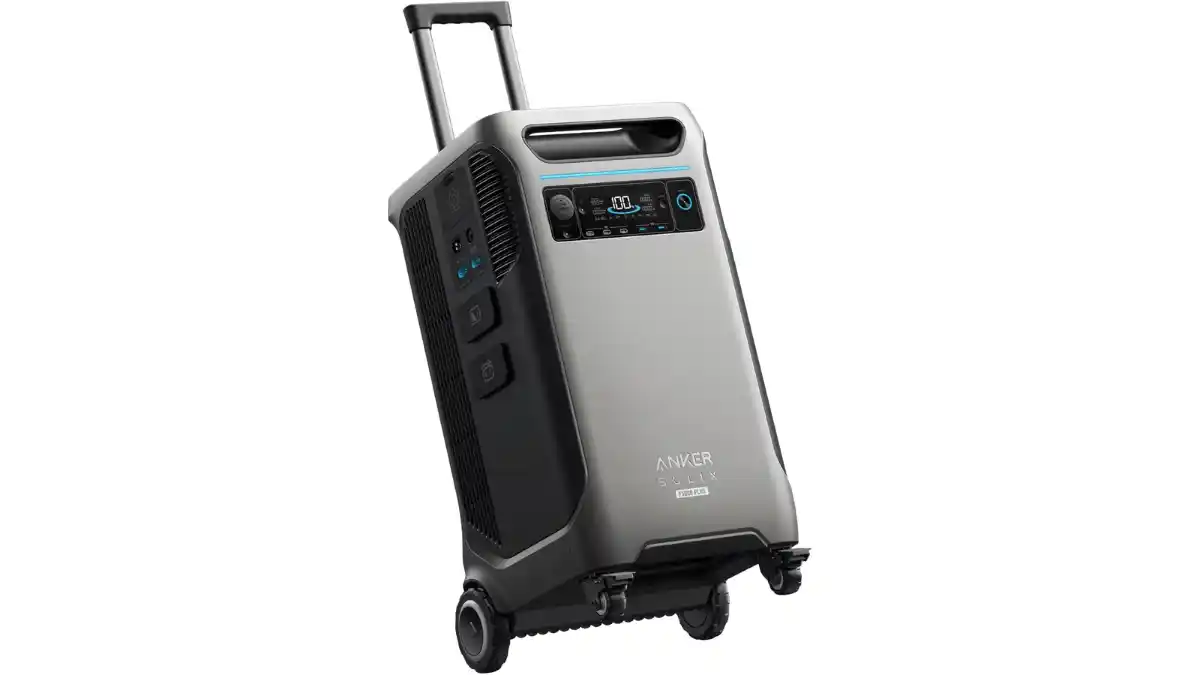
The suitcase design with wheels and a telescoping handle makes it significantly easier to move around than the F3800, which matters if you want to take it outdoors or shift it between rooms.
Who it is for: Smaller homes, renters who want portable backup they can take camping, or anyone who wants serious backup without the full weight of the F3800.
Pros:
- Fast 80-minute full recharge
- Expandable up to 24kWh
- EV charger pass-through
- More portable than F3800 series
- Sleep mode to reduce idle energy draw
Cons:
- Lower output than F3800 (3,600W vs 6,000W)
- No 240V output
- Slightly heavier than C-series at around 91 lbs
4. Anker SOLIX C2000 Gen 2 – Best for Apartments and Short Outages
Most outages in the US do not last more than 12 hours. For those situations, the C2000 Gen 2 gives you 2,048Wh of capacity and 2,400W of continuous output (peaking at 4,000W) in a significantly more manageable package at around 41 lbs.
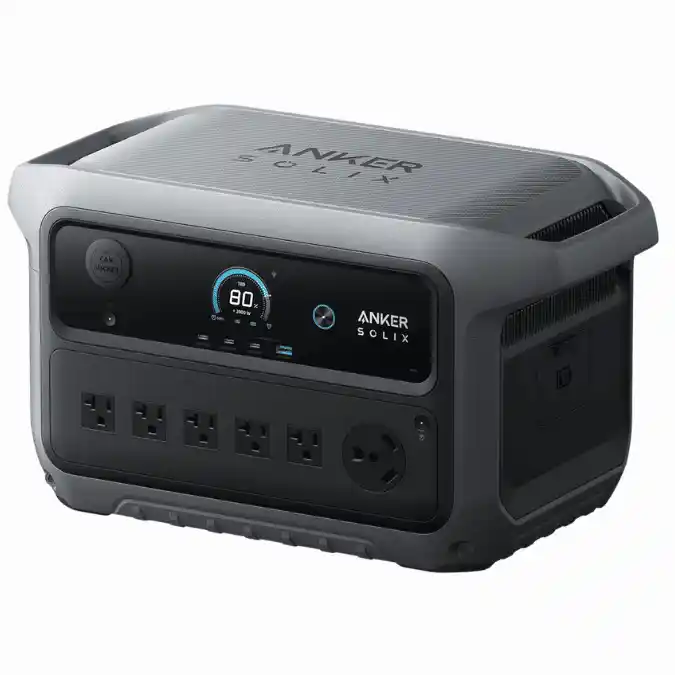
It features one of the lowest idle power draws among 2kWh units at just 9W standby, which Anker calls OptiSave. That matters if you plan to keep it plugged in as a UPS for sensitive equipment. The 10ms UPS switchover means your devices stay on seamlessly when an outage hits.
Charging is fast at around 58 minutes from AC. You can also charge it via solar (up to 1,000W input) or via a 12V car outlet, which is useful if you are road tripping or managing an extended outage away from the grid.
The five 120V AC outlets plus USB-C and USB-A ports cover all common home devices comfortably.
Who it is for: Apartment dwellers, smaller households, and anyone needing backup for refrigerator, router, lights, CPAP machine, and devices without the bulk of the F-series.
Pros:
- Compact at 41 lbs
- Only 9W idle power draw (great for UPS use)
- 58-minute AC recharge
- 10ms UPS switchover
- 4,000W peak handles startup surges
Cons:
- 120V only, no 240V output
- Not ideal for high-wattage appliances like window AC units
- Solar panels sold separately
5. Anker SOLIX C1000 Gen 2 – Best Budget Entry Point
If you just need to keep the lights on, charge your devices, run a router, and power a CPAP machine through a short outage, the C1000 Gen 2 does all of that at the most accessible price in the SOLIX lineup.
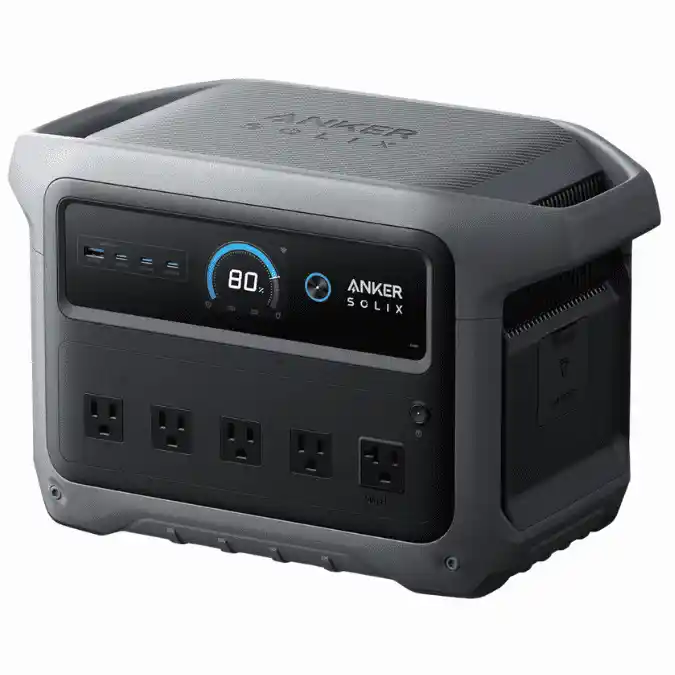
It holds 1,024Wh and delivers 2,000W continuous output with a 3,000W peak. The headline feature is its 49-minute full recharge via AC, which Guinness World Records certified as the fastest recharge time for a 1kWh portable power station as of August 2025. Even if you rarely need backup power, you can charge it up in under an hour when a storm is approaching.
At just under 25 lbs, it is also the easiest SOLIX unit to carry between rooms or take on a trip. The 10ms UPS switchover, LFP battery rated for 4,000 cycles, and 10-year lifespan make this a solid long-term investment even at its entry-level price.
One thing to note: the Gen 2 removed the expansion battery option to achieve its smaller size and faster charge. If you want expandability, look at the original C1000 instead.
Who it is for: Budget-conscious buyers, apartment renters, campers, and anyone who wants a reliable unit for short outages and daily device charging.
Pros:
- 49-minute full recharge (world record certified)
- Lightest SOLIX home backup option at 24.9 lbs
- 10ms UPS switchover
- 4,000 charge cycles
- Time-of-Use (TOU) mode to reduce electricity costs
Cons:
- No expansion battery option in Gen 2
- 1,024Wh is limited for multi-day home backup
- Fan can be noisy under heavy load
- Not suitable for high-wattage compressor devices at startup
How to Choose the Right SOLIX for Your Home
Before you decide, answer these three questions:
1. How long do your outages typically last? Short outages under 12 hours are common. For those, a C1000 Gen 2 or C2000 Gen 2 is plenty. If you live in an area with multi-day storm outages (hurricane zones, rural areas with aging infrastructure), you need the F3800 or F3800 Plus with expansion batteries.
2. What do you need to power? Below is a practical guide:
| Appliance | Typical Wattage | Unit Needed |
|---|---|---|
| Wi-Fi router + phones + lights | 100 to 300W | C1000 Gen 2 |
| Refrigerator + lights + router + CPAP | 500 to 900W | C2000 Gen 2 or F3000 |
| Refrigerator + window AC + lighting | 1,500 to 3,000W | F3000 or F3800 |
| Multiple circuits, dryer, HVAC | 3,000W+ | F3800 or F3800 Plus |
3. Do you want solar recharging? If you plan to stay off-grid during a prolonged outage, solar input matters a lot. The F3800 Plus accepts up to 3,200W of solar, which means a large solar array can recharge it in a few hours of sunlight. The C1000 Gen 2 handles 600W of solar, enough to stay topped up on sunny days with a couple of 200W panels.
Mistakes to Avoid When Buying a Home Backup Power Station
Do not size by price, size by load. A $400 unit that cannot run your refrigerator is not a deal. Calculate your critical appliance wattage first, then choose a unit that covers it with headroom.
Do not confuse capacity with output. A 3,840Wh station with 6,000W output is very different from a 3,840Wh station with 2,000W output. High-draw appliances like air conditioners and microwaves need high output, not just high capacity.
Do not skip the transfer switch. If you want to power hardwired circuits in your home, you need a transfer switch. The F3800 and F3800 Plus support this via their 120V/240V outlets. Running extension cords from the power station to individual appliances works in a pinch, but a transfer switch is cleaner and safer.
Do not store at 100% indefinitely. For long-term storage between outages, keep your unit at around 80% charge. LFP batteries degrade faster when stored at full charge for months at a time.
Anker SOLIX E10: When You Need More Than Portable
If your power needs go beyond what any portable station can handle, the SOLIX E10 is worth knowing about. It is a whole-home battery backup system that delivers 10kW turbo output and 7.6kW continuous output from a single unit. Three units together scale to 30kW turbo and 22.8kW continuous.
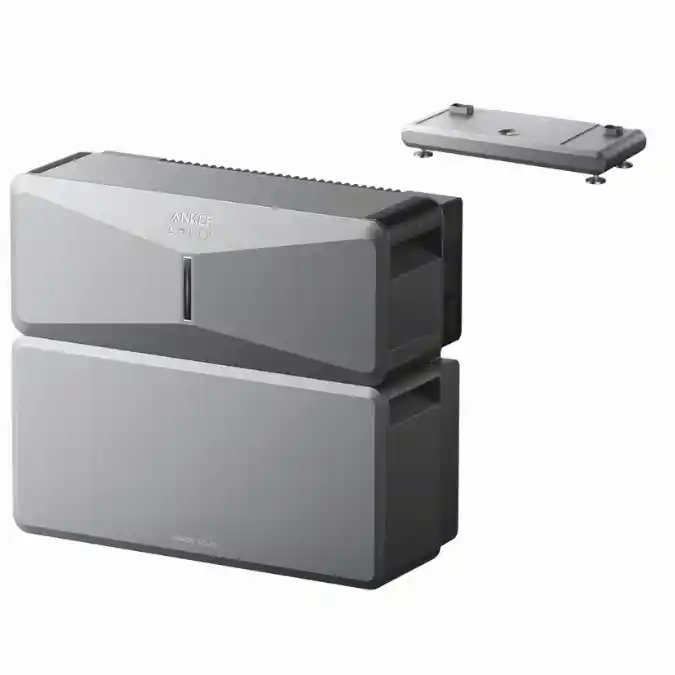
The E10 is not portable in the traditional sense, but it monitors weather forecasts, auto-charges before a storm hits, and prioritizes power across up to 12 circuits automatically. It is the step up for homeowners who want a fully automated, whole-home solution.
FAQs
What is the best Anker SOLIX portable power station for home backup?
The F3800 Plus. It delivers 6,000W output, supports 120V/240V, and expands up to 53.8kWh.
Can an Anker SOLIX power station run a whole house?
Yes, partially. A single F3800 or F3800 Plus covers essential circuits. Two paired units reach 12,000W for most households.
How long will an Anker SOLIX F3800 last during a power outage?
Around 15 hours running a standard refrigerator. Add expansion batteries to stretch runtime to multiple days.
Are Anker SOLIX power stations safe to use indoors?
Yes. LFP batteries produce no fumes or emissions, making all SOLIX models safe for indoor use.
How fast do Anker SOLIX stations charge with solar panels?
The F3800 Plus recharges in roughly 1.5 to 2 hours with its 3,200W solar input. The C1000 Gen 2 takes around 1.8 hours with 600W of solar.
What warranty does Anker SOLIX offer on their power stations?
A 5-year warranty with a 10-year lifespan rating and at least 80% capacity after 4,000 charge cycles.
Do I need an electrician to set up a SOLIX for home backup?
Not for plug-and-play use. For a transfer switch connecting to home circuits, yes, a licensed electrician is recommended.