The best portable power station should keep the essentials running first: your refrigerator, Wi-Fi router, phone, laptop, CPAP machine, lights, fan, or small kitchen appliance.
That’s because an outage is not a camping trip. It is a short window where comfort, food safety, work access, medical support, and communication all depend on stored power.
This review focusses on the best portable power stations for blackouts / power outages in 2026 (so far), and our top picks make sense for homes, apartments, RVs, and storm-prone areas. We looked at capacity, AC output, charging speed, battery chemistry, UPS support, solar charging, portability, price, and real feedback.
The goal is simple: help you choose the right blackout backup before the lights go out.
Our Top Picks for Blackouts
These are the five models we selected for review:
| Pick | Product | Best For |
|---|---|---|
| Best Fast-Charging 1kWh Pick | EF ECOFLOW DELTA 3 Plus | Fast storm prep, routers, fridge support, work setups |
| Best Compact High-Output Pick | Anker SOLIX C1000 Gen 2 | High output in a smaller 1kWh unit |
| Best Value Pick | BLUETTI AC180 | Strong specs at a lower mid-range price |
| Best 2kWh Backup Pick | BLUETTI Elite 200 V2 | Longer blackout runtime and heavier home essentials |
| Best Lightweight 2kWh Pick | Jackery Explorer 2000 v2 | 2kWh capacity with better portability |
These are not whole-home battery systems. However, they can cover the devices you care most about during a short or moderate outage.
Why Portable Power Stations Matter During Blackouts
Power outages often come from storms, extreme heat, winter weather, hurricanes, wildfires, grid strain, and local equipment failure. Here’s why portable backup power has become more useful now:
In May 2026, NERC said the U.S. grid looked better prepared for summer than the previous year, but it still warned about risk from rising demand, fast load growth, low wind output, and heat during maintenance periods. (Reuters)
A portable power station for blackouts gives you indoor-safe battery power without fuel, fumes, or engine noise. So, instead of running a gas generator for a router or laptop, you can use a battery station indoors for low to medium loads.
Still, expectations matter. A portable station will not run an entire house like a standby generator. It works best when you prioritize essentials and avoid waste.
Comparison Table
| Product | Capacity | AC Output | Peak Output | Fast Charging | UPS Support | Best Use | Pricing |
|---|---|---|---|---|---|---|---|
| EF ECOFLOW DELTA 3 Plus | 1024Wh | 1800W | 2200W+ X-Boost support | 80% in about 40 minutes | 10ms | Fast charging, UPS-style backup, essentials | See price here |
| Anker SOLIX C1000 Gen 2 | 1024Wh | 2000W | 3000W | Full charge in about 49 minutes | 10ms | Compact high-output blackout backup | See price here |
| BLUETTI AC180 | 1152Wh | 1800W | 2700W | 0 to 80% in about 45 minutes | 20ms | Value-focused home and camping backup | See price here |
| BLUETTI Elite 200 V2 | 2073.6Wh | 2600W | 3900W power lifting | 0 to 80% in about 50 minutes | Yes | Longer appliance runtime and 2kWh backup | See price here |
| Jackery Explorer 2000 v2 | 2042Wh | 2200W | Noted for home backup loads | 0 to 80% in about 66 minutes | 20ms | Lighter 2kWh backup and fridge support | See price here |
The Best Portable Power Stations for Blackouts
Here’s our lineup for the best portable power stations for blackouts:
EF ECOFLOW DELTA 3 Plus | Best Fast-Charging Power Station for Blackouts
Category: Best mid-range portable power station for fast home backup, internet backup, and emergency appliance support.
Key Features:
- 1024Wh LiFePO4 battery
- 1800W AC output
- 140W USB-C output
- Charges to 80% in about 40 minutes from AC power
- Up to 1000W solar input with compatible panels
- 10ms UPS switchover for routers, PCs, NAS, and basic work setups
- Expandable capacity up to 5kWh with compatible EcoFlow batteries
- App-based energy controls, charge settings, alerts, and usage tracking
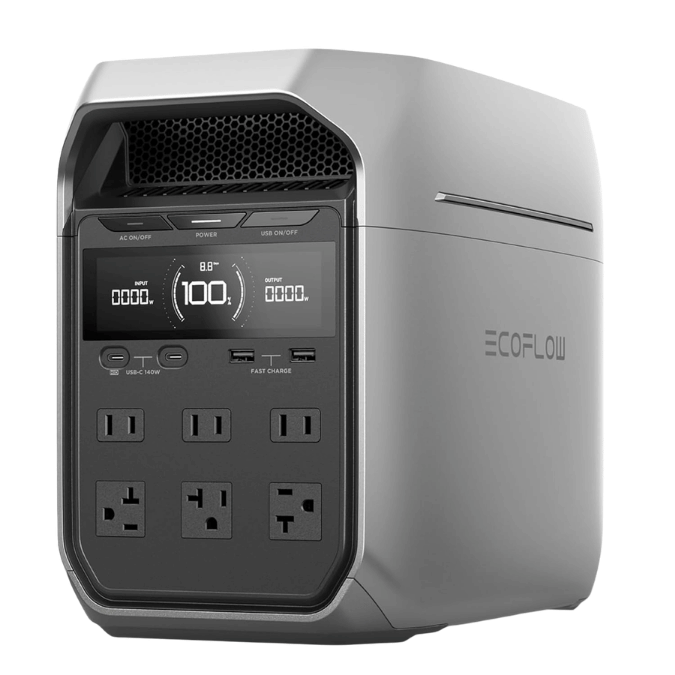
The EF ECOFLOW DELTA 3 Plus is one of the cleaner blackout picks in the 1kWh category because it does not feel like a basic battery box. It gives you a strong mix of fast charging, useful output, LiFePO4 battery life, and UPS-style backup in one unit. For short outages, it makes the most sense for keeping your router, modem, laptop, TV, lights, small kitchen appliances, or a refrigerator running without jumping straight into a huge and expensive home backup system.
Real user feedback is strongest around speed, quiet operation, and emergency confidence. Several buyers mentioned using it during outages for internet, TV, office equipment, security cameras, and refrigerators. One reviewer said it ran a refrigerator during an outage with much less battery drain than expected, while others liked how quickly it recharged after sitting in storage. That makes it a practical pick for people who want something ready before storms, not something they have to babysit once the power goes out.
The main limitation is that this is still a 1024Wh unit, not a whole-home solution. It can handle important essentials, but it is not the right choice if you want to run central HVAC, large pumps, or multiple heavy appliances for long hours. Some users also noted the weight, AC idle drain, and app dependency as small drawbacks. Still, for the price range, the DELTA 3 Plus feels like one of the better blackout-ready options because it balances capacity, charging speed, output, and real-world reliability better than many mid-range competitors.
Pros and Cons
| Pros | Cons |
|---|---|
| Very fast AC charging, useful when storms are coming | Still limited for long multi-day outages without solar or extra batteries |
| 10ms UPS switchover is excellent for routers, PCs, and office gear | Not a replacement for a full whole-home generator |
| Strong 1800W output for many household essentials | |
| LiFePO4 battery gives better long-term cycle life |
Best For: Homeowners, remote workers, apartment users, and RV/camping users who want a fast-charging 1kWh power station for blackouts, internet backup, refrigerator support, and essential devices.
Skip If: You need whole-home backup, long-term off-grid runtime, or enough power for central air, large well pumps, or several heavy appliances at the same time.
Anker SOLIX C1000 Gen 2 | Best Compact High-Output Power Station for Blackouts
Category: Best portable power station for high output, fast recharge, and short-to-medium blackout backup.
Key Features:
- 1024Wh LiFePO4 battery
- 2000W AC output
- 3000W peak output
- Full recharge in about 49 minutes with HyperFlash charging
- 600W solar input with compatible panels
- 10ms UPS switchover for laptops, routers, CPAP machines, and work setups
- 10 output ports for household and outdoor devices
- App control with Time-of-Use mode and power settings
- Around 4000 battery cycles to 80 % capacity
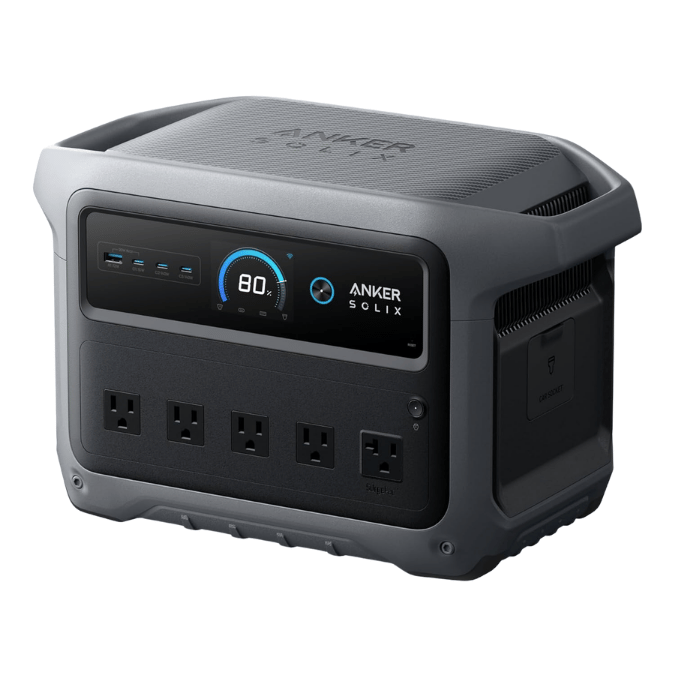
The Anker SOLIX C1000 Gen 2 is a strong blackout pick because it keeps the 1kWh size class portable while pushing output higher than many similar units. Its 2000W AC output gives it enough headroom for essentials like a fridge, router, modem, laptop setup, fans, lights, and a CPAP machine. It is still not a whole-home backup system, but for most short outages, it covers the devices people care about first.
Real user feedback is especially strong around charging speed. Several buyers called the fast recharge the main reason this unit worked well during storms, camping trips, van life, and work-from-home backup. One user said it helped during a ten-day outage by running a fridge at night and recharging quickly each day. Others liked that it was easier and safer to move around than a gas generator for smaller backup needs.
The main drawbacks are not performance-related as much as practical. Buyers mentioned that it needs a proper carrying/storage case, especially because the cords and adapters can get messy. One user also reported an issue with the first unit before getting a replacement, while another wanted better app notifications during UPS mode. Still, the overall review pattern is positive, with strong praise for portability, fast wall charging, steady output, and real emergency usefulness.
Pros and Cons
| Pros | Cons |
|---|---|
| Very fast 49-minute wall recharge is excellent for outage prep | No included protective case for cables and accessories |
| 2000W output gives more headroom than many 1kWh units | Still limited for long outages without solar, generator charging, or backup charging access |
| Compact and easier to move than larger backup stations | |
| Works well for routers, laptops, CPAP machines, fridges, fans, and lights |
Best For: Remote workers, campers, van-life users, CPAP users, and homeowners who want a compact 1kWh power station with strong output and very fast recharge during blackouts.
Skip If: You need whole-home backup, multi-day appliance runtime without recharging, or a unit that includes solar panels and a carrying case in the base package.
BLUETTI AC180 | Best Value Power Station for Blackouts
Category: Best mid-priced portable power station for home backup, outage prep, camping, and off-grid essentials.
Key Features:
- 1152Wh LiFePO4 battery
- 1800W AC output
- 2700W peak / power lifting mode
- Charges from 0 to 80% in about 45 minutes
- 500W max solar input
- 20ms UPS backup support
- 8 output options listed on Amazon
- BLUETTI app support for monitoring and control
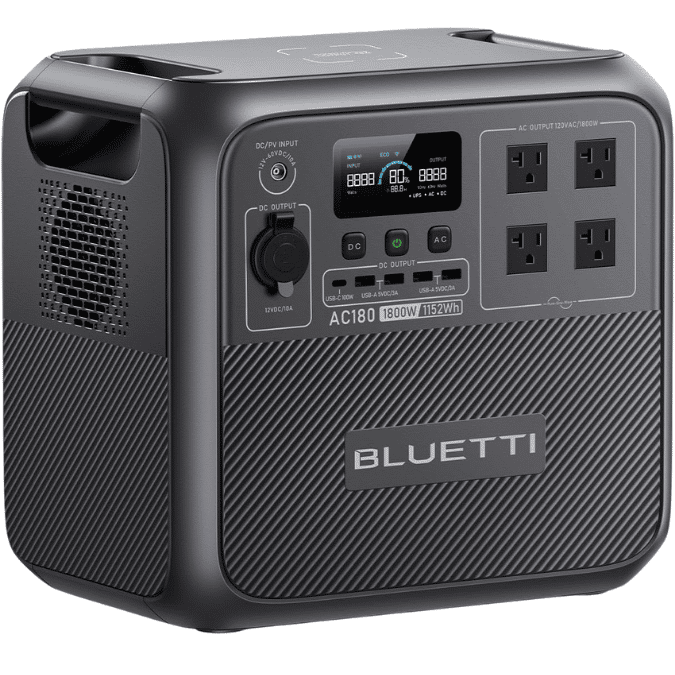
The BLUETTI AC180 is one of the stronger value picks in this blackout roundup because it gives you more battery capacity than many 1kWh units while staying in a lower mid-price range. The 1152Wh capacity, 1800W output, and fast AC recharge make it useful for short outages where you need to keep essentials running without paying for a much larger backup system. It can handle devices like phones, laptops, fans, lights, a mini fridge, CPAP equipment, and some kitchen appliances for limited use.
Real user feedback is mostly positive around build quality, output strength, and fast charging. Buyers used it for power outages, camping, everyday backup, solar setups, small fridges, fans, coffee makers, lights, and emergency appliance support. One long-term user said they had used the AC180 daily for over a year, mainly as an inverter and backup power source. That kind of real-world use makes it more convincing than a spec sheet alone.
The AC180 does have a few honest limitations. Some users mentioned inverter draw, runtime expectations, solar setup confusion, and the need to understand usable capacity instead of assuming the full 1152Wh will be available through AC outlets. One reviewer also reported a SHORT error and warranty confusion before the unit was repaired. So this is not the most polished power station in the group, but at its current Amazon price, it gives a lot of blackout-ready performance for the money.
Pros and Cons
| Pros | Cons |
|---|---|
| Strong value for a 1152Wh LiFePO4 power station | Solar performance depends heavily on panel setup and wiring |
| 1800W output can handle many household essentials | Internal inverter draw can reduce runtime on small AC loads |
| Fast 0 to 80 % charging is useful before storms | |
| Good for fridges, fans, lights, laptops, CPAP machines, and small appliances |
Best For: Buyers who want a practical, budget-friendly blackout power station with more than 1kWh capacity, strong AC output, fast charging, and enough power for home essentials.
Skip If: You want the smoothest UPS experience, the lightest portable design, or a power station that needs almost no setup knowledge for solar charging and runtime planning.
BLUETTI Elite 200 V2 | Best 2kWh Power Station for Blackouts
Category: Best higher-capacity portable power station for refrigerators, kitchen appliances, work setups, and longer blackout backup.
Key Features:
- 2073.6Wh LiFePO4 battery
- 2600W continuous AC output
- 3900W power lifting mode
- 4 AC outlets
- Charges from 0 to 80% in about 50 minutes with dual AC and DC charging
- Up to 1000W solar input with compatible panels
- Low 10W standby power consumption listed by BLUETTI
- App control with charging modes, monitoring, and power settings
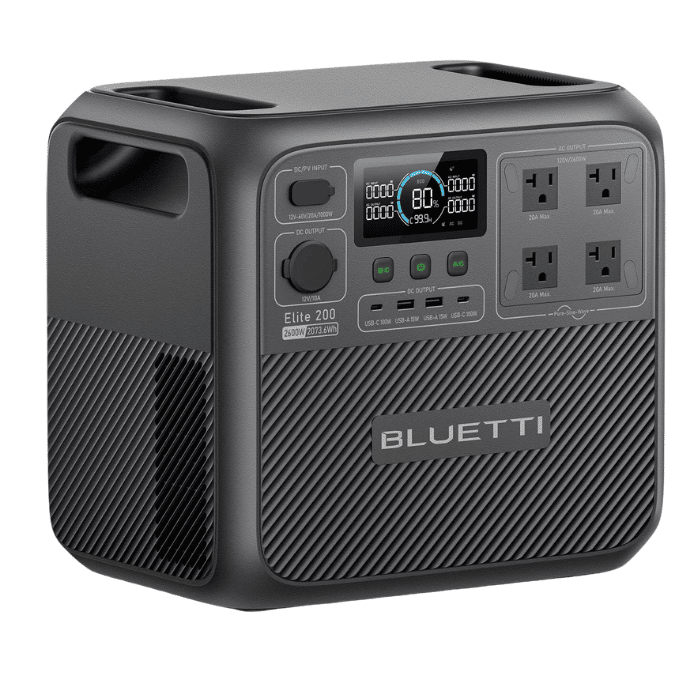
The BLUETTI Elite 200 V2 is the bigger step-up pick in this blackout roundup. It gives you roughly double the battery capacity of many 1kWh stations while staying portable enough for one person to move when needed. For outages, that extra capacity matters because it gives you more room for a refrigerator, Wi-Fi, work computers, lights, fans, small kitchen appliances, and medical or communication devices.
Real user feedback is strong around capacity, appliance handling, and blackout confidence. Buyers used it for fridges, computers, microwaves, air fryers, power tools, portable AC testing, camping, tailgating, shed backup, and off-grid setups. Several users liked that it feels more useful than a 1kWh unit because they do not have to keep checking the battery every hour during an outage.
The main tradeoff is size and complexity. It is still heavy, the app experience gets mixed feedback, and some users wanted better solar state-of-charge controls. It is also not expandable like some larger BLUETTI systems, so buyers should treat it as a strong standalone 2kWh unit rather than a modular home backup platform. Still, for blackout buyers who want more runtime without jumping into a huge wheeled system, this is one of the most practical higher-capacity picks.
Pros and Cons
| Pros | Cons |
|---|---|
| Large 2073.6Wh capacity gives much better runtime than 1kWh units | Heavy compared with smaller blackout power stations |
| 2600W output can handle many home essentials and high-draw devices | Overkill if you only need phones, lights, and a router |
| Strong choice for refrigerators, routers, computers, fans, and kitchen appliances | |
| Fast charging helps during storm prep or generator top-ups |
Best For: Homeowners, remote workers, RV users, and blackout-prep buyers who want a 2kWh power station for refrigerators, Wi-Fi, computers, fans, and limited kitchen appliance use.
Skip If: You want a lightweight unit, expandable battery support, or a simple plug-and-forget solar backup setup with more advanced charge-limit controls.
Jackery Explorer 2000 v2 | Best Lightweight 2kWh Power Station for Blackouts
Category: Best portable 2kWh power station for home backup, refrigerators, camping, and emergency power.
Key Features:
- 2042Wh LiFePO4 battery
- 2200W AC output
- 3 AC outlets
- 100W USB-C PD fast charging
- Charges from 0 to 80% in about 66 minutes with AC fast charging
- Full charge in about 102 minutes with Emergency Super Charging through the app
- Solar charging in as few as 6 hours with compatible 400W panels
- 20ms UPS switchover for backup power during outages
- Silent Charging Mode rated under 30dB
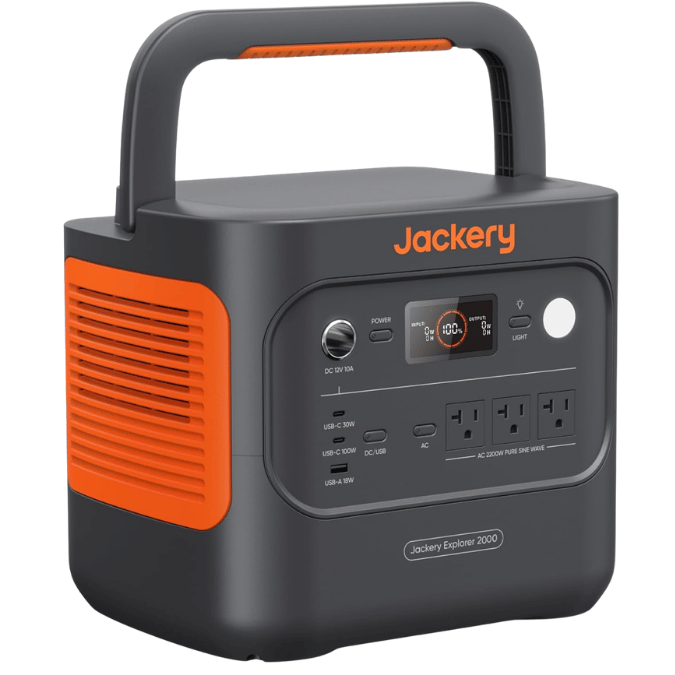
The Jackery Explorer 2000 v2 stands out because it gives you serious 2kWh backup capacity without feeling as bulky as many other large portable power stations. Its 2042Wh battery and 2200W output make it useful for refrigerators, fans, laptops, phones, CPAP machines, garage door openers, lights, and small home essentials during a blackout. For buyers who want more runtime than a 1kWh station but still care about portability, this is one of the cleaner options.
Real-world feedback is strong around fridge backup, quiet operation, and easy movement for its size. One user tested it with a refrigerator and reported more than 21 hours of runtime, while others used it during Florida outages, snow-season prep, camping trips, and garage-door backup. Several buyers also liked the handle, app monitoring, port layout, and the fact that it feels easier to carry than many competing 2kWh units.
The main drawback is solar speed if you use a smaller panel. A few buyers said 200W solar charging felt slow, which is expected for a 2kWh battery. It is also still heavy, even though it is light for its class. Another buyer noted confusion around solar panels not being included, so this should be clearly presented as the power station only unless the listing/bundle says otherwise. For blackout use, it is a strong pick, but it performs best when paired with enough solar input or quick wall charging before a storm.
Pros and Cons
| Pros | Cons |
|---|---|
| Large 2042Wh capacity is useful for refrigerators and longer backup sessions | Solar panels are optional and may not be included |
| Lighter than many 2kWh-class competitors | Still heavy for casual carrying |
| 2200W output handles many home essentials | |
| Quiet operation works well indoors during outages | |
| Not designed for whole-home backup | |
How We Chose These Models
We did not choose these power stations only because they are popular. Instead, we filtered for blackout use.
Each model fits a real outage role. Some are better for fast charging and short outages. Others make more sense for longer refrigerator runtime or larger household essentials.
We also kept price in mind. Our lineup leans toward higher-low to mid-range products. That price range gives you enough capacity and output to handle real blackout, whenever it happens.
What Size Portable Power Station Do You Need for a Blackout?
When it’s about homes, capacity matters more than the number of ports.
Capacity tells you how much stored energy the power station has. Output tells you what it can run at one time.
A smaller 500Wh station can help with phones, lights, tablets, and a router. However, it may fall short for refrigerator support. A 1000Wh unit works better for a router, laptop, fan, TV, CPAP machine, and short fridge backup.
A 2000Wh unit gives you more breathing room. It can support a refrigerator for longer, handle multiple essentials, and cover overnight use more comfortably. Therefore, a 2kWh station is often the smarter choice if food storage matters.
As a quick rule, choose around 1kWh for communication and light essentials. Choose around 2kWh if your goal includes a refrigerator, home office, CPAP use, fans, or more than one device at a time.
How to Estimate Blackout Runtime
Runtime depends on the appliance, battery size, inverter loss, temperature, and how often the device cycles on and off. So, no chart can give a perfect number.
Still, this formula helps:
Power station capacity ÷ device watts = rough runtime
For example, a 1000Wh power station running a 100W device may last around 8 to 9 hours after inverter loss. A fridge is trickier because it cycles. It may pull high power at startup, then lower power during normal operation.
That is why refrigerator feedback is important. Food safety matters too. During a power outage, FEMA guidance cited by AP News says refrigerators usually keep food cold for about 4 hours if doors stay closed, while freezers may hold safe temperatures longer depending on how full they are.
1kWh vs. 2kWh Power Stations for Blackouts
A 1kWh station makes sense when you want portability and price control. It is easier to carry, easier to store, and usually enough for phones, routers, laptops, lights, CPAP machines, fans, and short fridge support.
A 2kWh station makes more sense when the outage could last longer. It gives you more room for refrigerators, workstations, small kitchen appliances, garage door openers, and overnight loads. However, it also costs more and weighs more.
In short, a 1kWh unit is the practical starting point. A 2kWh unit is the safer outage pick for households that want stronger backup without moving into whole-home battery territory.
Can a Portable Power Station Run a Refrigerator During a Blackout?
Yes, many mid-size and 2kWh portable power stations can run a refrigerator during a blackout. However, runtime depends on fridge size, compressor cycling, temperature, door opening, inverter efficiency, and the battery’s usable capacity.
A 1kWh model may help with short fridge support. A 2kWh model gives you a better chance of getting through an overnight outage. Also, if you add solar charging or recharge from another source during the day, you can stretch runtime further.
For best results, test your fridge before storm season. Plug it into the power station, watch the watt draw, and note how fast the battery drops over two to four hours.
Will a Portable Power Station Run an Electric Blanket?
Yes, a portable power station can run many electric blankets if the blanket’s wattage stays within the station’s output rating. In fact, an electric blanket often makes more sense than a space heater during an outage because it uses less power.
However, users should check the label first. Some blankets draw around 50 to 150 watts, depending on size and heat level. A 1000Wh station can usually run a low-watt blanket for several hours, but the exact runtime depends on settings and inverter loss.
Use only undamaged cords. Also, avoid using electric blankets in wet areas or with overloaded power strips.
Are Portable Power Stations Dangerous?
Quality portable power stations are generally safer indoors than gas generators because they do not burn fuel or produce carbon monoxide. That is a major advantage during storms, hurricanes, and winter outages.
Still, battery safety matters. Do not use swollen, damaged, recalled, wet, or overheating battery products. Also, keep vents clear and use the charger supplied by the manufacturer. Recent lithium-ion battery recalls show that poor battery design can create fire and burn risks, so brand support, safety testing, and proper disposal matter.
So, are portable power stations dangerous? Not when users choose a reputable model and follow basic safety rules. The risk rises when people buy low-quality products, ignore warnings, or use damaged battery equipment.
Portable Power Station vs. Gas Generator for Blackouts
A portable power station is quiet, clean, and indoor-safe when used correctly. It works well for electronics, routers, CPAP machines, lights, fans, laptops, TVs, and some appliances.
A gas generator delivers more continuous power for heavy loads. However, it must stay outdoors because it produces carbon monoxide. FEMA guidance cited by AP says generators should run outside, at least 20 feet away from windows, doors, and garages.
Therefore, these two tools solve different problems. A battery station works best inside the home for essentials. A gas generator works better outside for higher power demands, but only with strict safety precautions.
How to Have Power When Power Goes Out
The best setup starts before the outage. Charge the power station before storm season, then store it somewhere easy to access. Next, make a short priority list.
Focus on devices that protect food, health, communication, and basic comfort. In many homes, that means the refrigerator, router, phone, laptop, CPAP machine, LED lights, and a fan.
If outages last longer in your area, add compatible solar panels. Also, test everything before an emergency. A 20-minute test tells you more than a spec sheet because you can see actual wattage and runtime on the display.
Why Portable Power Station Over a Small Power Bank?
A small power bank can charge a phone. A portable power station for power outages can run AC devices, USB-C laptops, routers, fans, small appliances, and emergency equipment.
That difference matters during a blackout. A phone battery helps you communicate. A power station helps the household function.
Also, many modern units use LiFePO4 batteries. This chemistry usually supports longer cycle life and better durability than older lithium-ion chemistries. So, if you plan to keep emergency backup power for years, LiFePO4 is worth prioritizing.
Final Verdict
The best portable power stations for blackouts come down to your real outage plan.
Choose a 1kWh model if you want fast charging, easier storage, and enough backup for Wi-Fi, phones, laptops, fans, lights, and short appliance use. The EF ECOFLOW DELTA 3 Plus, Anker SOLIX C1000 Gen 2, and BLUETTI AC180 fit that role well.
Choose a 2kWh model if your priority is a refrigerator, longer overnight use, a bigger home office setup, or several essentials at once. The BLUETTI Elite 200 V2 and Jackery Explorer 2000 v2 make more sense there.
The smartest answer is not always the biggest unit. It is the one that matches your devices, your outage risk, your storage space, and your budget.
FAQs
What is the best portable power station for blackouts?
The best portable power station for blackouts depends on your load. For routers, phones, laptops, lights, fans, and CPAP support, a strong 1kWh model may work well. For a refrigerator and longer runtime, a 2kWh model usually makes more sense.
Which is the best portable power station?
There is no single best model for every household. A compact apartment setup needs different backup power than a storm-prone home with a refrigerator, CPAP machine, router, fan, and work computer.
What is the best portable power station for power outages?
The best portable power station for outages should have enough watt-hours for your essentials, enough AC output for appliance startup, fast charging, safe battery chemistry, and good owner feedback. UPS support also helps if you want backup for routers, computers, or medical devices.
What size portable power station do I need for a refrigerator?
A 1000Wh station can help with short refrigerator backup. However, a 2000Wh station gives better runtime and more margin. Always check your refrigerator’s running wattage and startup surge before relying on any power station.
Will a portable power station run an electric blanket?
Yes, many portable power stations can run an electric blanket. Runtime depends on the blanket’s wattage, heat setting, and power station capacity. A low-watt blanket is usually more practical than a space heater during an outage.
Are portable power stations safe to use indoors?
Yes, quality portable power stations are safe indoors when used correctly because they do not emit carbon monoxide. Keep the unit dry, ventilated, and away from heat. Also, avoid damaged cables, recalled products, and blocked vents.
Is a portable power station better than a generator?
For indoor essentials, yes. A portable power station is quieter and safer indoors. However, a gas generator can handle larger loads for longer if used outside with proper carbon monoxide precautions.
Should you buy solar panels with a portable power station?
Solar panels make sense if you expect longer outages, camping use, RV use, or off-grid charging. However, solar charging depends on panel wattage, weather, shade, and input limits. For short outages, fast wall charging may matter more.