Yes, you can absolutely run a CPAP on a portable power station without the humidifier. In fact, turning off the humidifier is the single most effective way to extend your runtime on battery power. Without the humidifier, most CPAP machines draw 30 to 60 watts. That means a 400Wh portable power station is enough to get most users through a full 8-hour night on a single charge.
Why This Question Matters
If you rely on a CPAP machine to manage obstructive sleep apnea, skipping a night is not an option. Whether you are camping, dealing with a power outage, living in an RV, or traveling where outlets are not reliable, you need your therapy to work every night without exception.
The problem is that CPAP machines with heated humidifiers and heated tubing are power-hungry. Plug one in without thinking about it, and you could wake up at 3 AM to a dead power station.
Turning off the humidifier before running on battery power is not just a suggestion. It is the standard practice recommended by CPAP users and sleep therapy experts for off-grid use.
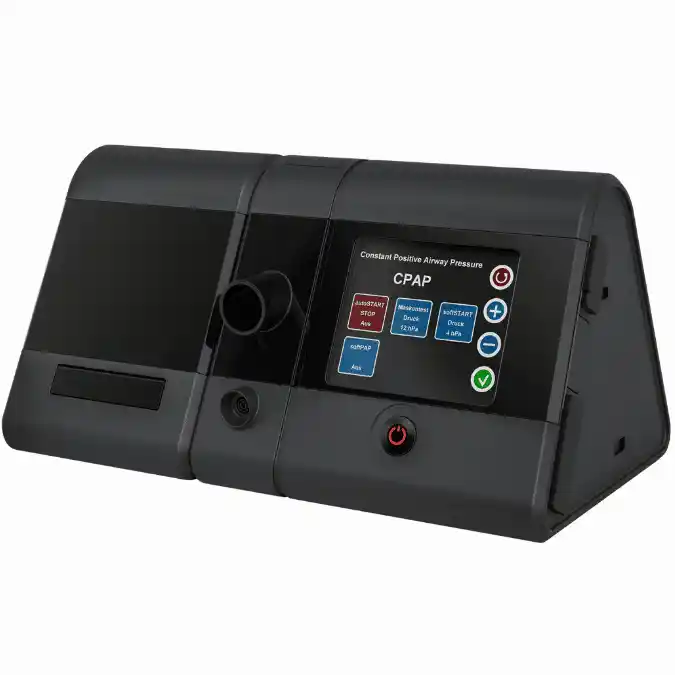
What Happens to Your Therapy Without the Humidifier?
This is the concern most articles skip over, so let us address it directly.
The humidifier in your CPAP machine is a comfort feature. It adds moisture to the pressurized air to prevent dryness in your throat, nose, and mouth. It does not affect the pressure settings that are actually treating your sleep apnea.
So when you turn off the humidifier:
- Your prescribed pressure therapy continues at the same settings
- Your airway stays open exactly as it would with the humidifier on
- Your sleep apnea is still being treated
The only thing that changes is air moisture. Some people experience mild dryness or a slightly scratchy throat, especially on the first night or two. Most people adapt within a few nights, particularly in outdoor environments where humidity is already present.
If you regularly use high humidity settings at home and find dryness uncomfortable, there is a zero-power solution called an HME filter (heat moisture exchanger). It clips between your mask and the tubing and captures your own exhaled moisture to humidify the incoming air passively, with no electricity required.
How Much Power Does a CPAP Use Without the Humidifier?
Understanding your CPAP power consumption is the foundation of choosing the right portable power station.
| CPAP Mode | Typical Watt Draw |
|---|---|
| Without humidifier or heated tubing | 30 to 60W |
| With humidifier only | 70 to 85W |
| With humidifier and heated tubing | 90 to 110W |
| Travel CPAP machines | 5 to 20W |
Real-world examples:
- ResMed AirSense 10: approximately 50 to 60W without the humidifier
- ResMed AirSense 11: approximately 56 to 73W without the humidifier
- Average across most standard CPAP machines: around 40W
The runtime formula:
Runtime (hours) = (Battery Capacity in Wh x 0.90) / CPAP Wattage
The 0.90 accounts for a 10% efficiency loss that is normal in any battery system. If you are using an AC outlet on your power station instead of a DC port, reduce that to 0.85, because AC inverters lose an additional 10 to 15%.
Example calculation:
A 500Wh power station running a 40W CPAP via DC: 500 x 0.90 = 450 usable Wh 450 / 40W = 11.25 hours of runtime
That is more than enough for a full night with capacity to spare.
How to Turn Off the Humidifier on Your CPAP
Most people do not know exactly how to do this, and competitor articles rarely explain it step by step.
For ResMed AirSense 10 and AirSense 11:
- Press and hold the home button to access the menu
- Navigate to My Options or Settings
- Find Humidifier and set it to Off or set the humidity level to 0
- Confirm and exit the menu
- Remove the water chamber or leave it empty (do not leave water sitting in it during transport)
For other brands:
The process is similar. Look for a Settings or Options menu on the device screen. Find a Humidity or Humidifier setting and reduce it to 0 or turn it off entirely.
Setting humidity to 0 is important even if you remove the water chamber. Some machines will still attempt to power the heating element if the setting remains active, wasting battery even with no water present.
Also disable heated tubing if you use it:
If your setup uses ClimateLineAir tubing or any other heated tube, switch it out for standard unheated tubing before running on battery power. Heated tubing draws its own power separately from the humidifier chamber and can add 10 to 20W on top of your base draw.
Enable airplane mode if your machine supports it:
Some ResMed models include a cellular or wireless module for remote monitoring. Turning on airplane mode disables this and saves a small but measurable amount of power, which adds up over multiple nights.
What Size Portable Power Station Do You Need?
Here is a straightforward guide based on your situation:
| Scenario | Recommended Capacity |
|---|---|
| One night, no humidifier, no other devices | 400Wh minimum |
| One night with safety margin + phone charging | 500Wh |
| Two to three nights without recharging | 600 to 800Wh |
| Multi-day camping or RV trip | 1000Wh or more |
| Power outage backup at home | 1000 to 1500Wh |
Do not go below 400Wh for a standard CPAP without the humidifier. Units under 400Wh create a tight margin that is not worth the risk for medical equipment.
Go with LiFePO4 chemistry over lithium-ion when possible. LiFePO4 (lithium iron phosphate) batteries last significantly longer in terms of charge cycles (2000 to 3500 cycles vs 500 to 800 for standard lithium-ion), maintain more stable voltage output, and are safer for sensitive electronics like CPAP machines.
AC vs DC: Why the Port You Use Matters
This is one of the most overlooked details in CPAP battery power, and it directly affects how long your charge lasts.
Most CPAP machines are designed to run on AC power (standard wall outlet). When you plug your CPAP into the AC outlet of a portable power station, the power goes through an inverter that converts DC battery power to AC. This conversion is not perfectly efficient. You lose 10 to 15% of your battery capacity in that conversion process.
If your power station has a 12V DC port and your CPAP machine has a compatible DC power cord or adapter, use it. Running on DC bypasses the inverter entirely, giving you direct, efficient power from the battery. This alone can extend your runtime by one to two hours depending on your setup.
Check your CPAP manufacturer’s website or your user manual for a compatible DC travel adapter. ResMed sells one for most of their AirSense models.
Real-World Runtime: What to Actually Expect
A CPAP user running a ResMed AirSense 10 with no humidifier and using a mid-size Jackery portable power station reported the following results over a three-night camping trip using a DC adapter and standard unheated tubing:
- Night 1: 84% battery remaining after 8 hours
- Night 2: 68% battery remaining
- Night 3: 52% battery remaining
That is three full nights of sleep therapy from a single charge, with more than half the battery left for charging phones and other devices.
This is consistent with what the math predicts: around 16% battery used per night, meaning a fully charged unit at that capacity could theoretically handle six nights of CPAP use.
6 Practical Tips to Maximize Your CPAP Runtime on Battery Power
- Set humidity to 0 in your CPAP settings, not just remove the water chamber. Some machines will still draw power to the heating element if the humidity setting remains active.
- Use a 12V DC connection instead of the AC outlet when possible. This cuts out inverter loss and adds meaningful runtime.
- Switch to standard unheated tubing. If you use ClimateLineAir or any heated hose, swap it out before your trip. Heated tubing adds its own power draw on top of the humidifier.
- Enable airplane mode if your machine has wireless connectivity. It is a small savings but worth doing.
- Use an HME filter if you struggle with dryness. It recycles your own exhaled moisture and requires zero power.
- Test at home before you rely on it. Run your CPAP on the power station for one full night at home before a camping trip or before you need it during an outage. Confirm it works with your specific machine and settings.
Portable Power Stations Worth Considering for CPAP Use
This is not a ranked product review, but here are well-regarded options across different capacity ranges that are commonly used for CPAP machines in the USA.
| Power Station | Capacity | CPAP Nights (No Humidifier) | DC Port | Battery Type |
|---|---|---|---|---|
| EcoFlow DELTA 3 Plus | 1,024Wh | 2 to 3 nights | Yes | LiFePO4 |
| Anker SOLIX C1000 | 1,056Wh | 2 to 3 nights | Yes | LiFePO4 |
| Bluetti AC70 | 768Wh | 1 to 2 nights | Yes | LiFePO4 |
| Jackery Explorer 500 | 518Wh | 1 night with margin | Yes | Lithium-ion |
| Goal Zero Yeti 500X | 505Wh | 1 night with margin | Yes | Lithium-ion |
| Medistrom Pilot-24 Lite | 154Wh | 1 night (CPAP-only device) | Yes | Lithium-ion |
The Medistrom Pilot-24 is a purpose-built CPAP battery rather than a general power station. It is FAA-approved for airline carry-on use, making it the right choice for air travel specifically. For camping and home backup, a general portable power station at 500Wh or above gives you far more flexibility.
Note on air travel: The FAA restricts lithium batteries over 100Wh in carry-on luggage without airline approval. Most portable power stations above 100Wh require prior airline permission for carry-on use. For flights, use a CPAP-specific battery like the Medistrom Pilot-24 or contact your airline directly.
Mistakes to Avoid
Buying a power station that is too small. Units under 300Wh are a gamble for a full night. The math is too tight, and battery efficiency losses can leave you without power before morning.
Leaving the humidity setting active. Even with an empty water chamber, some machines will still draw power to heat the element if the setting is not set to 0.
Using a cheap power station with unstable output. CPAP machines are sensitive to voltage fluctuations. Low-quality power stations with unstable AC output can cause your machine to shut off, run erratically, or display error codes. Stick with reputable brands that deliver clean, stable sine wave output.
Ignoring inverter loss. If you budget based on the rated battery capacity without accounting for 10 to 15% inverter loss, you may run short on power. Always use the formula above rather than trusting the manufacturer’s claimed runtime on spec sheets.
Skipping a test run. Never use a new power station for the first time on an important camping trip or during a real power outage. Test it at home first.
Frequently Asked Questions
Can you run a CPAP on a portable power station without the humidifier?
Yes. Most CPAP machines draw 30 to 60W without the humidifier. A 400Wh portable power station is enough for a full 8-hour night for most users.
Does turning off the humidifier affect CPAP therapy?
No. The humidifier adds moisture for comfort but does not affect the pressure therapy that treats sleep apnea. Your treatment continues at the same prescribed settings.
How long will a portable power station run a CPAP?
At 40W without a humidifier, a 500Wh power station using DC power will run a CPAP for approximately 11 hours. Use the formula: (Battery Capacity x 0.90) / CPAP Wattage.
What is the best portable power station for CPAP camping?
For one to two nights, a 500 to 768Wh LiFePO4 power station works well. For three or more nights or multi-device use, look at 1,000Wh units from EcoFlow, Anker, or Bluetti.
Can I use an HME filter instead of the humidifier?
Yes. An HME (heat moisture exchanger) filter captures your exhaled moisture and returns it to the incoming air passively. It requires no power and is a practical alternative for short trips.
Is it safe to run a CPAP on a portable power station?
Yes, provided the power station delivers clean, stable sine wave output. Avoid cheap units with unstable voltage. Reputable brands designed for sensitive electronics are safe for CPAP use.
What CPAP power station is FAA-approved for flights?
The Medistrom Pilot-24 Lite is one of the most widely used FAA-compliant CPAP batteries for air travel. Most general portable power stations over 100Wh require prior airline approval.
Can I charge the power station with solar panels while camping?
Yes. A 100 to 200W solar panel can replenish enough energy during the day to offset one night of CPAP use, making this setup viable for extended off-grid trips.