Most people only think about maintenance after the battery feels weaker or the display starts acting odd.
However, small choices like where it sits in summer, how long it stays at 100 %, and whether outputs are left on quietly decide the portable power station lifespan.
If you’re keeping your portable power station cool, storing it partially charged, avoiding deep discharges, and running a simple checkup schedule, you’re doing everything in your hand to improve its longevity. And you’re doing it right.
Keep doing it consistently, and you will slow capacity fade, reduce surprise shutdowns, and keep the station “ready” when an outage or trip hits.
This post includes a practical routine that fits real use if you’re in or around the U.S., from camping weekends to hurricane season prep.
What “longevity” actually means for a power station
A portable power station does not fail overnight. Instead, it gradually stores less energy, runs warmer under load, and reaches low battery faster.
In battery research and industry testing, end of life is commonly tracked at about 80 % remaining capacity, and the degradation rate shifts with temperature and state of charge. (NREL Docs)
So, how long do portable power stations last? It depends on how often it cycles and how stressful those cycles are.
That is great news, because the stress is manageable.
Early warning signs that longevity is being lost
Small symptoms are worth addressing early, because they often point to heat, connectors, or storage mistakes.
Watch for these:
- Noticeably less runtime on the same devices
- Hotter operation at loads that used to be easy
- Sudden shutdown near mid-charge
- Charging that stops unpredictably
- A battery gauge that feels “wrong” even after a full charge
If the unit swells, smells odd, shows physical damage, or was soaked, stop using it and follow the manufacturer’s safety steps.
Charging habits that protect the battery
Charging is not just “fill it up.” It is about how long the cells sit at stressful levels, and how much heat the unit builds while charging.
Start with this: if a full charge is not needed today, it is usually better not to park at 100 % for days. Many modern units have a battery management system that prevents obvious overcharge. Still, high state of charge plus warm ambient temperature is a classic aging combo.
Also, fast charging is convenient, but it often creates more internal heat. Therefore, if the unit has a “slow” or “quiet” charge mode, that mode is friendlier for longevity when time allows. Save the fastest setting for trips and emergencies.
Finally, avoid charging in extreme cold. If the station has temperature protections, it may refuse charging anyway. That is a good thing.
Practically:
- Recharge before the battery is “bottomed out” most of the time.
- Use fast charging when you need it, not as the default.
- Let the station cool down before charging if it was running a heavy load.
Storage rules that actually work
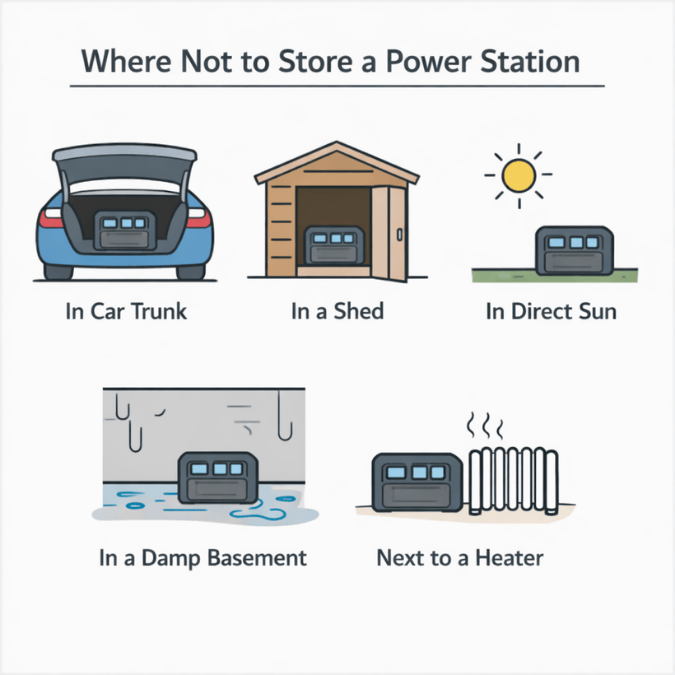
Long-term storage is where most portable stations get accidentally damaged. In the U.S., the common mistakes are leaving it in a hot car trunk in July, or in a freezing garage in January, or forgetting it for six months at a very low charge.
The safest storage approach is boring and consistent.
Store indoors, in a dry space, and not near a heat source. Keep the battery at a partial charge for multi-month storage. Many manuals land around the mid-range for state of charge, and recommend a check and top-up every few months.
If you live in a humid state or keep gear in a basement, humidity control matters too. Wipe the unit clean before storage, keep vents clear, and consider storing it in a case or bin that avoids moisture exposure.
A simple maintenance schedule
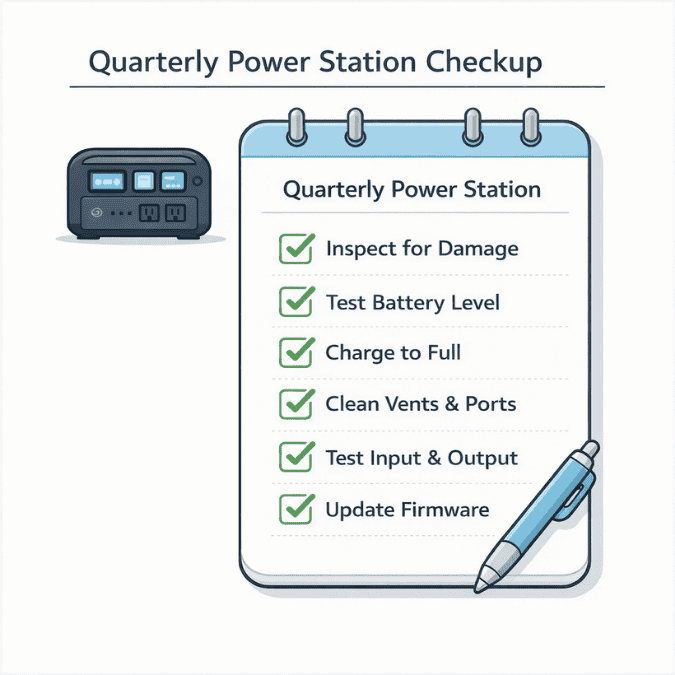
A schedule prevents the “forgot it for a year” failure mode. It also keeps the battery gauge more accurate on models that drift.
Use the table below as a baseline, then follow the brand manual if it gives a different cadence.
| When | What to do | Why it matters |
|---|---|---|
| Monthly (heavy users) | Quick visual check, wipe dust, confirm ports are clean | Prevents heat buildup and connection issues |
| Every 3 months (stored units) | Check charge, top up to a safe storage level, turn outputs on briefly | Prevents deep self-discharge and dormancy |
| Before storm season or long trips | Full inspection, full recharge, test a typical load | Confirms readiness under real conditions |
| After dusty trips | Clean vents and ports, inspect cables | Keeps airflow and connectors reliable |
Keep it cool while running, not just while storing
Heat is not only about storage. It also happens during use.
If the station is powering high-watt appliances, it needs airflow. Do not run it inside a closed tote, under a blanket, or pressed against a wall. Also, do not stack gear on it while it is working. Even if it does not shut down, running hotter for long periods accelerates wear.
A simple rule helps: if the fan is screaming, the setup needs more breathing room. Move it to shade, give it clearance, and reduce the load if possible.
Hardware care
Portable power stations live hard lives.
They ride in trunks, sit in garages, and get used around sand and dust. That is why physical care is part of battery longevity.
Clean the exterior with a soft cloth. Then clean vents and ports gently using a soft brush or compressed air, while being careful not to force debris deeper. Next, inspect cables for kinks, cuts, or loose connectors. Poor connections can create heat and voltage drops.
Also, many models draw a small amount of power when outputs are left on, even with nothing plugged in. Therefore, turn off AC and DC outputs when not in use. This alone prevents “it was 60 % last month, now it’s dead.”
Runtime basics, and the 200W and 300W confusion
Unfortunately, watts and watt-hours are mixed up.
Watts (W) are the speed of energy use. Watt-hours (Wh) are the size of the fuel tank.
So the lasting capacity of a 200w portable power station depends on its Wh capacity, not the 200W label. Many small units can output 200W, but their capacity might be 200Wh to 300Wh. That difference is everything.
A simple estimate:
Estimated runtime (hours) ≈ (Battery Wh × 0.85) ÷ Device watts
The 0.85 accounts for typical inverter and conversion losses.
Runtime for common appliances
Assumptions: 85 % usable energy, steady load.
Real-world results vary by model, temperature, and surge behavior.
| Appliance | Typical watts | 300Wh station | 500Wh station | 1000Wh station |
|---|---|---|---|---|
| Phone charging | 10W | ~25.5 hrs | ~42.5 hrs | ~85 hrs |
| Wi-Fi router | 15W | ~17 hrs | ~28 hrs | ~57 hrs |
| Laptop | 60W | ~4.25 hrs | ~7 hrs | ~14 hrs |
| LED light string | 20W | ~12.75 hrs | ~21 hrs | ~42.5 hrs |
| CPAP (no heated humidifier) | 40W | ~6.4 hrs | ~10.6 hrs | ~21.3 hrs |
| Mini fridge (average draw) | 70W | ~3.6 hrs | ~6 hrs | ~12.1 hrs |
If the goal is backup power for a fridge, the hard part is surge wattage. Many refrigerators pull a higher burst at startup. So the station must handle that surge, not only the running watts.
How long does a 300W portable power station last?
This usually means one of two things. Either the station can output 300W continuously, or it has around 300Wh of capacity. Those are not the same.
If it is a 300Wh station and you run a 60W laptop, the table shows around 4 to 5 hours. However, if you run a 300W load, the runtime can be under an hour after losses.
How long does a Jackery portable power station last?
It varies by model, battery chemistry, and how it is stored. The useful approach is to check the unit’s cycle rating and storage guidance, then follow the same habits in this guide: avoid heat, avoid deep discharge, and keep a multi-month storage routine.
If a brand recommends periodic “wake-ups” or specific storage charge levels, follow that. It is tuned to their battery management system and cells.
The biggest lifespan killers (ranked)
Heat and high charge are the slow leaks that most people miss. Deep discharges and heavy loads add the fast punches. Battery aging is known to vary with storage state of charge and temperature, and cycling wear varies with temperature and depth of discharge.
Here is the quick ranking we use when diagnosing early wear.
- Heat exposure
- Repeated deep discharge
- Long storage at 100 % or near 0 %
- Poor airflow under heavy loads
- Leaving outputs on (silent drain)
End of life and safe recycling in the U.S.
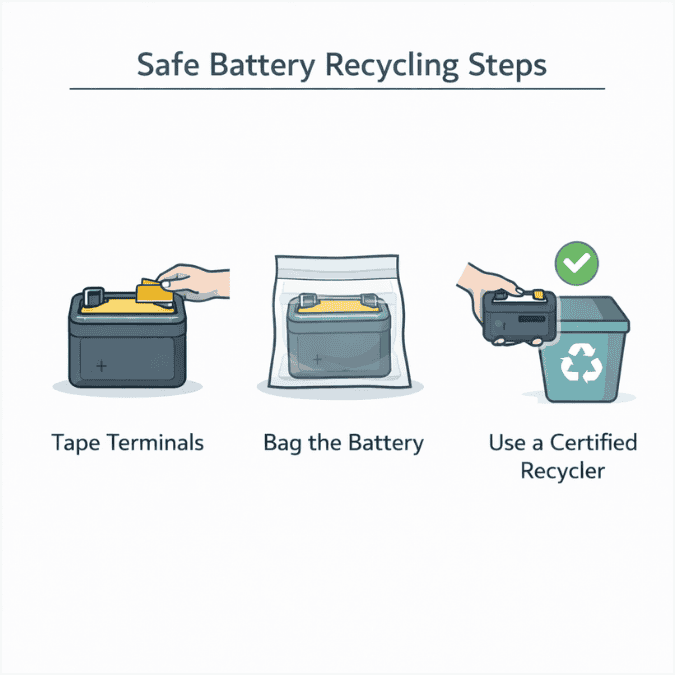
When a station is truly at end of life, recycling matters.
Lithium batteries can cause fires if crushed or damaged in trash or curbside recycling streams. The U.S. EPA recommends recycling at certified locations, and it also advises taping terminals and separating batteries to reduce short-circuit risk during handling.
Quick wrap-up
How to maintain a portable power station is mostly about reducing heat, avoiding deep discharges, and storing it at a sensible partial charge with a quarterly check.
Do that, and the station stays dependable, which is the whole point. Also, once you use the runtime method and table above, battery sizing decisions become much easier.
FAQs
How long do portable power stations last?
Portable power station lifespan is usually years; you can extend it by limiting heat and deep discharge.
How long does a portable power station last if I only use it for camping?
If you only camp, fewer cycles and cooler storage usually mean a longer lifespan.
How long can a portable power station run a refrigerator/router/CPAP? (U.S. 120V context)
Use Wh divided by W with losses; 120V fridges need surge headroom; CPAPs often use 30 to 60W.
Should I keep my power station plugged in all the time?
For emergency readiness, you can keep it plugged in; otherwise, unplug after full to reduce wear.
What’s the best storage charge percentage for long-term storage?
To maintain a portable power station in storage, keep 40% to 60% charge and top up quarterly.