A portable power station which has the highest continuous AC output that still qualifies as a consumer portable unit, meaning it is wheeled or movable, plug-and-play, and does not require a permanent installation, is the most powerful portable power station you can buy in the U.S.
Today, that “top tier” is a 7.2 kW class system from a single inverter unit, which is enough to run many high-draw household loads that smaller stations cannot.
You’re wondering about this because you want to stop guessing. You want to know what can actually run a fridge, a sump pump, a space heater, or even an AC, and for how long.
This post explains what “powerful” really means, how to size your needs, and how to pick the right unit without wasting money or buying something that cannot start your appliances.
The most powerful tier
At the top end, a single unit delivering roughly 7.2 kW continuous AC output is currently the benchmark for “as powerful as portable gets” for consumer power stations. That level of output is strong enough to handle multiple heavy appliances at once, and it can cross into central-air territory depending on the system and home setup.
One example of this tier is the EcoFlow DELTA Pro Ultra, which advertises 7.2 kW output from one inverter and the ability to scale significantly with additional components.
However, “most powerful” is not only about one number.
A unit that can output huge watts but cannot recharge fast, or cannot support the voltage you need, will disappoint quickly.
Quick sizing for homes and camping
Start with your “must-run” list, then add one convenience load. After that, choose a power station that comfortably clears both running watts and starting watts.
Typical loads to help with output and runtime
Here is a fast way to estimate, without turning this into an engineering project.
If you’re not sure what wattage your appliances actually draw, the U.S. Department of Energy (DOE) explains reliable ways on estimating appliance and home electronic energy use.
| Device or use | Typical running watts | Typical starting surge | What this means for selection |
|---|---|---|---|
| Refrigerator (standard) | 100–300W | 600–1200W | Surge headroom matters more than big battery |
| Sump pump (1/3 hp) | 800–1200W | 1500–3000W | Needs strong inverter, not just capacity |
| Microwave | 900–1500W | Low surge | Output watts determines usability |
| Space heater | 1500W | Low surge | Output watts and battery size both matter |
| Window AC | 500–1500W | 1500–3000W | Many mid units fail at startup |
| CPAP | 30–90W | Low surge | Battery and DC output options matter most |
| Induction cooktop | 1200–1800W | Moderate | High draw, drains batteries quickly |
This is why deciding on the best portable power station depends on the load mix.
A camping setup can be “best” at 800W and 800Wh. A home backup setup can be useless at those numbers.
“Powerful” has three meanings
Most shoppers mix these up, so the purchase goes sideways.
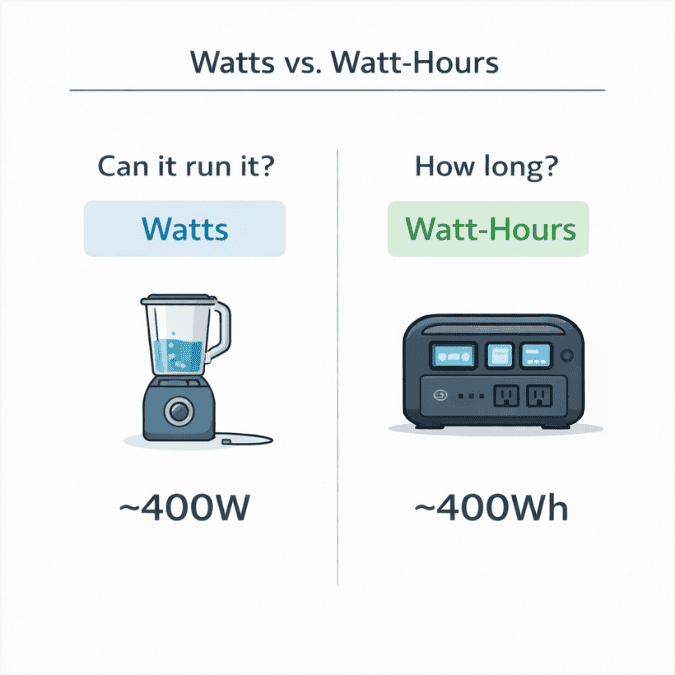
- First is output power, measured in watts (W). This decides what you can run at one moment, and whether you can start motors.
- Second is energy capacity, measured in watt-hours (Wh) or kilowatt-hours (kWh). This decides how long you can run things.
- Third is voltage capability and system behavior, usually 120V only versus 120V and 240V. This decides whether you can support certain home circuits and larger loads.
If the goal is “the biggest, strongest unit,” output watts is the main deciding factor.
However, runtime and voltage still matter, because a high-watt unit with a small battery will feel powerful for five minutes.
A simple way to compare top-end systems
Instead of reading ten spec sheets, compare using the same scorecard every time.
Output muscle: This is continuous watts first. Then check surge behavior and whether the unit is known to start motor loads reliably.
Energy you can actually use: Capacity is the runtime fuel. For outage backup, this matters as much as watts.
Voltage and ports: If you need 240V for certain circuits, you need a system designed for it. If you are camping, you usually do not.
Recharge path: Fast AC recharge and meaningful solar input are what turn a big battery into a practical tool.
Two “high-output” reference points
This is not a “best list.” It is a reality check showing what the high-output end looks like today.
| Model (reference examples) | Continuous AC output | Starting capacity | Expandability angle | Best fit |
|---|---|---|---|---|
| EcoFlow DELTA Pro Ultra | 7.2 kW | Modular system | Designed to scale far beyond a single battery | Heavy home backup, high-load needs |
| Anker SOLIX F3800 | 6.0 kW | Large single-unit output | Expandable ecosystem with 120V and 240V support | Home backup plus RV, strong “all-rounder” power |
So if you’re thinking about the most powerful portable power station, the 7.2 kW class sits above the 6.0 kW class on raw output.
Camping choice: balancing power and portability
So now, which portable power station is best for camping? Or, which one will feel easy to carry and still run the fun stuff?
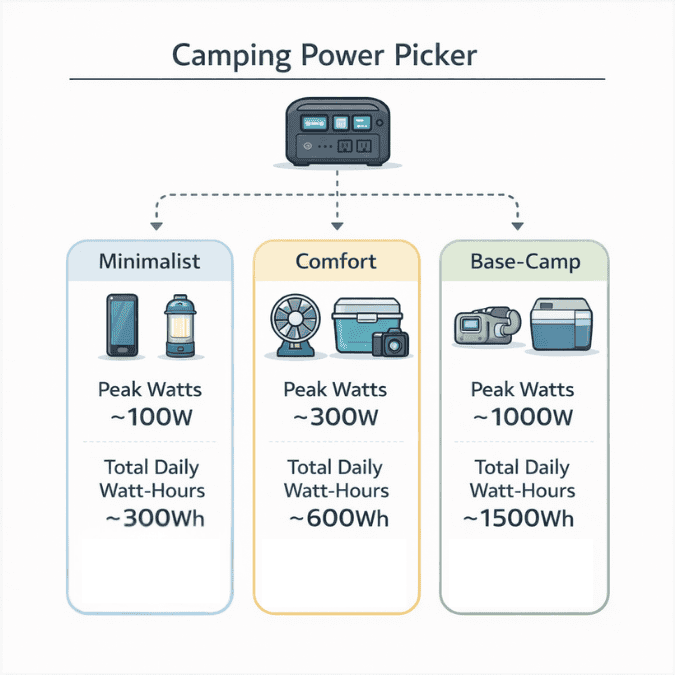
A practical camping strategy is to pick the smallest unit that runs your peak load, then size capacity to your nights.
For example, a weekend base-camp often wants enough output for a cooler, lights, charging, and one high-draw item like a coffee maker. Then it wants enough capacity to avoid anxiety overnight.
Feature checklist
Use the following checklist once, and shopping becomes simple.
- Output: continuous watts above your peak running load, plus surge headroom for motors
- Battery: enough Wh for your target runtime, and preferably a chemistry designed for long life
- Ports: the outlets you will actually use, including DC options if you run low-watt devices overnight
- Charging: AC recharge time that fits your routine, plus solar input that matches your panel plan
- Voltage: 120V only for most camping, 120V and 240V capability when home circuits require it
- Practical build: wheels or handles if it is heavy, clear display, predictable controls, solid warranty support
Two mistakes you need to avoid
First, people buy by battery size alone. Then the unit cannot start the appliance they care about.
Second, people buy by watts alone. Then they realize the runtime is short, and the recharge plan was never thought through.
When “most powerful” becomes the wrong goal
This sounds blunt, yet it saves money.
If the use case is camping, the most powerful unit is usually a bad buy. It is heavier, it is harder to move, and it pushes you into bigger solar panels and bigger charging gear.
Meanwhile, most camping loads are low to moderate and benefit more from a smart balance of capacity and portability.
If the use case is home backup, “powerful” is only meaningful when paired with a plan.
That plan includes where the unit sits, how it is ventilated, how it recharges, and how you will safely power home circuits.
Bottom line
If “powerful” means maximum output, the current top tier of portable units reaches 7.2 kW class output from a single inverter, which is a meaningful jump for high-load home backup use.
However, the smartest purchase is the one sized to your peak load, your desired runtime, and your recharge plan.
That’s how you get a setup that feels dependable instead of impressive only on paper.
FAQs
What is the most powerful portable power station in the world?
If “power station” includes installed home energy storage, the numbers go far beyond portable. This article stays in the portable category, meaning movable, plug-and-play systems.
What is the best portable power station on the market?
For outages, prioritize high watts and 240V; for camping, prioritize lighter LiFePO4 and enough Wh.
Which portable power station is best for camping?
The best portable power station for camping fits your peak watts and carry weight, not max output.
Who makes the best / highest rated portable power station?
Highest rated portable power station brands score well on measured output, charge speed, portability, and features.
What’s the recommended portable power station for camping (balancing power and portability)?
Recommended portable power station for camping: 1000–2000W, 700–1200Wh, under ~40 lb, fast recharge.