When you think about taking power to the camping, you want quiet, clean power that keeps your essentials running without carrying a noisy gas generator.
Whether you’re charging phones, running a mini fridge, powering lights, or keeping your laptop alive in a campsite, the right power station makes all the difference.
Here, we have covered the best portable power stations for camping, including how to choose a power station that fits your style and needs, which models stand out in 2026, and why these units are worth your money when compared with older tech and noisy generators.
What to Look for in a Camping Power Station
Battery Capacity
This is measured in watt‑hours (Wh). Higher Wh means longer run time for more devices.
For example, lights and phones might only need several hundred watt‑hours, while running a fridge or CPAP overnight pushes you above 500Wh.
Output Power
Measured in watts (W), this determines what devices the station can drive. Larger appliances need more continuous power.
Battery Chemistry
LiFePO₄ (lithium iron phosphate) is now the most recommended for camping because it lasts much longer and is safer than older lithium‑ion batteries.
Recharge Options
Look for fast AC recharging and solar compatibility. Some stations can recharge from zero to full in about an hour, which is ideal if you’re moving campsites.
Port Variety
More ports mean more devices at once. Most modern stations include AC outlets, USB‑C, USB‑A, and a 12 V car port for versatile charging.
Comparison Table
Here’s a snapshot of the best portable power stations featured in this post:
| Model | Capacity (Wh) | Output (W) | Weight | Best Use | Price |
|---|---|---|---|---|---|
| Jackery Explorer 1000 v2 | 1070 Wh | 1500 W | ~24 lb | All‑around camping | See Price Here |
| EcoFlow RIVER 2 Max | 512 Wh | 500 W (1000 W surge) | ~13 lb | Balanced daily use | See Price Here |
| Anker SOLIX C300 | 288 Wh | 300 W (600 W surge) | ~15 lb | Compact trips | See Price Here |
| Anker 535 PowerHouse | 512 Wh | 500 W | Medium | Multi‑port versatility | See Price Here |
| BLUETTI EB3A | 268 Wh | 600 W (1200 W surge) | ~10 lb | Ultra portable | See Price Here |
We’ll break down what each unit excels at next.
Best Portable Power Stations for Camping
Jackery Explorer 1000 v2 | Best Overall for Camping
Category: Large‑capacity camping power station
Key Features: 1070 Wh high‑capacity LiFePO₄ battery, 1500 W continuous AC output, Ultra‑fast charging, Multiple output options: AC, USB‑C (100 W), USB‑A, DC car port plus built‑in LED, Lightweight ~23.8 lb design with foldable handle.
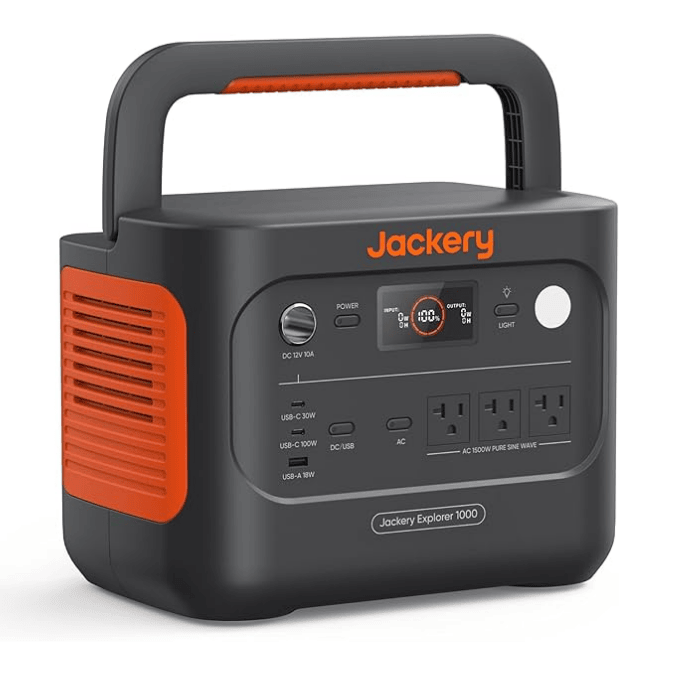
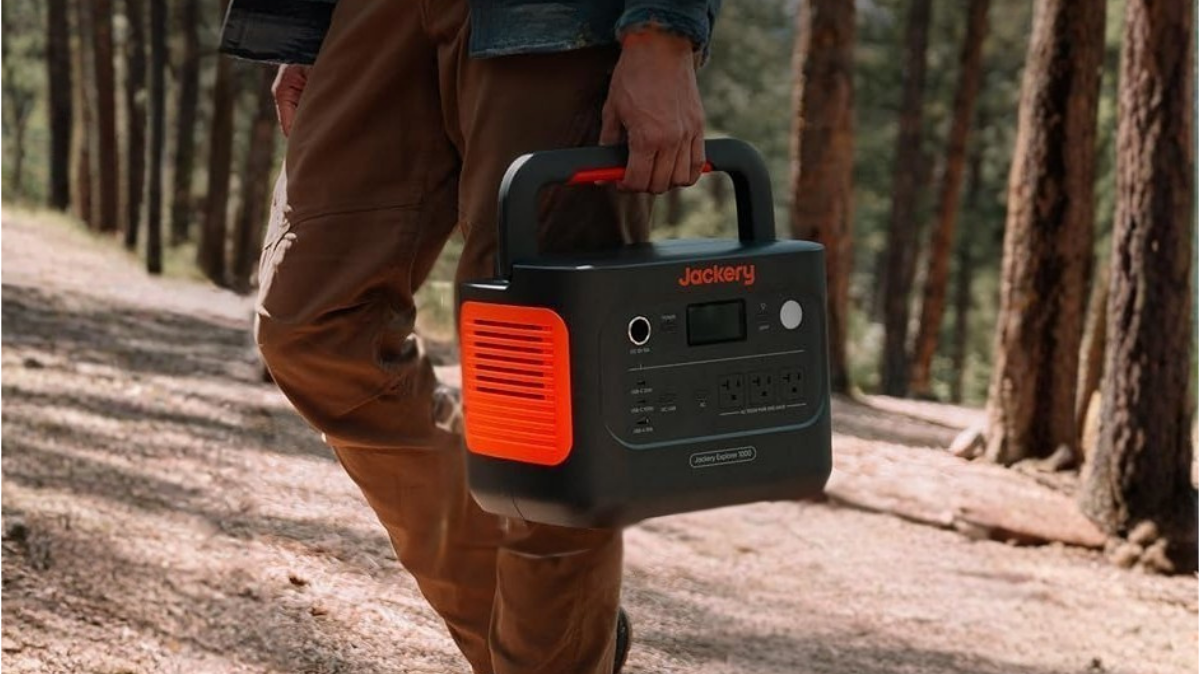
The Jackery Explorer 1000 v2 is one of the most powerful and versatile portable power stations for camping and off‑grid use in 2026.
This power station earns its spot for delivering big, reliable power in a manageable size. With approximately 1070 Wh capacity, it can run laptops, lights, small fridges, and more without slowing down. Its 1500 W pure sine wave AC output ensures safe delivery for sensitive electronics, and the durable LiFePO₄ battery chemistry supports thousands of cycles before capacity drops. Its fast charging technology gets you back to full power faster than most rivals.
Portability is a strength for its class. While not as light as small models, its ~24 lb heft is manageable for base camp, camper van, or RV setups, especially with the ergonomic handle. Advanced safety features like ChargeShield 2.0 deliver protection against overheat and overcurrent situations, and the companion app lets you monitor usage and switch between charging modes easily.
The Explorer 1000 v2 is consistently praised for its balance of power, speed, and durability, the kind of stuff that’s ideal for camping, weekend adventures, or emergency backup at home.
Because it balances performance and usability so well, this is a top recommendation for both car camping and longer trips.
Pros and Cons
| Pros | Cons |
|---|---|
| Very fast charging (≈1 h with emergency mode) | Requires app for fastest charging mode |
| High 1500 W AC output handles more devices | Heavier than smaller units (~24 lb) |
| Durable LiFePO₄ battery with long lifespan | |
| Multiple port types for all gear |
Best for: Campers and RV travelers who want a powerful station for multiple devices.
Skip if: You need a lightweight base‑camp unit under ~15 lb.
👉 If you’re considering smaller Jackery models, the Jackery Explorer 300 offers a great entry-level solution for short camping trips or light travel.
EcoFlow RIVER 2 Max | Most Balanced Mid‑Size Pick
Category: Mid‑size camping power station
Key Features: 512 Wh LiFePO₄ long‑life battery, Up to 500 W AC output, Ultra‑fast 1‑hour recharge with AC wall outlet; supports solar, car, and USB‑C charging, Lightweight ~13.3 lb (≈6.1 kg) portable design, Smart app control (Wi‑Fi/Bluetooth) and advanced battery protection system.
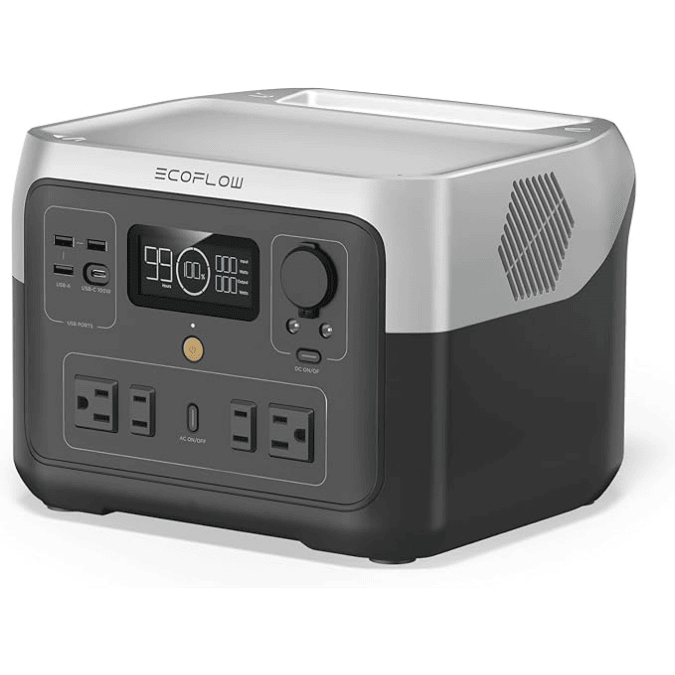
The EcoFlow RIVER 2 Max balances capacity, portability, and power for camping, RV travel, and everyday outdoor activities.
For campers looking for portability and power balance, this power station actually checks all the boxes. Its 512 Wh LiFePO₄ battery and up to 500 W continuous output are ideal for weekend trips, charging cameras, running LED lights, and powering smaller appliances.
Ultra‑fast AC recharge in about an hour means you won’t be stuck waiting for power between stops. EcoFlow’s smart app control and robust safety management make this an excellent all‑purpose unit for frequent outdoor use.
With up to 1000 W surge output through X‑Boost, the RIVER 2 Max can handle heavier loads than many similarly sized units, meaning you get more flexibility when running small appliances or power tools during outdoor use.
The inclusion of multiple charging and output options – AC outlets, USB‑C, USB‑A, and DC ports – makes it a go-to for powering a variety of devices and gadgets.
Pros and Cons
| Pros | Cons |
|---|---|
| Ultra‑fast 1‑hour AC recharge | Fan can be audible under heavier loads |
| X‑Boost up to 1000 W surge power | Capacity may be limited for long multi‑day runs |
| Long‑cycle LiFePO₄ battery (~3000 cycles) | |
| Lightweight ~13.3 lb for its class |
Best for: Weekend campers and outdoor travelers who want a solid mix of capacity and portability.
Skip if: You need high capacity for fridge‑level loads overnight.
Anker SOLIX C300 | Best Compact Camping Power Station
Category: Compact camping power station
Key Features: 288 Wh LiFePO₄ battery rated for over 3,000 cycles, 300 W continuous / 600 W surge output, Fast recharging: Dual USB‑C PD 3.1 ports can recharge to ~80 % in about 50–60 min; supports solar panel and car charging, Quiet and portable: ~25 dB operation quieter than a whisper; easy to carry, Multiple ports: AC outputs, USB‑C, USB‑A, and car socket.
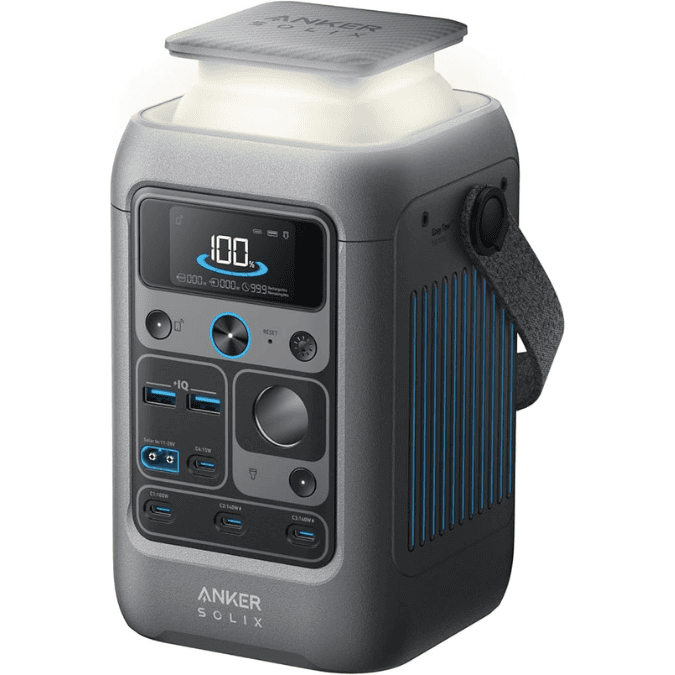
If you want a compact unit that’s still powerful enough for everyday camping, the Anker SOLIX C300 fits perfectly.
It’s one of the most capable compact portable power stations for camping in 2026. With 288 Wh capacity and 300 W continuous output, it’s excellent for phones, tablets, cameras, lights, and some small appliances. The LiFePO₄ battery means long life, and dual USB‑C fast charging keeps you fueled quickly. Also, its chemistry means this unit will keep performing for years with hundreds of charge cycles, a strong advantage over many smaller power banks.
This station also handles a surge of up to 600 W, giving it flexibility despite its small size. It is quiet and lightweight, making it a favorite for solo campers or as a backup power option.
Pros and Cons
| Pros | Cons |
|---|---|
| Very fast recharge (≈80 % in ~50–60 min) | Solar panel and charging accessories sold separately |
| Quiet operation (≈25 dB) ideal for camp | 300 W output limits heavy appliance use |
| Long‑lasting LiFePO₄ battery (3,000+ cycles) | |
| Multiple ports for versatile device charging |
Best for: Solo campers and weekend travelers who need portability without compromising on basic power.
Skip if: You plan to run heavier devices like mini‑fridges for long periods.
Anker 535 PowerHouse | Best All‑Purpose Multi‑Port Station
Category: Mid‑size compact camping power station
Key Features: 512 Wh LiFePO₄ battery with 3,000+ cycle life, 500 W continuous AC output (750 W surge), 9 output ports including 4 AC outlets, 3 USB‑A, 60 W USB‑C PD, and car port, LED display and built‑in lights, Fast recharge options via adapter and USB‑C; supports solar input with MPPT (Maximum Power Point Tracking).
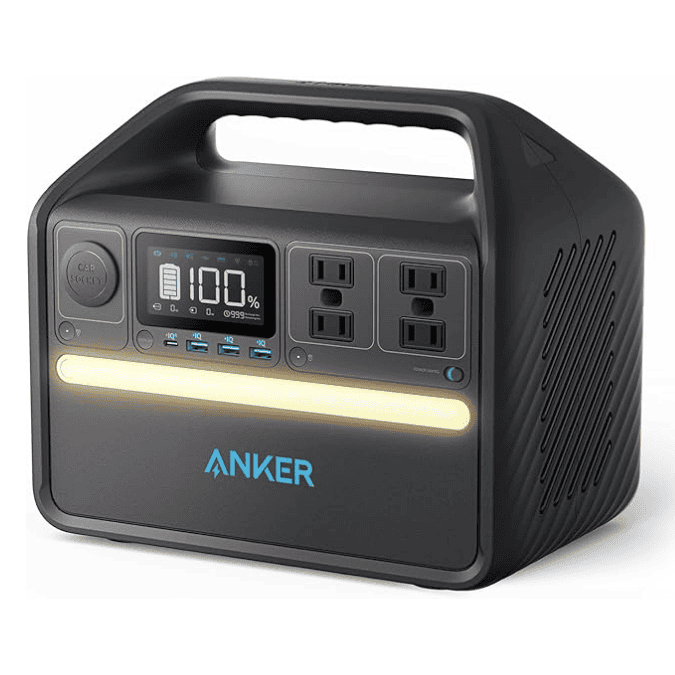
The Anker 535 PowerHouse strikes a strong balance between capacity, port versatility, and portability, making it an excellent all‑around choice for camping, RV trips, and outdoor emergencies.
Its 512 Wh LiFePO₄ battery delivers durable performance that outlasts many competitors, and the array of four AC outlets plus multiple USB and car ports lets you power everything from mini‑fridges and laptops to phones and lights without juggling adapters. This means you can power multiple devices – phones, laptops, and lights – at the same time.
Users highlight its reliable multi‑device support and rugged build quality, with the station performing well for extended device charging and small appliance support.
Safety features such as battery management systems and pure sine wave AC output ensure stable and protected charging for sensitive electronics.
The built-in LED display and lights add practical convenience at a campsite, and the system supports solar panel input for eco‑friendly recharging. This makes it a strong multi‑purpose option for varied outdoor activities.
Pros and Cons
| Pros | Cons |
|---|---|
| LiFePO₄ battery with long lifespan (~10 yr) | Continuous 500 W output won’t run heavy appliances |
| Multiple output ports (4 AC, USB‑A, USB‑C, car) | Slower solar recharge in less ideal conditions |
| LED display and built‑in light for camping convenience | |
| Solid build quality with quiet operation |
Best for: Campers who want to power multiple devices with a balanced set of features.
Skip if: You want maximum surge power or very high continuous output.
BLUETTI EB3A | Best Ultra‑Portable Compact Unit
Category: Ultra‑portable compact camping power station
Key Features: 268 Wh LiFePO₄ battery with ~2,500+ cycles to 80% capacity, 600 W continuous / 1200 W surge pure sine wave output, Ultra‑fast recharge, Versatile output ports: 2 AC outlets, USB‑C 100 W PD, USB‑A ports, 12 V car port, DC5521 ports, and a 15 W wireless charging pad, Compact and lightweight (~10.1 lb) with built‑in handle.
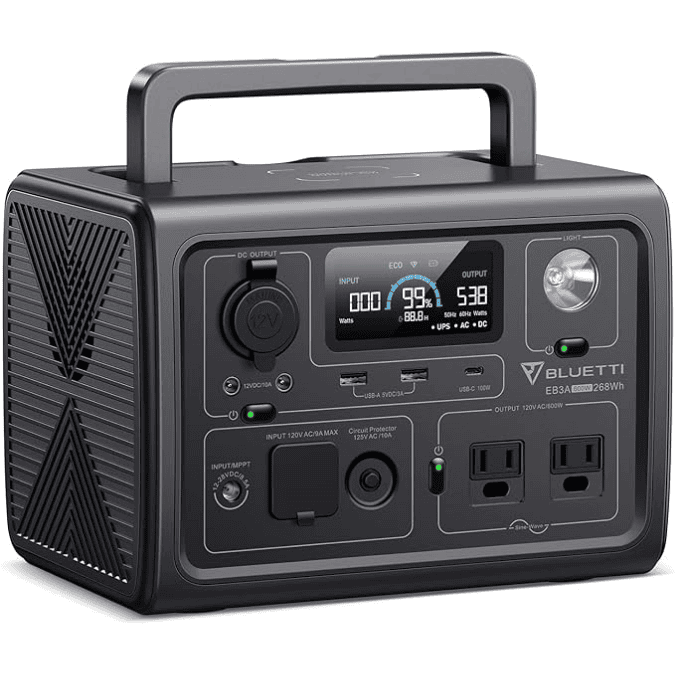
The BLUETTI EB3A is a standout ultra‑portable power station in 2026 for campers, travelers, and outdoor adventurers who want quick, usable power without bulk.
For campers who prioritize weight and portability but still want meaningful power, this power station is ideal. Its 268 Wh capacity and 600 W continuous output keep phones, lights, and laptops going, and it charges from 0 to approximately 80 % in about 30 minutes.
The pure sine wave inverter and 600 W continuous output mean you can power a range of devices – phones, tablets, laptops, lights, and even small fridges or fans – within its wattage limits.
This unit is among the lightest reviewed here, making it easy to transport on hikes or car trips. Optional solar compatibility increases its utility off‑grid, though panels are sold separately.
Pros and Cons
| Pros | Cons |
|---|---|
| Very fast recharge (0–80 % in ~30 min) | Fan noise can be noticeable under load |
| Solid 600 W continuous output | Higher‑draw appliances still drain quickly |
| Long‑lasting LiFePO₄ battery (~2,500+ cycles) | |
| Light and highly portable (~10 lb) |
Best for: Campers and travelers who want a highly portable solution with fast recharging.
Skip if: You need long runtime for high‑draw appliances.
Why Portable Power Stations Matter for Camping
Portable power stations have reshaped outdoor power.
They are silent, emission‑free, and let you plug in devices just like at home. Many campgrounds and parks have restrictions on gas generators, and campers increasingly prefer power solutions that are safe, lightweight, and reliable.
They are especially useful in the U.S. where camping styles range from car camping in national forests to weekend RV trips and remote backcountry excursions.
Recent tests indicate while marketing often pushes large 1000Wh units, many campers actually use between 180 and 250 Wh on a weekend trip when focusing on essentials.
Therefore, capacity, output, recharge speed, and battery chemistry… these are the critical metrics that will help you get the most value for your investment.
Choose the Right Station for Your Camping Style
Every camper’s power needs are different. If your trip involves only phones and small electronics, smaller <300Wh stations are often sufficient and save weight. For car camping with fridges or CPAP machines, a 500Wh+ unit gives better uptime without frequent recharging. For extended stays or powering larger loads, even larger systems beyond this list may be worth exploring.
Field testing suggests typical weekend campers may not need massive capacity, but capacity over 500 Wh adds comfort and flexibility.
Final Thoughts
Choosing the best portable power stations for camping in 2026 comes down to balancing capacity, portability, and how you plan to use it. The five stations above cover all major use cases, from ultra‑portable everyday units to all‑purpose camping powerhouses.
👉 For those seeking a lightweight yet powerful portable power station, the Jackery Explorer 500 might be a better fit as it offers portability with enough power for everyday camping needs.
Investing in a reliable station means more freedom on your outdoor trips and less worry about dead batteries and quiet nights without light.
FAQs
What capacity do I need for camping?
This depends on your devices. For phones, lights, and small gadgets, ~200‑300 Wh works well. For refrigerators, CPAP machines, or longer stays, 500 Wh+ is recommended.
Can portable power stations run mini fridges?
Yes, many can run a mini fridge depending on their continuous output and battery size. Always check the fridge’s power draw and compare it with the station’s rated output.
Are power stations better than generators for camping?
In most cases yes. They are silent, emission‑free, and allowed in more campsites. Traditional gas generators are louder, heavier, and require fuel management.