
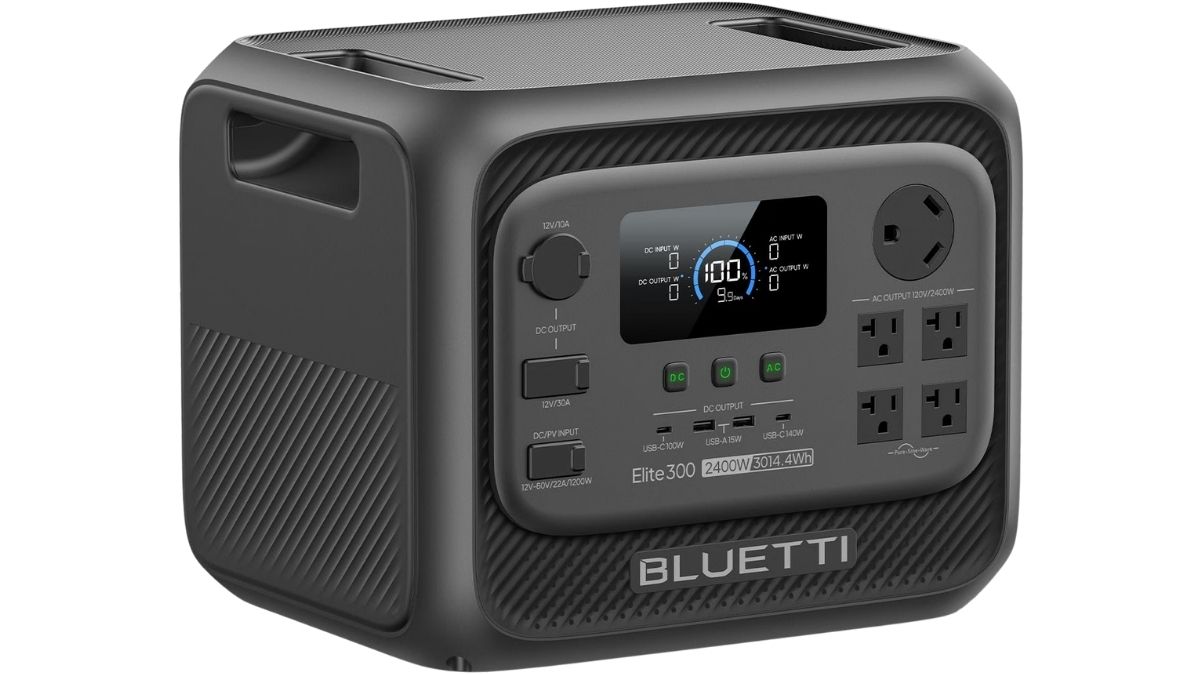
The BLUETTI Elite 300 Portable Power Station for RV & Home Backup is built for users who want roughly 3kWh of portable energy without moving into a much larger battery system. Its 3,014.4Wh capacity, 2,400W AC output, RV-focused features, and compact design make it an interesting option for camping, van travel, and selected home backup needs. The trade-off is that the fixed battery capacity and nearly 58-pound weight limit how easily it fits every situation.
Quick Take
The BLUETTI Elite 300 is a strong fit when you need a high-capacity portable power station that can handle more demanding loads than smaller units. I see its biggest advantage as the balance between 3kWh-class storage and a portable enclosure, especially for RV users who want a simpler setup.
The main drawback is that this is not an expandable battery platform. You get the built-in capacity, so users who need multiple days of additional storage may prefer a different approach. The weight also matters if you expect to move the unit frequently.
Best fit: RV users, van travelers, off-grid setups, and home backup users powering selected devices.
Main concern: The fixed capacity means you need to plan your loads carefully.
Skip it if: You need a lightweight station or a system that grows with additional batteries.
What Are the BLUETTI Elite 300 Specs?
The Elite 300 is designed around higher-capacity portable backup rather than ultra-light travel. Capacity, output, recharge limits, and weight all affect whether it matches your intended use.
| Specification | Verified value |
|---|---|
| Battery capacity | 3,014.4Wh |
| Battery chemistry | LiFePO4 |
| Continuous AC output | 2,400W |
| Surge output | 4,800W |
| Solar input | Up to 1,200W |
| AC charging | Supported through wall charging modes |
| UPS function | Supported with manufacturer-rated switching behavior |
| Weight | About 58 lb |
Why the Elite 300’s 3kWh-Class Capacity Matters
The Elite 300’s main selling point is not just its watt rating. The 3,014.4Wh battery gives you more stored energy for longer operating periods, while the 2,400W inverter determines what devices you can run at the same time.
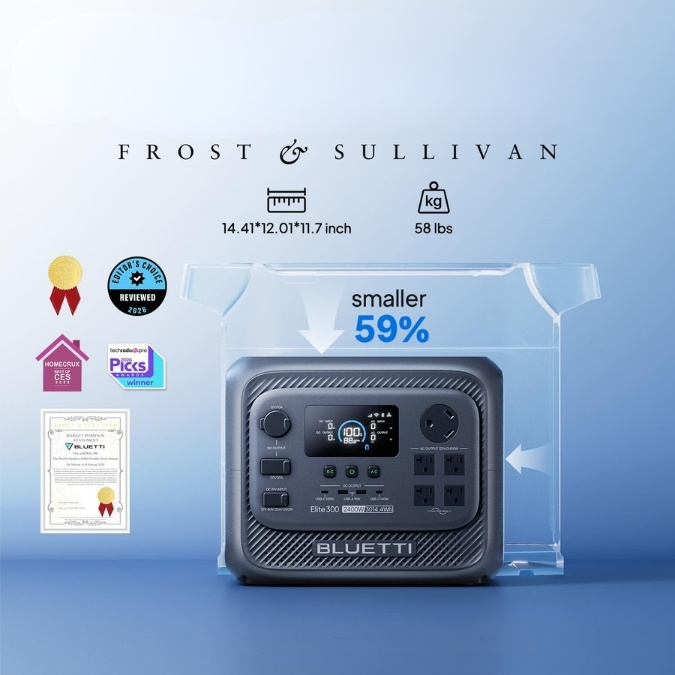
Why Compact 3kWh Capacity Helps RV and Backup Planning
For RV users, stored energy can reduce reliance on campground hookups or frequent charging stops. A larger battery reserve also gives you more flexibility when solar conditions are inconsistent.
The trade-off is physical size. A larger battery always creates a balance between runtime, portability, and storage space.
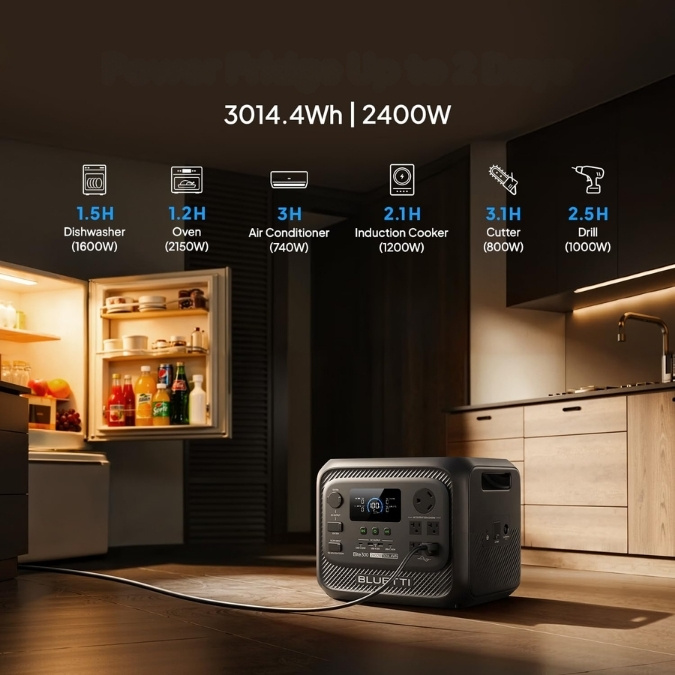
What Can the BLUETTI Elite 300 Actually Run?
The Elite 300’s 2,400W continuous output gives it room for many common appliances, but the battery capacity and device startup requirements still determine real performance.
- Small electronics and networking equipment can use only a small portion of the available battery.
- Refrigerators require checking both running demand and compressor startup surge.
- Heating appliances consume energy quickly because they convert electricity into heat.
- Power tools and motor-driven equipment need surge planning before connection.
For runtime planning, I separate stored energy from delivered energy. The 3,014.4Wh rating is the battery capacity, not the exact amount of AC energy available after conversion losses.
The calculation is:
Estimated runtime = usable energy (Wh) ÷ average load (W)
Without a product-specific independent usable-energy measurement, I use an 80%-90% planning assumption:
Estimated usable AC energy = 3,014.4Wh × 80%-90%
| Average load | Estimated runtime range |
|---|---|
| 50W | About 48-54 hours |
| 100W | About 24-27 hours |
| 500W | About 4.8-5.4 hours |
| 1,000W | About 2.4-2.7 hours |
These are planning estimates; actual results depend on inverter efficiency, temperature, battery condition, reserve settings, and whether the connected device cycles on and off.
Charging the BLUETTI Elite 300: AC, Solar, and Vehicle Options
The Elite 300 supports multiple charging paths, which is important for RV and off-grid use. The right charging setup depends on how quickly you need to recharge and what power sources are available.
AC Charging Performance
Wall charging is the fastest and most predictable recharge method. For backup planning, I would focus less on the headline charging speed and more on whether your available outlet and schedule allow the station to refill before the next use.
Solar Input Limits and Panel Matching
The Elite 300 supports solar charging up to 1,200W, but the panel setup must remain within the station’s voltage and current limits. A larger solar array does not automatically mean faster charging if the electrical characteristics do not match.
For solar planning, check your panel open-circuit voltage, operating voltage, and current before connecting panels. This matters because exceeding input limits can damage equipment.
Vehicle Charging for RV Users
Vehicle-based charging can help maintain the battery while travelling, but the charging speed depends on the available vehicle power source and charging equipment. RV users should plan around actual recharge opportunities rather than assuming driving time alone will restore a large battery.
RV Features: TT-30 Output and 12V Support
The BLUETTI Elite 300 stands out from many general-purpose power stations because it is designed with RV users in mind. The combination of higher battery capacity, AC output, and RV-focused connections makes it easier to integrate into mobile power setups.
Direct RV Connection
The RV-oriented outlet can simplify temporary power setups where you want to connect selected RV systems without installing a permanent battery system. You still need to confirm your RV’s electrical requirements and any grounding considerations before use.
For users comparing portable options for travel, the Elite 300 fits the same broader category as other portable power station comparisons, where output, charging, and portability matter more than one headline specification.
High-Current DC Output
The 12V output options are useful for RV equipment and DC devices that do not need inverter conversion. Using DC power directly can reduce conversion losses compared with running the same device through AC power.
The important point is matching the output type to the equipment you actually use. More ports do not automatically mean every device can run simultaneously at maximum output.
Battery Chemistry and Long-Term Lifespan
The BLUETTI Elite 300 uses LiFePO4 battery chemistry, which is common in newer portable power stations because of its cycle-life characteristics. The manufacturer lists a 6,000+ cycle claim under stated conditions.
A cycle-life number is not the same as a warranty promise or a guarantee of identical performance over years of use. Storage conditions, charging habits, temperature, and depth of discharge all affect long-term battery behavior.
BLUETTI Elite 300 Pros and Cons
| Pros | Cons |
|---|---|
| Large 3,014.4Wh battery capacity | Nearly 58 lb weight limits frequent carrying |
| Strong 2,400W AC output | Battery capacity cannot be expanded |
| RV-focused connection options | |
| Multiple charging and control options |
BLUETTI Elite 300 vs Alternatives
The Elite 300 is easiest to understand when compared with similar use cases. A larger battery is not always better if the added weight or lack of portability changes how you use the unit.
BLUETTI Elite 300 vs BLUETTI Elite 400
The Elite 400 is the more capacity-focused choice for users who prioritize longer runtime over a smaller footprint. The Elite 300 makes more sense when compact 3kWh-class storage is the priority.
If your main goal is powering larger loads for longer periods, the additional capacity of a larger model may justify the trade-off. If you frequently move the unit, the Elite 300’s size advantage becomes more important.
BLUETTI Elite 300 vs BLUETTI Elite 200 V2
The Elite 200 V2 comparison comes down to the balance between capacity, portability, and intended use. The Elite 300 provides a larger energy reserve, while a smaller model may be easier to transport for shorter trips.
For readers comparing different BLUETTI options, the BLUETTI Elite 100 V2 review provides additional context on the brand’s smaller portable options.
BLUETTI Elite 300 vs Larger Home Backup Systems
A portable power station can cover important loads without the installation requirements of a permanent backup battery. However, larger installed systems remain better suited for users who need automatic whole-home backup or significantly more stored energy.
Before choosing a station for outage planning, I recommend using a power requirement calculator to estimate your actual load instead of relying only on appliance labels or battery capacity numbers.
| Feature | BLUETTI Elite 300 | Alternative class |
|---|---|---|
| Battery capacity | 3,014.4Wh | Varies by model |
| AC output | 2,400W | Varies by model |
| Portability | Portable but heavy | Depends on capacity |
| Expansion | Fixed battery capacity | Some systems support expansion |
| Best fit | RV and portable backup | Depends on design goal |
Buying Guide
The right portable power station depends on your actual loads, charging opportunities, and how you plan to move the unit. The Elite 300 has strong specifications, but the best choice depends on whether those specifications match your situation.
Start With Your Real Power Needs
List the devices you need during an outage or trip and separate average running power from startup demand. Refrigerators, pumps, compressors, and power tools can require extra surge capacity when starting.
Match Solar Input to Your Panel Setup
If solar charging is part of your plan, confirm that your panels match the station’s input limits. Maximum panel wattage alone does not determine compatibility.
Consider Weight and Storage
A larger battery gives you more flexibility, but it also increases the physical burden of transport. The Elite 300 works best when you have a realistic place to store it and a practical way to move it.
Compare Backup Needs Before Buying
For users building a broader home backup plan, compare your needs with options listed in guides covering portable power stations for home backup. A portable station can be useful for essential devices, but it should match the specific loads you expect to support.
Is the BLUETTI Elite 300 Worth It?
The BLUETTI Elite 300 makes the most sense when you need more energy storage than compact camping stations provide but still want a unit you can transport. The 3,014.4Wh battery gives you useful backup capacity for electronics, refrigeration planning, RV equipment, and selected appliances.
I would not treat the Elite 300 as a replacement for a permanent home battery system. Its value comes from flexibility. You can store it, move it, recharge it, and use it where needed without installing a larger system.
Who This Power Station Is Actually Built For
The Elite 300 is especially suited to RV and van users because the design focuses on portable energy with higher output capability. The RV-oriented features make it easier to integrate into mobile setups, while the battery capacity gives you more room for longer operating periods than many smaller stations.
For home backup, it works best when you identify the devices that matter most. A router, refrigerator, lights, communication equipment, and selected electronics require very different planning than trying to power an entire home.
Who Should Consider Another BLUETTI Model
If your priority is expanding storage over time, a different BLUETTI model with expansion support may fit better. The Elite 300’s fixed battery is simple, but it limits how far you can scale your energy reserve.
If portability means carrying a unit often, smaller stations may also be easier to handle. The Elite 300 is portable, but 58 pounds is still a significant load.
Final Verdict
The BLUETTI Elite 300 is a strong choice for users who want a high-capacity portable power station with RV-friendly features and enough output for many demanding devices. Its biggest advantage is the combination of 3,014.4Wh storage and a more compact design than many larger battery systems.
I would choose it when portability and capacity both matter. My main reservation is the fixed battery size. If you need a system that grows over time, or you regularly need multiple days of additional storage, another approach may fit better.
FAQs
How much does the BLUETTI Elite 300 weigh?
The BLUETTI Elite 300 weighs about 58 pounds. That is reasonable for a 3kWh-class portable power station, but it is still heavy enough that frequent carrying should be part of your planning.
Can the BLUETTI Elite 300 run a refrigerator?
The Elite 300 may support many refrigerator setups, but you should check both the refrigerator’s running wattage and compressor startup demand before relying on it. Runtime also depends on how often the compressor cycles and the average energy use.
What’s the difference between the Elite 300 and Elite 400?
The main difference is the balance between capacity and portability. The Elite 300 focuses on a compact 3kWh-class design, while a larger model may better suit users who prioritize longer runtime.
How fast does the BLUETTI Elite 300 charge from solar?
Solar charging speed depends on panel output, sunlight conditions, and whether the panel setup stays within the station’s input limits. The Elite 300 supports solar input up to 1,200W under the manufacturer’s specifications.
Is the BLUETTI Elite 300 good for RV use?
The Elite 300 is designed with RV users in mind, including RV-focused output options and a large battery reserve. It is best suited for users who understand their power requirements and plan their charging sources.
What is the BLUETTI Elite 300’s continuous and surge output?
The Elite 300 provides 2,400W of continuous AC output with a listed 4,800W surge capability. Continuous load, startup demand, and connected-device requirements should all be checked before use.
Does the BLUETTI Elite 300 support alternator charging?
The charging options available depend on the selected accessories and setup. RV users should confirm the specific charging equipment and connection method they plan to use.


