Quick Summary: In our review of the Jackery vs EcoFlow vs BLUETTI for camping, EcoFlow RIVER 3 Plus comes out as the best overall for weekend campers. The Jackery Explorer 240D model wins for lightweight USB gear, while the BLUETTI AC200L model suits RVs and appliance-heavy base camps more. Since these models serve different power classes, capacity alone cannot decide the winner. So there had to be more to it.
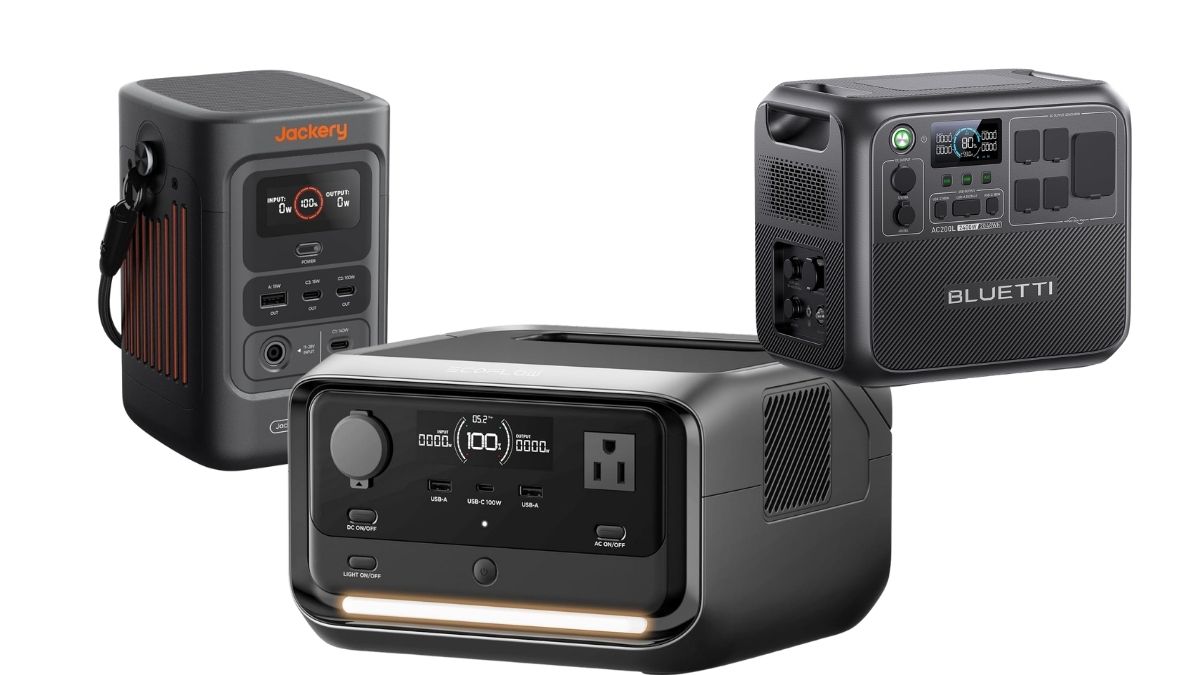
This review we’ll go in-depth with these three models: Jackery Explorer 240D, EcoFlow RIVER 3 Plus, and BLUETTI AC200L. They all solve campsite power at different scales. We’ll be comparing their true value, reliability, output, and actual runtime.
Surprisingly, the most useful option for most campers is not the largest.
Comparing the Jackery vs. EcoFlow vs. BLUETTI Models
This Jackery-EcoFlow-BLUETTI comparison covers the exact models listed below.
(We also separate continuous output from boost modes.)
| Specification | Jackery Explorer 240D | EcoFlow RIVER 3 Plus | BLUETTI AC200L |
|---|---|---|---|
| Capacity | 256Wh | 286Wh | 2,048Wh |
| Battery and cycle rating | LiFePO4; 6,000 to at least 70 % | LiFePO4; 3,000 to 80 % | LiFePO4; 3,000+ to 80 % |
| Output | 200W total DC | 600W AC; 1,200W surge/X-Boost | 2,400W AC; 3,600W Power Lifting |
| Main output ports | 3 USB-C, 1 USB-A | 3 AC, 2 USB-A, 1 USB-C, 1 car outlet | 4 AC, TT-30 RV, 2 USB-C, 2 USB-A, DC outputs |
| Solar and fast charging | 100W; 0-80 % in 1 hour with suitable input | 220W; 0-100 % in 1 hour by AC | 1,200W; 0-80 % in 45 minutes with optional 20A setup |
| Expansion | No | Up to 858Wh | Up to 8,192Wh with compatible batteries |
| Weight | 4.85 lb | 10.4 lb | About 62 lb |
| Best use and limitation | USB trips; no AC or 12V outlet | Weekend camping; small base battery | RV/base camp; heavy and costly |
| Pricing | See price here | See price here | See price here |
Is This an Apples-to-Apples Camping Comparison?
No. This brands comparison for camping choice spans three product categories. Jackery is a 256Wh DC-only power bank. EcoFlow adds a 600W inverter and AC outlets at 286Wh. BLUETTI jumps to 2,048Wh and 2,400W, giving it more than seven times their capacity.
Consequently, watt-hours alone cannot determine the winner. We also assessed portability, output, solar recovery, price, warranty, ports, and limitations.
Camping Scenario
Here’s how each portable power station lines up for camping:
Jackery Explorer 240D Review
Highlight: Best for Lightweight USB Power
The Explorer 240D supplies 200W shared DC output through three USB-C ports and one USB-A port. Its 140W USB-C connection handles laptops, Starlink Mini, cameras, and drones.
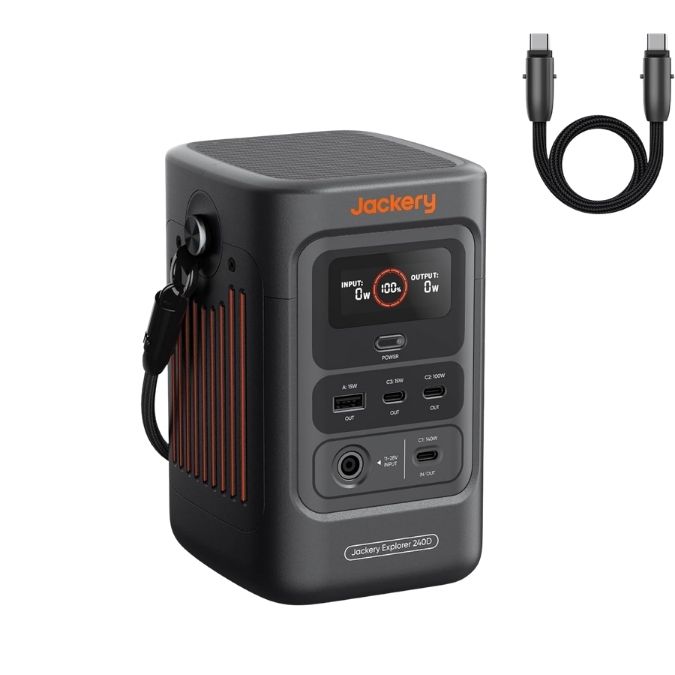
At 4.85 pounds, it fits a camera kit, and its cable doubles as a handle.
However, there is no app, AC outlet, car outlet, or wall charger in the box. Fast wall or vehicle charging may require an adapter. There is, though, 100W solar input and a five-year warranty.
Best for: USB-C trips.
Skip it if: You need standard AC or 12V equipment.
If Jackery’s USB-only design feels too restrictive, find a top portable power station under $300 that still gives you AC outlets.
EcoFlow RIVER 3 Plus Review
Highlight: Best Overall for Weekend Camping
The RIVER 3 Plus is the practical middle ground. Its 600W inverter and seven outputs run fans, lights, air pumps, electronics, and suitable refrigerators. Its rating is 600W continuous, not 1,200W.
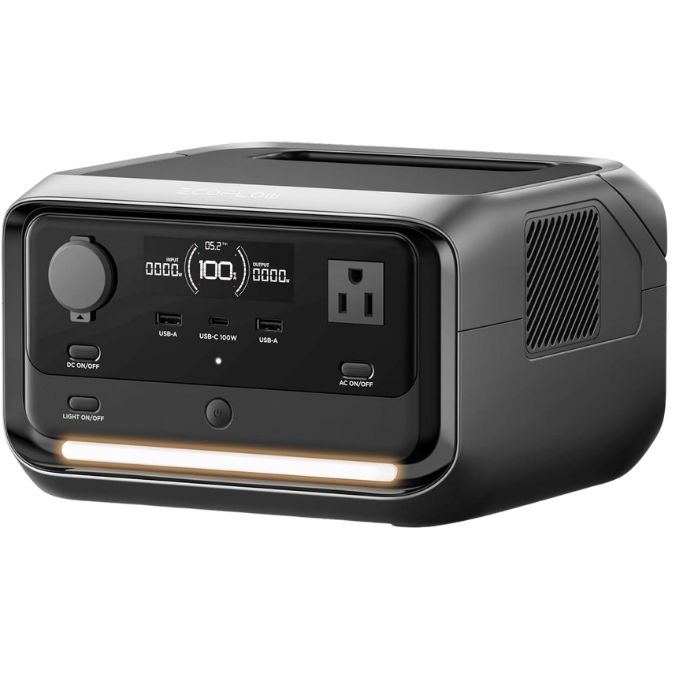
At 26W, we’re looking at about nine hours. Yet a CPAP with heat or a refrigerator may outlast the 286Wh battery. Solar or an EB300 or EB600 battery sorts this out.
The app, light, quiet operation, and fast charging are excellent. For UPS use, enable AC-output restoration and move critical gear before firmware updates. Stop charging if a persistent burning odor develops.
Best for: Weekend car camping.
Skip it if: You need guaranteed overnight appliances or high-wattage cooking.
BLUETTI AC200L Review
Highlight: Best for RV and Multi-Day Base Camping
The AC200L is a mobile RV power system. Its 2,048Wh battery and 2,400W inverter handle refrigerators, coffee makers, CPAP machines, tools, and cooking appliances. Light RV loads can run 10-11 hours, while a CPAP without heat can last multiple nights.
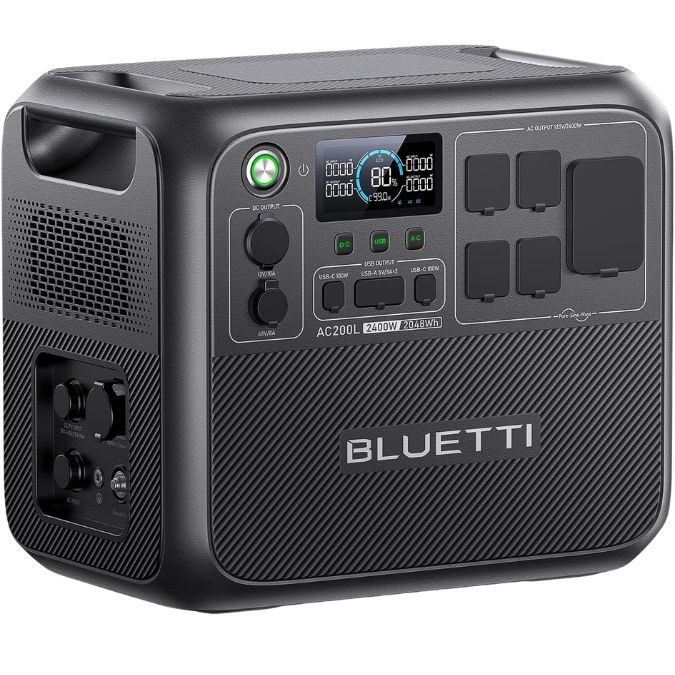
The TT-30 outlet simplifies RV connection, but output remains 2,400W, or about 20A at 120V. Power Lifting is not normal 3,600W output.
Solar reaches 1,200W, and storage expands to 8,192Wh. However, 45-minute charging requires an optional 20A setup.
Best for: RV base camps.
Skip it if: You must carry it.
Pros and Cons
| Model | Pros | Cons |
|---|---|---|
| Jackery 240D | 4.85 lb; 140W USB-C; efficient DC; 6,000-cycle rating | No AC or 12V output; adapters may cost extra |
| EcoFlow RIVER 3 Plus | AC utility; one-hour charging; app, light and UPS; expandable | Small base battery; X-Boost is not 1,200W continuous |
| BLUETTI AC200L | 2,048Wh; 2,400W output; TT-30; strong solar and expansion | About 62 lb; accessories are expensive |
What Camping Gear Can They Actually Run?
Capacity controls runtime, while continuous output controls startup. Estimates assume 90 % DC and 85 % AC efficiency.
Conditions can change results, too.
| Camping device | Typical load | Jackery 240D | RIVER 3 Plus | AC200L |
|---|---|---|---|---|
| Smartphone | 15Wh per charge | 12-15 charges | 14-17 charges | 100+ charges |
| 60W laptop | 60W | About 3.5 hours | About 4 hours | About 29 hours |
| LED camp light | 10W | 20-23 hours | 22-25 hours | 160-175 hours |
| Portable fan | 30W | About 7 hours if USB/DC | About 8 hours | 55-60 hours |
| CPAP, no humidifier | 40W | About 5 hours with DC setup | About 5-6 hours | 40+ hours |
| 12V refrigerator | 50W average | No car outlet | About 4-6 hours, longer with cycling | About 30-35 hours |
| Air-mattress pump | 100-600W | No AC output | Yes if rated at 600W or less | Yes |
| Coffee maker | 600-1,200W | No | Usually unsuitable | Yes |
| Induction cooker | 1,200W+ | No | No | Model-dependent |
Estimated runtime = battery capacity x efficiency / device wattage
If your camp breakfast means hot coffee and cold food and fruits, see what it takes to run a coffee maker and mini fridge together. The short brewing burst and the fridge’s compressor cycle create a more demanding load than either appliance suggests alone.
Which Model Is Most Portable for Camping?
For portability, Jackery wins.
EcoFlow adds one-hand AC power. BLUETTI needs a vehicle and often a dolly.
Jackery is usually quietest because it avoids an inverter. EcoFlow is often below 30 dB, while BLUETTI is louder during fast charging. None is rainproof.
Note: EcoFlow’s IP54 statement covers battery protection, not the enclosure.
Which One Has the Best Solar Compatibility and Off-Grid Recharging?
BLUETTI wins raw solar input, but EcoFlow has the strongest solar-to-capacity ratio.
The RIVER 3 Plus model is easier to refill with a panel.
| Model | Solar ceiling | Realistic planning range |
|---|---|---|
| Jackery 240D | 100W | 3.5-5 hours |
| RIVER 3 Plus | 220W | 2-3.5 hours |
| AC200L | 1,200W | 2.5-5+ hours |
Panels are usually sold separately. Therefore, you have to verify voltage, current, connector, and adapter requirements. Shade, heat, clouds, and panel angle will extend charging time.
EcoFlow and BLUETTI support car charging. Jackery may need an optional adapter. Still, wall-charge all three before departure.
Price, Warranty and Long-Term Value
Compare price per watt-hour and required functions beforehand.
Jackery offers DC, EcoFlow adds AC and UPS, while BLUETTI often costs less per watt-hour.
If the EcoFlow RIVER 3 Plus feels too small but the AC200L feels excessive, head to our review of the best portable power stations under $500. That middle tier can deliver substantially more battery and inverter headroom without moving into a 62-pound power system.
For camping purchase, accessories can change your net total drastically. So run a double-check one the pricing before your purchase.
Buying Guide: How Do You Pick the Right One Here?
A useful portable power station for camping decision starts with loads. Get the smallest unit that covers them with a reserve.
- Calculate Your Daily Watt-Hour Requirement
Multiply watts by operating hours, then leave 15-20 % room for conversion losses and unexpected use.
To size the battery around your actual camping kit, enter every device in our portable power station calculator and compare its capacity, output, and runtime estimate with these three models.
- Check Continuous Output, Not Boosted Wattage
Use continuous output for calculations. Surge, X-Boost, and Power Lifting have narrower purposes.
- Confirm the Outlets Your Equipment Requires
Check USB-C, AC, 12V, and TT-30 needs. Standard AC equipment rules out the DC-only Jackery.
- Match Capacity to the Camping Style
Choose Jackery for USB trips, EcoFlow for weekends, and BLUETTI for RV or multi-day base camps.
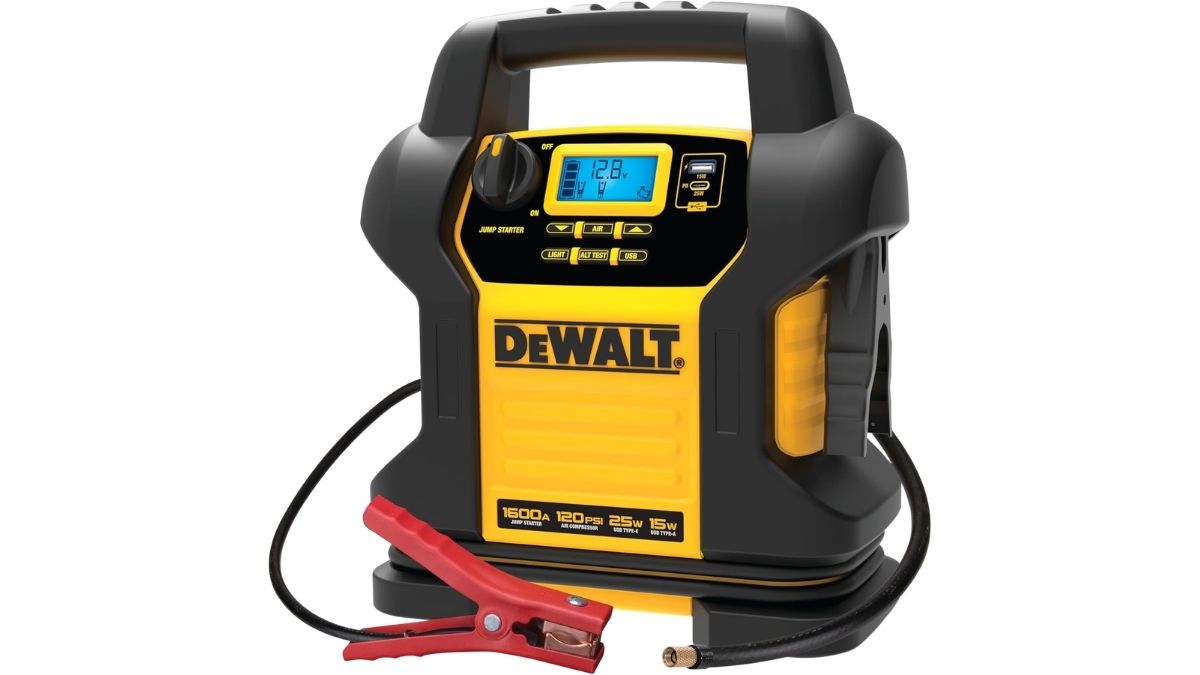
If you’re an overlander who cares more about a dead battery or soft tire than overnight appliance runtime, you might need a different tool. The DeWalt DXAEJ14 combines jump-starting, tire inflation, and USB charging, but know that it’s not a substitute for the campsite energy stored by these LiFePO4 stations.
- Consider Solar Recovery, Weather, and Nighttime Noise
Match panel size to sun hours. Keep the station dry, ventilated, and away from the sleeping area during fast charging.
- Check the Complete Ownership Cost
Include panels, adapters, batteries, protection, and warranty conditions. A cheap station is poor value if it cannot connect.
Jackery vs. EcoFlow vs. BLUETTI for Camping
EcoFlow RIVER 3 Plus is best overall because it combines AC utility, low weight, fast charging, and expansion.
Jackery Explorer 240D wins for lightweight USB gear.
BLUETTI AC200L wins for RVs, refrigerators, cooking, and shared power.
So our take is: the largest battery is not automatically the smartest purchase. Instead, buy for the trip you actually take.
If none of these three fit your exact load, packing space, or budget, do check out our review of the top camping power stations in 2026, including compact solo-trip models, balanced mid-size units, and larger base-camp options.
FAQs
Is Jackery Better Than EcoFlow for Camping?
Jackery is better for weight and USB-C. However, EcoFlow is the best camping power station brand for broader use because it adds AC, 12V, UPS, and expansion.
Can the EcoFlow RIVER 3 Plus Run a Camping Refrigerator Overnight?
It may run an efficient refrigerator overnight if cycling keeps consumption low. At continuous 50W, expect 4-6 hours. For reliable cooling, add a battery, solar, or capacity.
Can the Jackery Explorer 240D Power AC Appliances?
No. Explorer 240D provides USB DC only. It cannot run an AC refrigerator, pump, coffee maker, blanket, or standard CPAP adapter. It suits USB-C equipment.
It is too heavy for walk-in camping but works at a drive-up camp. At 62 pounds, keep it near the vehicle, RV, or trailer. Use a dolly.
Are Jackery, EcoFlow, and BLUETTI Power Stations Safe Inside a Tent?
They produce no exhaust, but placement matters. Keep them dry, stable, ventilated, and temperature-safe. Stop use after unusual heat, swelling, or persistent burning odor.