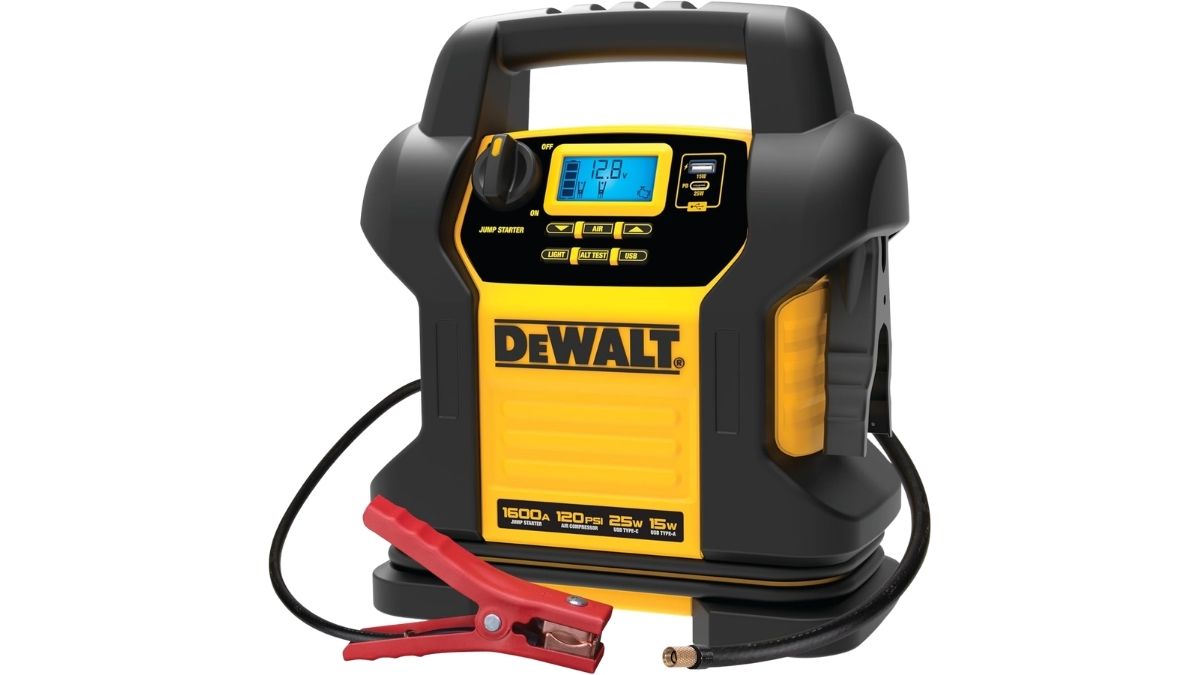
The DEWALT DXAEJ14 digital portable power station combines a jump starter, tire inflator, alternator tester, USB power bank, and emergency light in one rugged unit. In my view, it’s ideal for a dead battery or a low tire. However, its 17.3-pound weight and sealed lead-acid battery create trade-offs that lighter lithium jump starters avoid.
In this DEWALT DXAEJ14 review, I cover what this digital portable power station does well and when I’d pick a rival instead.
Is the DEWALT DXAEJ14 Worth Buying?
Yes, I think the DEWALT DXAEJ14 is worth considering for car, SUV, pickup, and light-truck owners who want one dependable roadside unit instead of separate jump-starting and inflation tools. In my opinion, its strongest qualities are serious starting power, sturdy clamps, an effective compressor, and simple controls.
However, it isn’t the right choice if you need a lightweight glove-box jump starter, an AC outlet, solar charging, or enough stored energy to run appliances. For that, a station like the Jackery Explorer 300 fits better.
| Quick verdict | Assessment |
|---|---|
| Best for | Roadside emergencies, garages, trucks, contractors and road trips |
| Starting output | 1,600 peak amps |
| Compressor | 120 PSI with AUTOSTOP |
| USB charging | 15W USB-A and 25W USB-C |
| Internal battery | Sealed lead-acid |
| Weight | 17.3 pounds |
| Main strength | Jump starter and compressor in one durable unit |
| Main drawback | Heavy and requires routine recharging |
| Our verdict | Strong all-in-one roadside equipment |
What Is the DEWALT DXAEJ14?
The DEWALT DXAEJ14 is a digital portable power station that’s mainly an automotive jump starter with several extra emergency functions. For example, it delivers 1,600 peak amps and supports most four-, six-, and eight-cylinder cars and trucks with 12V WET, GEL, or AGM batteries.
It also includes a digital compressor, USB charging, an alternator check, reverse-polarity protection, a backlit display, and an LED work light. As a result, it can replace several separate items in a vehicle emergency kit.
Is the DXAEJ14 a True Portable Power Station?
Not in the usual solar-generator sense. Because it has no household AC output, this DEWALT portable power station can’t run a refrigerator, CPAP machine, coffee maker, TV, or corded power tool.
Instead, the term “power station” mainly refers to its ability to jump-start vehicles and charge small USB devices. In other words, its core purpose is roadside support rather than extended backup power.
If vehicle rescue isn’t your main priority, compare my picks for portable power stations under $300 with real AC output. Several compact options in that price range can run laptops, routers, lights, fans, and smaller AC devices (although they can’t replace the DEWALT’s jump starter and tire compressor.)
DEWALT DXAEJ14 Specs
| Specification | DXAEJ14 Type 3 |
|---|---|
| Peak starting current | 1,600 amps |
| Vehicle support | Most four, six, and eight-cylinder cars and trucks |
| Supported batteries | 12V WET, GEL and AGM lead-acid |
| Internal battery | Sealed lead-acid |
| Compressor | 120 PSI digital compressor |
| Compressor features | AUTOSTOP and 10-minute automatic shutoff |
| USB-A output | 15W |
| USB-C output | 25W Power Delivery |
| AC output | None |
| Safety feature | Reverse-polarity alarm |
| Diagnostic feature | Alternator check |
| Lighting | Built-in LED work light |
| Dimensions | 6 x 11.75 x 13 inches |
| Weight | 17.3 pounds |
| Warranty | Limited one-year manufacturer warranty |
DEWALT DXAEJ14 Jump-Starting Performance: My Assessment
The DEWALT DXAEJ14 combines a jump starter and compressor in one roadside tool. So when I assess its starting capability, I focus on battery condition, clamp contact, operating information, and portability.
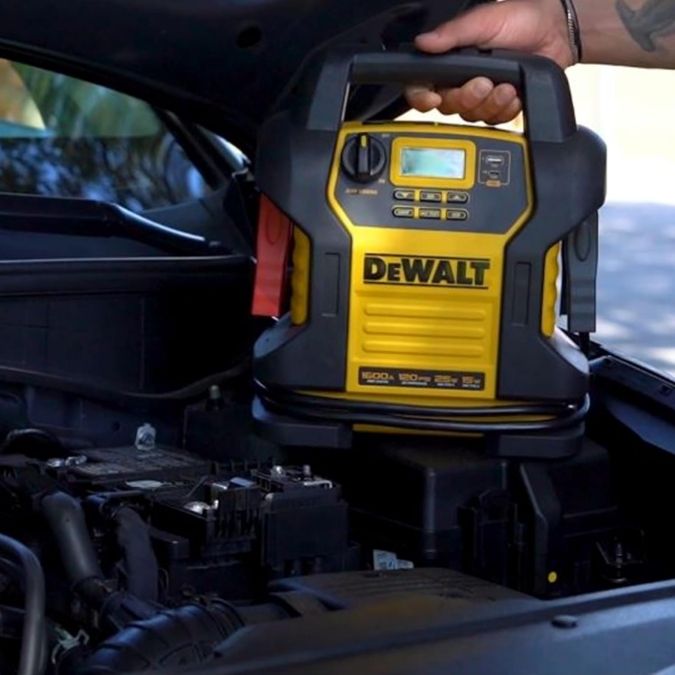
The Setup
For a cold-morning no-start in a 5.7L V8, I’d begin with a fully charged DXAEJ14 and check the vehicle’s approved jump-start procedure. I’d also confirm the battery’s condition first, since a vehicle that won’t crank doesn’t automatically have a zero-volt battery.
I like the heavy-duty, powder-coated metal clamps for durability. However, for a solid electrical connection, make sure the exposed jaws grip the designated connection points securely, because the protective coating itself doesn’t improve conductivity.
Real-World Performance
The Type 3 version carries a 1,600-peak-amp rating. Also, I recommend checking the type and rating printed on the unit when you compare versions.
For me, the main advantage is starting help without needing another vehicle. DEWALT specifies support for most four-, six-, and eight-cylinder cars and trucks with compatible 12V lead-acid batteries, so a V8 pickup is a realistic use case. Still, reliable cranking depends on temperature, engine demand, battery condition, and the jump starter’s charge level, so the peak-amp rating alone can’t guarantee a cold start.
My main reservation is the 17.3-pound weight. I’d set the unit on a stable surface before connecting the cables, because its bulk makes repositioning around a crowded engine bay awkward. That’s a fair trade-off if you also need the built-in compressor, but it matters if easy carrying is your priority.
Safety and Digital Features
The backlit LCD shows battery status and operating information, while the reverse-polarity alarm warns you about an incorrect clamp connection. I value having those checks on the front panel, especially in low light. However, the display only shows the unit’s status; it can’t diagnose your vehicle battery’s health on its own.
Before enabling the jump starter, I’d verify the connection points and follow both the vehicle and DEWALT manuals. Also, keep the leads clear of belts and fans, and never try to jump-start a frozen or visibly damaged battery.
Owners report successful starts on V8 vans, GMC trucks, Ford Expeditions, older vehicles, cold batteries, and vehicles that had sat for long periods. In addition, several owners got multiple starts before recharging.
Is the 120 PSI Compressor Actually Useful?
Yes. In fact, the compressor is one of the biggest reasons I’d choose this digital portable power station over a smaller lithium jump pack.
First, you set the target pressure on the digital panel, then connect the Sure Fit nozzle and let AUTOSTOP end inflation at the selected PSI. The Type 3 also has a 10-minute automatic shutoff to reduce heat damage if the compressor is left running.
In my view, the compressor works best for pressure top-ups, roadside tire inflation, bicycles, lawn equipment, and sports gear. However, it isn’t a tank-style shop compressor, so it may feel slow or loud when filling a large tire from nearly empty.
Owners rate the compressor very highly. For example, they’ve used it on passenger tires, truck tires, and for more than a dozen tire top-ups on one charge, although results naturally vary.
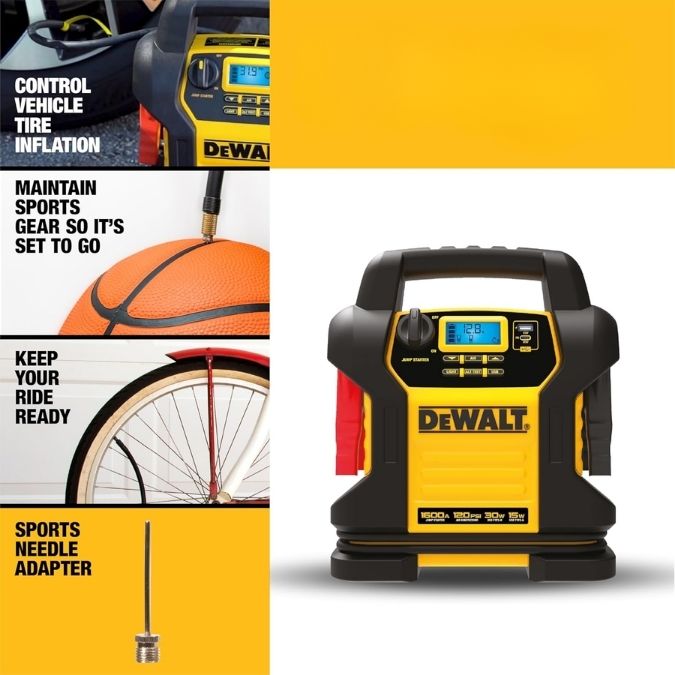
Does the DEWALT DXAEJ14 Have an AC Outlet?
No. The DXAEJ14 doesn’t have an AC outlet for household appliances or corded tools.
Its wall-power connection only recharges the internal battery. Therefore, don’t confuse the charging input with a 120V output.
This matters because the larger DEWALT DXAEPS14 does provide portable household power, while the DXAEJ14 focuses on vehicle starting, inflation, and USB charging.
The DXAEPS14 also offers 2,000 peak amps and a 120 PSI compressor. However, it’s a larger and more expensive alternative.
If you need to keep food cold and still brew coffee, I’d first see what it takes to power a coffee maker and mini fridge at the same time. That job requires a true inverter-equipped power station with much higher continuous output and battery capacity.
What Can the USB Ports and LED Light Power?
The 25W USB-C Power Delivery port and 15W USB-A port charge phones, tablets, navigation devices, flashlights, and other small electronics. They’re most useful on road trips or during short power outages, when staying in touch matters more than running large equipment.
However, every device you connect uses energy that could otherwise start your vehicle. For that reason, I treat the USB function as an emergency convenience rather than a replacement for a high-capacity power bank.
The LED helps when locating battery terminals, checking a tire, or working beside a vehicle after dark. Still, the light gets more mixed feedback than the jump starter and compressor, so I’d keep a separate flashlight in the vehicle too.
Build Quality, Controls, and Portability
The housing, handle, metal clamps, broad base, and simple control panel feel better suited to garage and truck use than many low-cost emergency devices.
On the other hand, 17.3 pounds is heavy compared with compact lithium units. Moving it between a garage and trunk is manageable, but it may be inconvenient for older users.
Overall, owner sentiment is strongly positive. The few criticisms involve size, weight, charge retention, the missing charging extension cord, compressor noise, cable or hose length, and occasional defective ports or controls.
Pros and Cons I Weighed
| Pros | Cons |
|---|---|
| 1,600 peak amps support most cars, SUVs and V8 light trucks | Heavy compared with compact lithium jump starters |
| 120 PSI AUTOSTOP compressor handles common tire emergencies | Requires routine charging and does not include AC output |
| Strong clamps, reverse-polarity warning and alternator check | |
| 25W USB-C, 15W USB-A and LED add emergency versatility |
Is It Suitable for Jobsite Power and Professional Use?
In my view, the DXAEJ14 makes sense for professional use when the job involves vehicles. For example, contractors, landscapers, mobile technicians, delivery drivers, and fleet operators can use it to start a work truck, inflate a tire, test an alternator, charge a phone, or light up an engine bay.
However, it isn’t true jobsite power for drills, saws, chargers, or other AC equipment. The DEWALT brand and rugged housing fit a work-truck setting, but without an inverter, its usefulness stops at automotive tasks.
DEWALT DXAEJ14 vs. Competing Jump Starters
| Model | Battery type | Compressor | AC power | Weight class | Best use |
|---|---|---|---|---|---|
| DEWALT DXAEJ14 | Sealed lead-acid | Yes | No | Heavy | Jump-starting plus tire inflation |
| DEWALT DXAEPS14 | Sealed lead-acid | Yes | Yes | Very heavy | Automotive support plus limited AC power |
| NOCO Boost Plus GB40 | Lithium | No | No | Lightweight | Compact emergency jump-starting |
The NOCO GB40 weighs about 2.4 pounds and delivers 1,000 amps, so it’s far easier to store and carry. However, it doesn’t replace the DEWALT’s built-in tire compressor.
My advice: choose the DXAEJ14 when a dead battery and a low tire worry you equally. On the other hand, choose the NOCO when space and portability matter most, or move to the DXAEPS14 when you need an inverter for AC devices.
Campers and homeowners who don’t need vehicle jump-starting have another route. My EBL Voyager 1000 review examines a 999Wh lithium station with 1,000W continuous AC output, pure sine wave outlets, USB-C charging, and solar input. It’s better suited to CPAP machines, laptops, small fridges, and campsite electronics, but it has no built-in tire compressor.
What Should You Check Before Buying?
| Buying factor | What to consider |
|---|---|
| Vehicle type | Confirm that your 12V vehicle and engine size fall within the supported range |
| Portability | Make sure you are comfortable lifting and storing a 17.3-pound unit |
| Compressor need | Its value is much stronger if you also need tire inflation |
| AC requirements | Do not purchase it for appliances or corded tools |
| Storage routine | Plan to recharge it regularly, even when unused |
| Included accessories | Expect clamps, cables and a sports needle, but verify the charging-cord arrangement |
| Emergency role | Treat it as vehicle equipment, not whole-home backup power |
The decision becomes easier when jump-starting and tire inflation are the main jobs. However, appliance backup requires actual load calculations. In that case, use my portable power station calculator to match capacity with your devices before choosing an inverter-equipped alternative. It also accounts for device wattage, daily runtime, efficiency loss, and the extra headroom needed for startup surges.
Who Should Get the DEWALT DXAEJ14?
In my view, the DEWALT DXAEJ14 digital portable power station is best suited to:
- Drivers who want a jump starter and compressor in one unit
- Pickup, SUV, van, and light-truck owners
- Contractors and tradespeople carrying emergency equipment
- Families preparing for winter driving or long road trips
- Campers who need vehicle support and basic USB charging
- Homeowners who prefer a garage-based emergency starter
However, I’d skip it if you need a lightweight glove-box unit, solar input, AC appliance power, or a lithium battery that’s easier to carry.
If you need short-outage backup rather than roadside help, check out my review of the best portable power stations under $500 for AC-powered essentials. That price tier opens the door to larger LiFePO4 batteries, faster charging, solar input, and enough inverter output for equipment such as routers, laptops, CPAP machines, televisions, and some small refrigerators.
How Often Should the DXAEJ14 Be Recharged?
When you’re not using it, I recommend charging the unit every 30 days. Also, recharge it right away and leave it charging overnight after jump-starting, inflating, or long USB use. In my opinion, this isn’t optional maintenance.
A monthly phone reminder is the simplest solution. Also, check the charge before winter, storm season, camping trips, or long-distance travel.
My Final Verdict on the DEWALT DXAEJ14
In my view, the DEWALT DXAEJ14 digital portable power station is a strong roadside tool for drivers who value starting power, tire inflation, sturdy construction, and easy controls over lightweight portability. It handles two common roadside problems without needing another vehicle, a separate inflator, or a nearby outlet.
Its weaknesses are clear, though. It’s heavy, needs disciplined recharging, can be noisy when inflating, and can’t power AC appliances.
Even so, I’d recommend it for garages, pickups, work vans, family SUVs, road trips, and contractor vehicles. For those uses, its all-in-one design offers more practical value than a basic lithium jump starter.
FAQs
Is the DEWALT DXAEJ14 a lithium jump starter?
No. The current Type 3 uses a sealed lead-acid internal battery. That explains its weight and strong cranking focus, but it also means the unit needs regular recharging in storage.
Can the DEWALT DXAEJ14 start a V8 engine?
Yes, in most cases. Its 1,600 peak amps can help start most four-, six-, and eight-cylinder cars and trucks. However, results depend on engine size, temperature, battery condition, and the jump starter’s charge level.
Does the DEWALT DXAEJ14 have an AC outlet?
No. It can’t directly run household appliances or corded tools. Instead, its only power outputs are the 15W USB-A and 25W USB-C ports.
Can the DXAEJ14 run DEWALT power tools?
No. It has no AC inverter and isn’t part of the DEWALT cordless-tool battery platform. So while it handles vehicle tasks and charges USB electronics, it can’t run standard power tools.
What is the difference between the DXAEJ14 and DXAEPS14?
The DXAEJ14 is lighter and focuses on jump-starting, tire inflation, diagnostics, and USB power. By contrast, the larger DXAEPS14 adds household AC power and a 2,000-peak-amp rating, so it’s more capable but less portable.