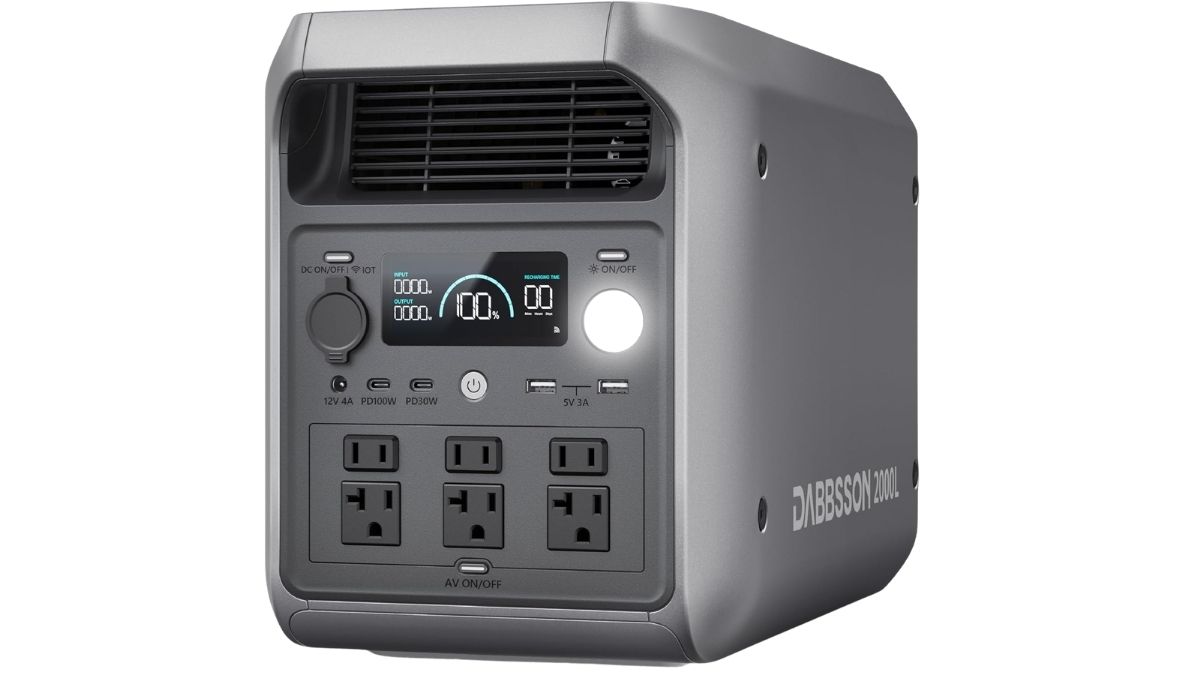
Quick Summary: The DABBSSON 2000L is a strong pick if you want a portable power station for a CPAP machine on a camping trip and you also want headroom to run a fridge, lights, or an e-bike charger off the same battery. Its pure sine wave output and 2,048Wh capacity give most CPAP users four to five nights per charge. It might not be the lightest or cheapest option if CPAP is the only thing you’re gonna plug in, but for a trip where the CPAP shares duty with everything else, it earns its price.
The DABBSSON 2000L effectively takes CPAP therapy off-grid: having enough usable energy to sleep through the night without obsessing over the battery percentage. If you’re looking for a portable power station for CPAP machine on a camping trip, its 2,048Wh capacity, pure sine wave AC output, DC options, and fast recharging make it far more capable than a small one-night CPAP battery. Reality is: 41 pounds is manageable around a vehicle or RV, but definitely not backpack-friendly.
And what happens if the battery gives out at 3 a.m., miles from an outlet? This review breaks down exactly how the 2000L handles that job, plus two app settings almost nobody talks about that can make or break your first night out.
Is the DABBSSON 2000L Good for CPAP Camping?
Yes. The DABBSSON 2000L is a strong choice for multi-night CPAP use during car camping, RV trips, van life, and other off-grid stays where weight is less important than runtime.
Its 2,048Wh battery is the key feature. A CPAP does not need anything close to its 2,200W inverter output, but that large energy reserve gives you considerably more overnight headroom than a compact CPAP battery. DABBSSON also uses a pure sine wave inverter and provides a 12.6V car outlet for compatible DC setups.
The catch is that a portable power station for CPAP machine this large is unnecessary for many single-night campers. It makes much more sense when the trip lasts several nights or the same battery also needs to run lights, phones, laptops, a fan, or a camping refrigerator.
Specs of the DABBSSON 2000L
The headline 3,300W Power Boost sounds impressive, but it has little relevance to CPAP therapy. Capacity, output quality, low-load efficiency, available DC power, and recharging options matter more.
| CPAP-Relevant Spec | DABBSSON 2000L | Why It Matters |
|---|---|---|
| Battery capacity | 2,048Wh | Determines potential overnight runtime |
| AC output | 2,200W | Vastly more than a CPAP requires |
| AC waveform | Pure sine wave | Suitable output type for sensitive AC electronics |
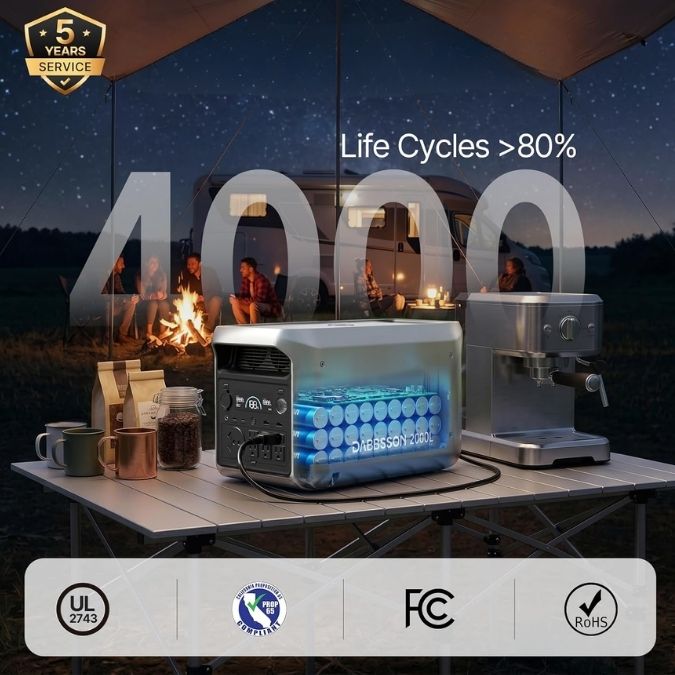
| Battery chemistry | Semi-solid LiFePO4 | Designed for long cycle life |
| Cycle rating | 4,000 cycles to 80 % | Useful for frequent camping and backup use |
| AC outlets | 6 | CPAP plus other campsite equipment |
| Car outlet | 12.6V, 10A, 126W | Useful with a compatible CPAP DC adapter |
| DC5521 | 12.6V, 4A, 50.4W | Additional DC option |
| Solar input | Up to 800W | Useful for longer off-grid trips |
| AC charging | Up to 1,500W | 80 % claimed in about 1.5 hours |
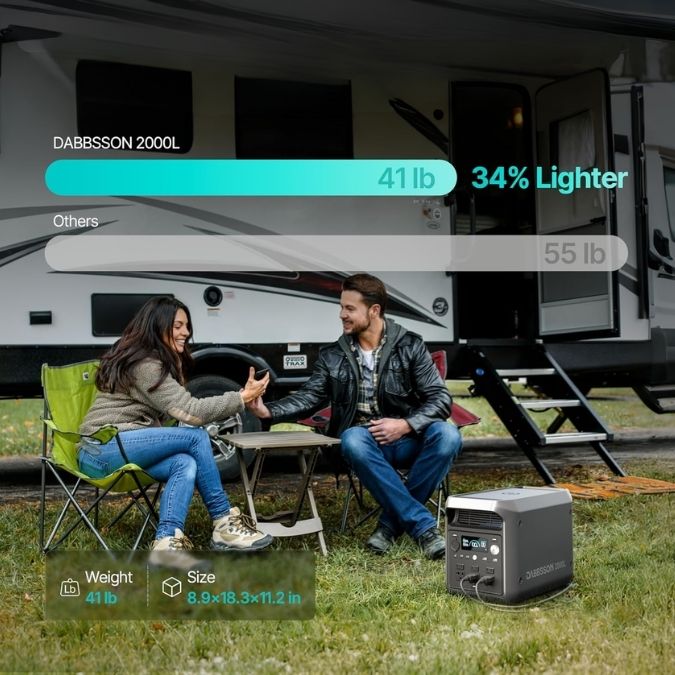
| Weight | 41 lb | Better for vehicle-based camping |
| Dimensions | 11.2 x 18.3 x 8.8 in | Compact for the 2kWh class |
| EPS transfer | 15ms | Backup feature, not a medical-grade UPS |
What’s confirmed: 2,048Wh capacity, six pure sine wave AC outputs, 800W solar input, 4,000-cycle rating, 41-pound weight, and 15ms EPS. The six-outlet setup earns its keep once you are charging phones, a headlamp, or an e-bike battery alongside the CPAP.
How Long Will the DABBSSON 2000L Run a CPAP Machine?
That’s very specific. CPAP wattage draw, pressure, humidification, heated tubing, inverter overhead, temperature, and the exact CPAP model all affect overnight runtime.
For context, ResMed lists typical power consumption of 53W and peak consumption of 104W for an AirSense 10 configuration covered by its user guide. Other travel CPAPs can draw much less. ResMed, for example, states that the AirMini peaks at 27W.
How Many Watts Does a CPAP Machine Actually Use?
Most CPAP machines without a heated humidifier draw between 20 and 40 watts. Switch on a heated humidifier and tubing, and that climbs to roughly 60 to 100 watts. Travel machines like the ResMed AirMini sit lower still, often under 20 watts.
The wattage on your CPAP’s power brick is a maximum rating, not a constant draw, so plan around the higher end of your setup’s range rather than the lowest number you find.
How Many Watt-Hours Does a CPAP Need Overnight?
The basic calculation is:
CPAP watts × hours of use = watt-hours needed
Therefore, a CPAP averaging 40W for eight hours requires about 320Wh before accounting for losses.
However, the full 2,048Wh printed on the DABBSSON battery should not be treated as 2,048Wh of guaranteed AC energy at your CPAP plug. Actual moderate-load testing has shown roughly 1,500Wh of delivered energy in some lower-load conditions, while much higher loads can be more efficient. You might get around 93 % inverter efficiency under specific test conditions, but efficiency changes with load.
See our portable power station calculator to run the numbers against your exact machine.
For conservative trip planning, we would leave additional reserve instead of calculating right down to 0 %.
| Average CPAP Load | Energy Per 8 Hours | Conservative Planning Range* |
|---|---|---|
| 25W | 200Wh | About 6 nights |
| 40W | 320Wh | About 4 nights |
| 53W | 424Wh | About 3 nights |
| 70W | 560Wh | About 2 nights |
*These are planning estimates, not guaranteed runtimes. They deliberately assume less than 2,048Wh is available after operating losses and reserve.
That makes the DABBSSON particularly compelling as a portable power station for a CPAP machine lasting several nights.
Two App Settings You Should Change Before The First Night
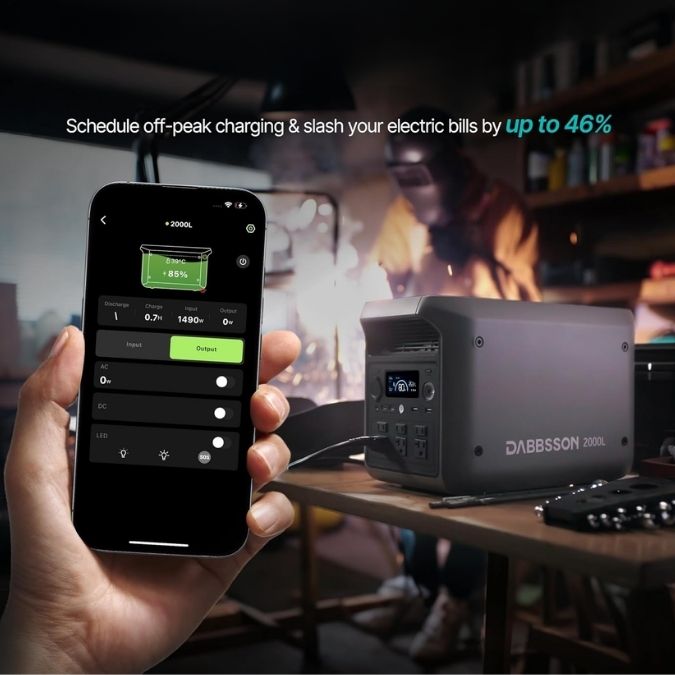
The DABBSSON app comes with a default auto-off timer set to two hours, which cuts power well before an eight-hour sleep unless you open the app and extend or disable it ahead of time.
Separately, the unit’s Eco Mode automatically shuts off once it detects a load under roughly 20 watts, treating that as an idle appliance rather than an active one. A basic CPAP without a humidifier can sit right at or below that threshold, meaning Eco Mode could quietly cut your air supply mid-sleep if left on. Switching Eco Mode off, or setting the unit to Always Standby instead, closes that gap in under a minute.
How Much Does the Humidifier Affect CPAP Runtime?
Potentially a lot. Heated humidification and heated tubing require additional energy, so the same power station can last noticeably longer when those systems are not drawing power.
It’s better to turn off humidification when using an external battery with certain devices if maximizing battery life is your goal. However, battery conservation should not override prescribed therapy or comfort requirements without appropriate guidance.
In other words, the humidifier power draw deserves to be included when estimating watt-hours needed. Do not calculate runtime from blower consumption alone.
Should You Use AC or DC for a Camping CPAP?
AC is the easiest route. You can connect the CPAP’s normal power supply to one of the DABBSSON’s six 120V pure sine wave outlets.
DC can be more efficient because it may avoid converting battery DC into AC and then back into DC inside the CPAP power brick. However, compatibility matters. The 2000L provides a 12.6V, 126W car outlet, but that does not mean every CPAP should be connected directly to it.
For example, ResMed provides a specific Air10 DC/DC converter that accepts 12V or 24V input and delivers the required 24V output to compatible AirSense 10 and AirCurve 10 machines. It also has a dedicated AirMini converter.
For a CPAP battery backup camping setup, the safest point is: use the CPAP manufacturer’s approved AC supply or its specified DC converter.
Why Pure Sine Wave Matters for an Off-Grid CPAP
The DABBSSON 2000L supplies pure sine wave AC at 120V. That gives the connected CPAP’s normal power adapter a cleaner AC waveform than the modified sine wave produced by some basic inverters.
Still, the CPAP manufacturer remains the authority on acceptable power sources and adapters.
This distinction is important when you’re looking to shop a portable power station. The DABBSSON has the right type of AC inverter, but the exact CPAP still needs to be connected according to its own specifications.
What Is the DABBSSON 2000L Like at Camp?
For vehicle-based camping, the 2000L strikes a useful middle ground. At 41 pounds, it is lighter than many large 2kWh-class stations, and its dual handles make short carries realistic. Its 11.2 x 18.3 x 8.8-inch body is relatively easy to move from a trunk to a campsite.
Camping clearly supports the capacity on show here. In a four-day-and-night camp setup, the station can power a 12V freezer and still return 20 % remaining charge, while also staying available to use with a laptop and phone. Solar-equipped camping use has likewise shown the station topping up during daylight and covering camp loads through the night.
Is It Quiet Enough to Sleep Near?
The station is very quiet and its silent charging mode stays below 25 dB. However, low-load use can still trigger intermittent cooling-fan operation, and there are cases where that cycling was audible even when the attached load was very small.
For CPAP camping, we would place the station several feet from the sleeping area where practical while keeping it dry, ventilated, and protected from weather.
DABBSSON 2000L vs. Two Other CPAP Camping Options
| Feature | BLUETTI X30 | DABBSSON 2000L | EcoFlow DELTA 2 Max |
|---|---|---|---|
| Capacity | 297Wh | 2,048Wh | 2,048Wh |
| Weight | ~4 lbs | 41 lbs | 50 lbs |
| Output type | DC only, CPAP cables | 6x AC, pure sine wave | 4x AC, pure sine wave |
| Typical price | $250-360 | $480-700 | $850+ |
| Best for | CPAP power and nothing else | CPAP plus everything else on the trip | Same capacity as the 2000L, at a real premium |
If a CPAP is genuinely the only device you will ever plug in, the X30 undercuts everything here on price and weight, though you lose AC outlets and get locked into CPAP-specific cabling. The DELTA 2 Max matches the 2000L’s capacity almost exactly but costs meaningfully more for no real CPAP runtime advantage. The 2000L sits in the sweet spot for anyone who wants CPAP reliability plus headroom to run a fridge, charge an e-bike, or keep a laptop alive on the same trip.
Pros and Cons
| Pros | Cons |
|---|---|
| 2,048Wh gives strong multi-night CPAP headroom | 41 lb is too heavy for backpacking |
| Pure sine wave AC plus a 12V car outlet | Fan cycling and low-load overhead can reduce the appeal beside a bed or tent |
| 800W solar input supports longer off-grid stays | |
| Fast recharge and enough capacity for CPAP plus other campsite gear |
The hardware is the stronger part of the package. However, the app deserves caution. Wi-Fi pairing, energy-management controls, and low-load standby behavior have produced inconsistent experiences, including cases involving confusing Eco Mode behavior or unexpected battery drain while devices remained connected.
Does the DABBSSON 2000L Match What a CPAP Camping Needs?
| What Matters | DABBSSON 2000L | Our Take |
|---|---|---|
| One full CPAP night | Easily enough capacity | Excellent |
| Multi-night runtime | 2,048Wh battery | Excellent |
| Pure sine wave AC | Yes | Excellent |
| Compatible DC route | 12.6V car outlet | Very useful |
| Solar charging | Up to 800W | Excellent |
| Tent-side noise | Fan behavior varies | Average |
| Car or RV portability | 41 lb | Good |
| Backpacking | 41 lb | Poor |
| CPAP-only value | Much larger than necessary for one night | Mixed |
This is why we rate it more highly as a portable power station for CPAP machine for a camping trip involving multiple nights than as a basic overnight CPAP battery.
Buying Guide
Calculate Watt-Hours, Not Just Maximum Watts
A huge inverter rating does not automatically mean longer CPAP runtime. For sleep therapy, battery capacity measured in watt-hours is usually far more important.
Check the CPAP wattage draw, multiply it by the expected sleep time, then add a meaningful reserve. If humidification or heated tubing is being used, calculate with those features operating.
Plan for Real Usable Energy
Avoid dividing 2,048Wh by the CPAP’s wattage and treating the result as guaranteed runtime. The inverter, electronics, standby behavior, temperature, and conversion stages all consume energy.
This is particularly important for an off-grid CPAP, where unexpectedly losing power halfway through the final night is exactly what good capacity planning is meant to prevent.
Check DC Compatibility Before the Trip
A DC connection can improve efficiency, but only if the CPAP manufacturer supports the setup. ResMed itself recommends either a suitable adapter from a vehicle battery or a portable power source for unplugged camping.
Test the complete setup at home before relying on it in the woods.
Match Battery Size to the Camping Style
For backpacking, the DABBSSON is the wrong category of product. For a campground, van, truck, RV, or drive-up tent site, its 41-pound weight becomes much easier to justify.
A portable power station for CPAP machine camping trip should ultimately be sized around nights away from power, CPAP consumption, other campsite loads, and available recharging.
A Note on Pass-Through and EPS Use
DABBSSON includes a 15ms EPS function. However, we would not get the 2000L specifically to act as a medical-grade UPS.
Also, heavy pass-through operation can cause unusually high AC input draw, reaching roughly 2,200W to 2,400W under tight conditions. Know that this involves heavy loads, not a low-draw CPAP.
For camping, the cleaner use case is: charge the station, then use its stored battery energy overnight.
Who Should Get the DABBSSON 2000L?
The DABBSSON makes the most sense for someone who camps from a vehicle, stays away from electrical hookups for several nights, uses a full-size CPAP, or wants enough capacity to power other essentials as well.
It also makes sense when the same battery will serve as a CPAP power station camping solution and a home-outage backup between trips.
Our camping power station roundup shows how it stacks up against other favorites, and our home backup roundup covers the outage side in more depth.
Who Should Skip It?
A backpacker should skip it immediately. So should someone who needs only enough energy for one night and wants the smallest possible battery.
There are also better fits for anyone who wants expandable battery capacity, since the 2000L does not support expansion. Users who expect flawless app control or silent operation at every load should also temper expectations.
Is the DABBSSON 2000L Worth It?
Yes, particularly for multi-night car camping, RV travel, van life, and off-grid trips where running out of CPAP power is a bigger concern than carrying 41 pounds.
As a portable power station for CPAP machine, the DABBSSON 2000L gets the fundamentals right: 2,048Wh of storage, pure sine wave AC, useful DC output, fast charging, solar support, and enough reserve to power more than the CPAP alone. Its 2,200W inverter is overkill for sleep therapy, but the battery capacity is not.
The weaknesses are there, too. Fan cycling can be noticeable, low-load operation does not deliver the full battery capacity to the outlet, the app has some rough edges, and the station is too heavy for hike-in camping. Still, for the target user who wants several nights of CPAP headroom from one box, those drawbacks do not erase its core advantage.
FAQs
A DABBSSON 2000L could cover roughly two to six 8-hour nights in conservative planning scenarios, depending heavily on average CPAP wattage, humidification, heated tubing, conversion losses, and other connected devices. Actual overnight runtime should always be tested with the exact CPAP before traveling.
Yes, its output and battery capacity are more than sufficient for typical CPAP power requirements. However, humidification increases energy consumption and can shorten the number of nights available from one charge. The CPAP’s own documentation should be used when calculating humidifier power draw.
A CPAP’s normal AC power supply can generally be plugged into the DABBSSON’s 120V pure sine wave AC outlet when the CPAP power supply supports U.S. mains power. DC operation requires a converter or cable specifically approved for the exact CPAP model.
No. The station does not force 2,200W into the CPAP. The CPAP draws only the power it requires. For this use case, the 2,048Wh battery capacity matters much more than the inverter’s 2,200W maximum output.
It is one of the stronger fits for multi-night vehicle-based camping because it combines a large 2,048Wh battery with pure sine wave AC, DC output, and solar charging. However, the best power station for CPAP outdoors is different for a backpacker who needs minimum weight.