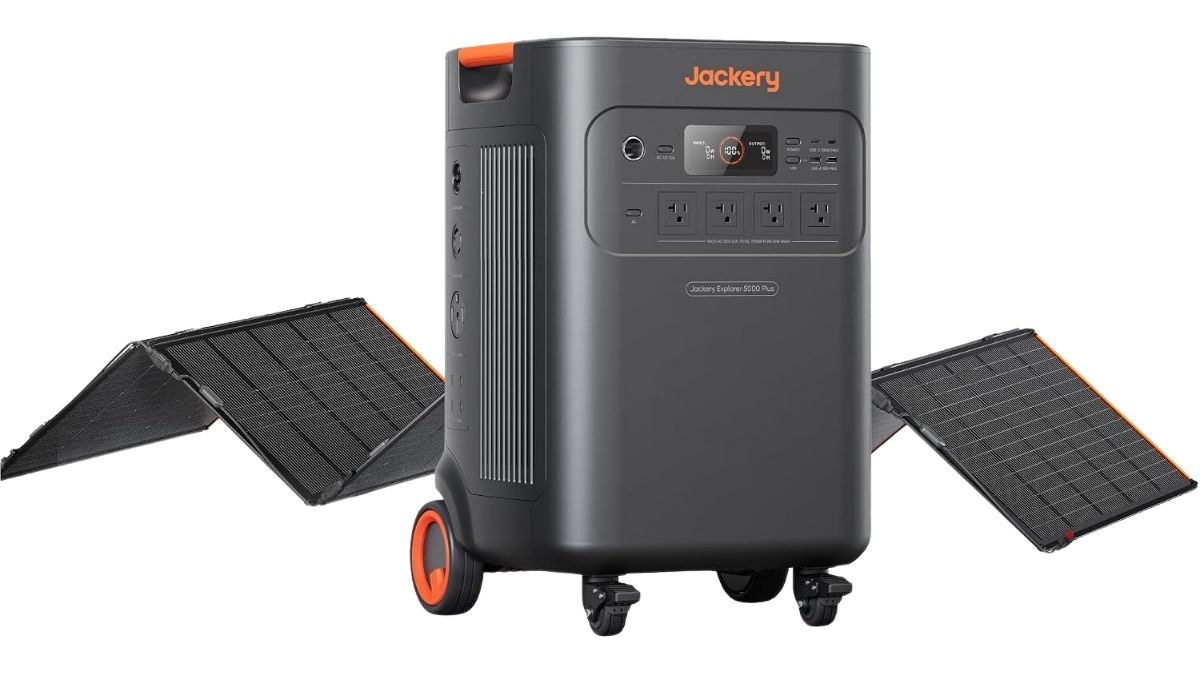
Quick Summary: The Jackery Explorer 5000 Plus (with 500W panels) is right now the best portable power station and solar panels bundle for a typical residential 120V or 240V well pump, provided the pump’s measured startup demand is within the inverter’s real capability. It is powerful, field-proven and expandable. It just lacks in one department: that guarantee that it will start every well pump, so you need to run related checks before you go get it.
Can a portable power station run a well pump? Yes, this Jackery Explorer 5000 Plus (solar generator) with 500W panels targets the exact moment a rural power outage turns into a no-water emergency. For a portable power station for well pump backup, voltage, starting surge and connection safety obviously carry more value than the system’s capacity.
For this review, we checked performance, reliability and full installed value against the specifications, so you can better understand where this heavyweight delivers.
Can the Jackery 5000 Plus run a well pump?
Yes, the Jackery Explorer 5000 Plus can run many 120V and 240V single-phase residential well pumps from roughly 1/2 to 2 HP. Its 7,200W continuous output and true split-phase design make it unusually suitable, but you must keep the pump’s measured starting current within the inverter’s real surge capability.
That detail is crucial. Jackery gives 14,400W surge, but it realistically reaches about 9,300W briefly at 240V and sustained 9,500W for 20 to 30 seconds. Now that might not be enough to start a 10,000W-surge air conditioner, so horsepower alone cannot guarantee success in this case.
| Quick verdict | Assessment |
|---|---|
| Best fit | Verified 120V or 240V, single-phase pumps from 1/2 to 1.5 HP |
| Conditional fit | 2 HP pumps after nameplate and inrush verification |
| Poor fit | Three-phase pumps, larger motors or unknown high-inrush systems |
| Our rating | 8.6/10 for well-pump backup |
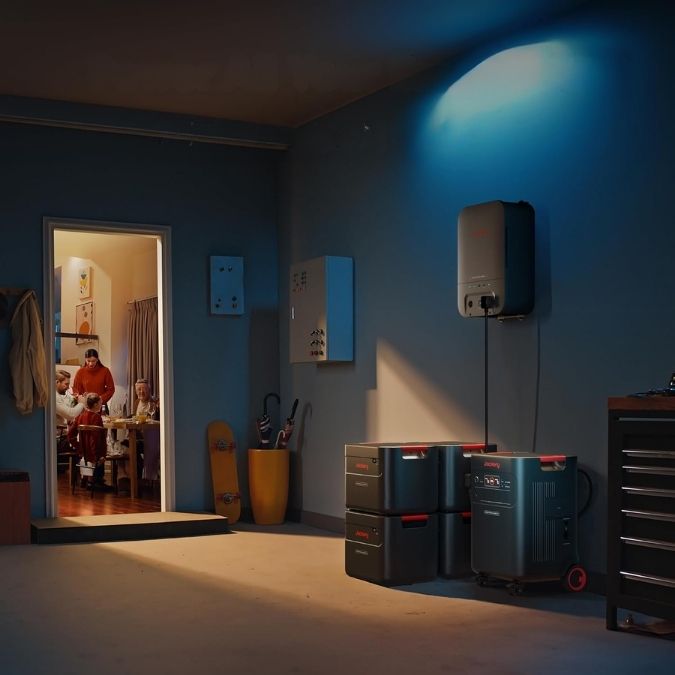
Specs: Why this portable power station for well pump backup stands out
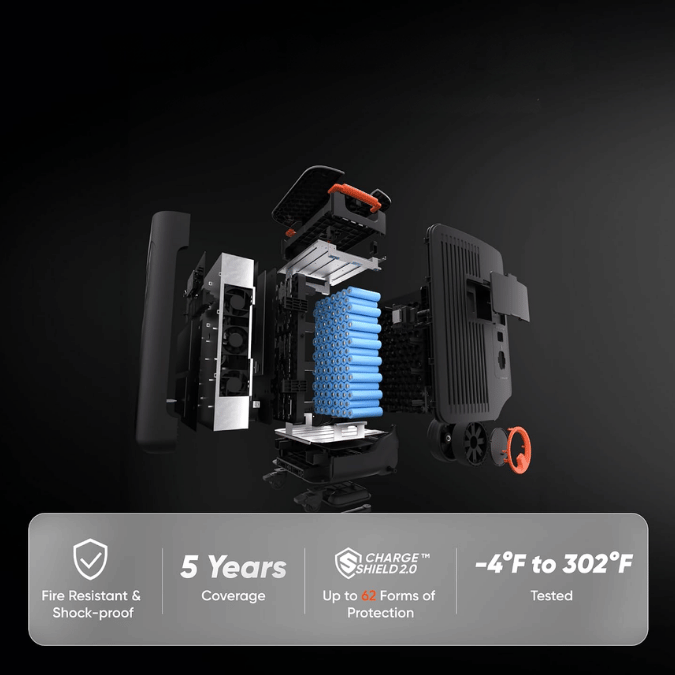
You’re getting a 5,040Wh LiFePO4 battery, 7,200W output and 4,000 cycles to at least 70 percent capacity. Yet its the 134.5-pound weight that makes it rollable, not hand-portable.
| Spec | Well-pump relevance |
|---|---|
| Battery | 5,040Wh LiFePO4 |
| AC output | 7,200W continuous; 14,400W surge |
| Voltage | Simultaneous 120V and 240V split phase |
| 240V limit | 30A and 7,200W combined |
| Connections | Four NEMA 5-20 outlets, L14-30R and NEMA 14-50 |
| Solar | Up to 4,000W input; this bundle includes one 500W SolarSaga 500X |
| Longevity | 4,000 cycles to 70 percent or more; five-year warranty |
| Bundle Weight | 190.5 pounds (about 134.5 pounds for the Jackery Explorer 5000 Plus) |
The NEMA 14-50 socket does not make it a 50A source. The 5000 Plus user manual caps output at 30A and 7,200W, a crucial limit when sizing a portable power station for well pump duty.
How many watts does a well pump need?
Most residential pumps from 1/2 to 2 HP use roughly 700 to 3,500 running watts. However, starting surge can be several times higher.
A portable power station for well pump equipment must handle both values without an overload trip. This one does. Pretty easily.
| Pump size | Rough running range | Jackery 5000 Plus outlook |
|---|---|---|
| 1/2 HP | 700 to 1,200W | Strong candidate after voltage check |
| 3/4 to 1 HP | 1,000 to 2,000W | Strong candidate after surge check |
| 1.5 HP | 1,800 to 2,800W | Often viable; verify nameplate and inrush |
| 2 HP | 2,200 to 3,500W | Possible, but field verification is essential |
Again, these are planning ranges, not a substitute for your motor label. Record voltage, full-load amps, locked-rotor amps, phase and control type.
A two-wire submersible pump can need more starting headroom than a comparable three-wire model. There needs to be 50 percent more capacity for two-wire installations. A compatible variable-frequency drive may reduce inrush, but requires professional checkup.
Do not size a deep-well motor from a basement-pump wattage chart. If flood prevention is your real priority, our review of the Jackery HomePower 3600 Plus for sump-pump backup covers that use case, including startup load and outage runtime.
How long will it maintain water pressure?
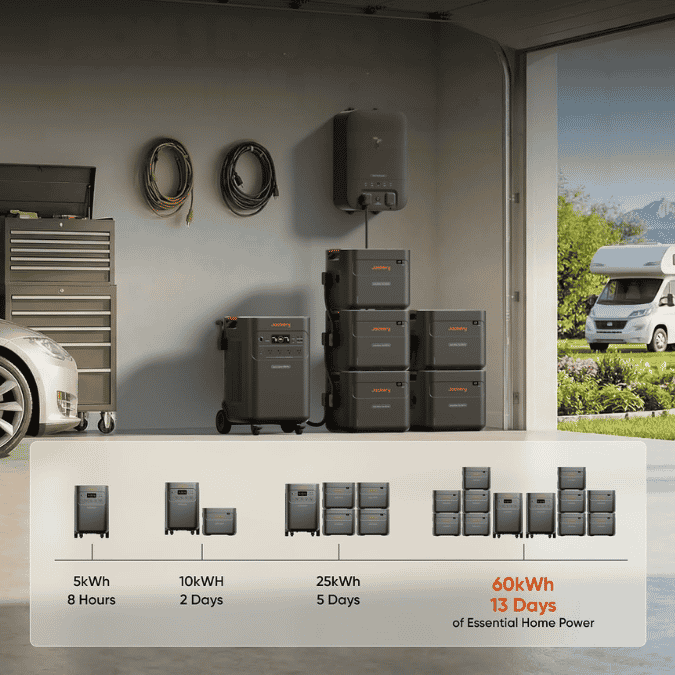
Sizing your portable power station’s runtime here starts with 5,040Wh × 0.85 ÷ running watts.
| Pump load | Pump-only continuous runtime |
|---|---|
| 900W | About 4.8 hours |
| 1,500W | About 2.9 hours |
| 2,500W | About 1.7 hours |
A pressure tank extends elapsed time because the pump cycles. Still, repeated starts, other loads and roughly 58 to 85W of measured inverter idle draw consume energy. Log your normal duty cycle, then calculate your pump and essential-load runtime with real wattage.
How should a portable power station for well pump backup connect?
Plug-in 120V jet pumps
Your 120V jet pump may use a correctly rated front outlet if running current and surge fit. Keep the station dry and ventilated. Also, avoid long or undersized extension cords because extended cords have triggered insulation-check shutdowns in field use.
Hardwired 240V submersible pumps
A hardwired 240V submersible pump needs a listed inlet plus a transfer switch or approved interlock. A licensed electrician must size conductors, address grounding and prevent backfeed. Jackery also identifies a transfer switch or interlock as the safe panel connection.
Note: The exact bundle here does not include Jackery’s Smart Transfer Switch. Include transfer hardware and installation to the total cost.
Is it a true 240V well-pump UPS?
Not through an ordinary wall-cord setup. The manual says 0ms online UPS applies only to the NEMA 5-20 outlets, with a 3,600W maximum. It also says the L14-30R and NEMA 14-50 outputs cannot operate in bypass while the station charges from a wall outlet.
Energy Saving Mode can also shut all outputs after 12 hours when AC draw stays at or below 25W. A pressure-tank system may idle that long. Configure it, update firmware and simulate an outage before relying on automatic backup.
Is one 500W solar panel enough?
One SolarSaga 500X can extend an outage, but it will not reset a 5,040Wh battery. The math starts above ten peak-sun hours before losses. You get 6.5 hours with two 500X panels, so one can take about two favorable solar days.
That can work when a pump cycles lightly. However, a long cloudy outage may require a second panel, an expansion battery or another charging source.
Reliability
The balance is positive for build quality, stored-charge readiness, quiet operation and output choice.
There are a few concerns around weight, delivery condition, firmware, app lockups, output dropouts, solar-input behavior and slow warranty logistics. Firmware fixed some F6 and Smart Transfer Switch faults. Even so, inspect every box, confirm all cables, register the warranty and complete a pump-start test before storm season.
Pros and Cons
| Pros | Cons |
|---|---|
| True 120V/240V split-phase output suits common residential pumps | At 134.5 pounds, it is portable mainly on smooth, level surfaces |
| 7,200W continuous output gives useful pump and essential-load headroom | One 500W panel recharges slowly, while firmware and support issues add risk |
| 5,040Wh LiFePO4 battery is quiet, indoor-friendly and expandable | |
| Wheels, app controls and flexible solar inputs improve outage usability |
Ideally, these points only make sense when you genuinely need 240V pump power. If your backup list stops at Wi-Fi, lights, phones or a CPAP, the strongest backup stations under $500 offer far better value.
Buying guide for a portable power station for well pump use
- Photograph the pump label and control box. Capture voltage, phase, horsepower, running amps and locked-rotor amps.
- Confirm starting current with the manufacturer or a qualified electrician. Measure inrush if it remains unknown.
- Add simultaneous loads. The pump, refrigerator and freezer must stay within running and surge limits together. If overnight therapy is essential too, use our CPAP runtime guide for overnight power planning to account for humidification and heated tubing.
- Price the complete connection. Hardwired pumps need an inlet and transfer equipment, sold separately.
- Model measured daily pump runtime, then reserve energy for losses, idle draw and other essentials.
- Update firmware, review Energy Saving Mode and repeat pump starts at several battery levels.
Who should buy it, and who should skip it?
This portable power station for well pump backup is best for a rural home with a 120V or 240V single-phase pump, especially from 1/2 to 1.5 HP. It suits users who value quiet indoor operation, solar replenishment and no fuel storage.
If water pressure is only one part of your outage plan, compare the Jackery with our best home-backup power station shortlist before committing to a pump-first system.
A 2 HP system deserves a witnessed start test before the return window closes. Skip it for three-phase pumps, unusually high inrush or larger farm motors. Also, output falls to 3,600W between 5°F and 14°F, so an unheated winter pump house is a poor location.
If you only want a compact communications and charging kit, these top power stations under $300 worth considering are the lighter choice. None should be expected to start a residential well pump.
Is the Jackery 5000 Plus worth it for well pump use?
Yes, with compatibility checks. The Jackery 5000 Plus is a top-tier portable power station for well pump duty because it combines true 240V output, substantial usable capacity and strong real surge performance without fumes or generator noise.
The few limits: one 500W panel can be slow, the 240V UPS path needs proper transfer equipment, and software maturity deserves a full pre-outage test.
For a matched 1/2 to 1.5 HP residential pump, we totally recommend it. If you have a 2 HP pump, purchase only after confirming starting amps and the complete connection plan.
FAQs
Yes, it supplies 120V/240V split-phase power at up to 30A and 7,200W. The pump must be single-phase, correctly transferred from the grid, and within real starting-surge limits.
Usually, if combined running watts remain below 7,200W and overlapping surges do not trip the inverter. Stagger large motor starts.
Before adding breakfast loads, use our coffee-maker and mini-fridge load breakdown so a brew cycle does not collide with the pump surge.
There is no safe universal number. Use locked-rotor amps or measured inrush because voltage, motor design and controls all change demand.
Usually not from empty. More than ten ideal peak-sun hours are required before losses, so a full recovery commonly spans about two good solar days.
Only through a properly designed transfer system with settings tested for the pump’s cycling behavior. Standard 240V outputs do not provide wall-cord bypass, and long low-load intervals can trigger the default Energy Saving Mode.